Türkiye’s New Axes | #17 RAIL MODERNISATION FROM DİVRİĞİ TO THE GEORGIAN BORDER AND DEMAND FOR LOGISTICS PROPERTY
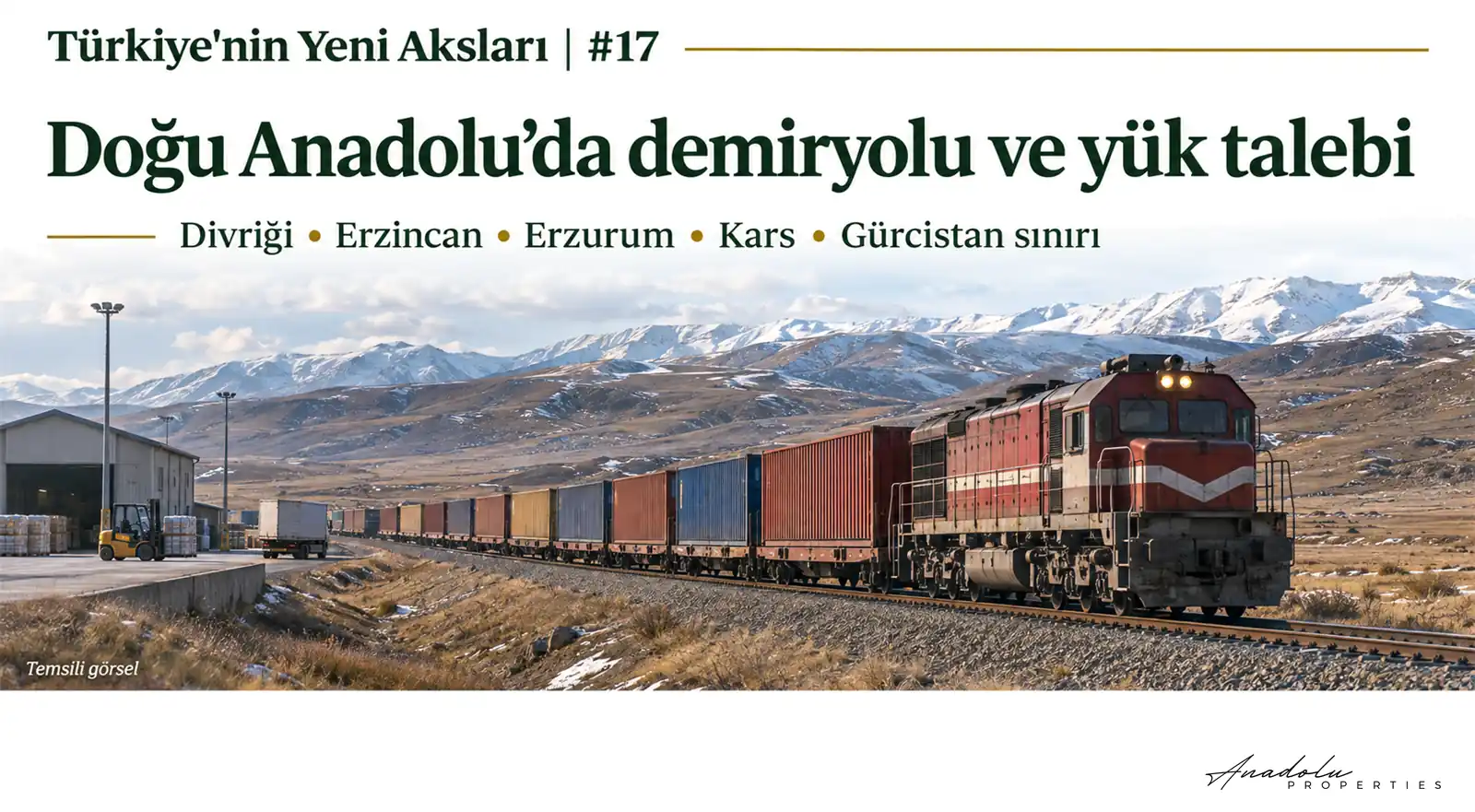
Where a freight wagon connects with the local economy
Several steps connect a train passing through a district with a local producer being able to ship goods by rail. The producer must be able to move the freight to a suitable station, load it onto a wagon and plan delivery around the rail service. When assessing the modernisation of the existing line from Divriği to the Georgian border, our first question for property owners is where that connection can be made.
A more reliable rail service can make shipments easier to plan and affect transport costs. Whether this creates a local need for warehouses, bonded storage or industrial space depends on production volumes, loading and unloading facilities, road connections and demand from businesses.
The tender for the project between Divriği and the Georgian border
In its statement of 28 October 2026, the Ministry of Transport and Infrastructure identifies four sections along the route. Technical bids for the works covering the Divriği–Erzincan, Erzincan–Erzurum and Erzurum–Kars sections are scheduled to open on 22 December 2026. The Ministry reports a separate procurement process for a second track between Kars and the Georgian border, financed by the Islamic Development Bank. Ministry statement of 28 October 2026
The project covers renewal of the existing railway infrastructure and superstructure, together with electrification, signalling and communications works. The Ministry identifies the World Bank, the Asian Infrastructure Investment Bank and the Islamic Development Bank as co-financiers. The aim is to strengthen the east–west link and increase freight capacity on the Middle Corridor.
The Ministry puts the length of the line at approximately 667 kilometres. On its project page, the Directorate General of Infrastructure Investments (AYGM) gives 660 kilometres for the first component. The relevant tender documents should guide any assessment of the technical scope of an individual section. To track the Ministry’s estimated construction period of around four years, the dates of contract signing, site handover, construction, testing and commissioning should be recorded separately. AYGM project information and components
The Freight Flow Capture Threshold
At Anadolu Properties, we use five questions to examine how a region could capture a share of freight moving along the corridor. We call this assessment the Freight Flow Capture Threshold. It helps us identify the evidence behind a claim of demand for a particular property.
1 Where can the freight be transferred?
Does the station have loading and unloading facilities for the type of freight involved? We trace the route from the production or storage site to the terminal using connections that a goods vehicle can actually take.
2 Who produces the freight?
We look for industrial, mining, agricultural and foreign trade businesses that could use the railway. Production volumes and shipment patterns help us understand their need for transfer or storage space.
3 Is the parcel suitable for logistics use?
Permitted uses under the zoning plan, parcel size, infrastructure and legal conditions should be examined together. Proximity to the tracks can benefit a business able to load freight. At the same location, noise or access restrictions may make another use more difficult.
4 Does the business have a concrete transport plan?
We ask what goods the business plans to ship, how often and through which terminal. Whether existing facilities can handle those shipments is central to assessing the need for additional capacity.
5 How does demand show up in the market?
We examine completed sales and lettings, occupancy rates and business investment decisions. These data allow us to test where expected freight flows translate into actual demand for property.
What data should be monitored in Erzincan, Erzurum and Kars?
In Erzincan, we start with the producer. What is produced and where, how it is currently transported and the cost of reaching the terminal determine whether a shift to rail is feasible. In Erzurum, regional distribution links come to the fore. We need to identify the centres that receive the goods and the part existing warehouses play in that distribution.
When examining cross-border transport in Kars, we need to ask what freight is transferred in the city and which services are purchased from local businesses. In all three provinces, a specific property can be assessed by examining terminal capacity, actual freight volumes, zoning and completed transactions together.
Local freight demand from the property owner’s perspective
When assessing a property along the route, we first identify a business that might use it and trace its freight. Where does the need for production, transfer or storage arise? Can the property’s permitted use and access roads meet that need? The answers and comparable completed transactions give owners a concrete basis for deciding whether to buy or sell.
As the project progresses, we at Anadolu Properties will track how freight flows translate into local trade and purchases of logistics services. This study is for general information. A decision to buy or sell a particular property, or a valuation of it, requires a property-specific assessment.
Mustafa Yılmaz
CEO – Anadolu Properties
Europe–Türkiye Investment Bridge