The Investment Map of the Future | #10 FACTORY ADAPTABILITY IN INDUSTRIAL REAL ESTATE
Industrial growth does not always require new land
A factory’s future cannot be assessed solely by the size of its land. A building that accommodates today’s production may be unable to adapt to tomorrow’s production line. Two facilities with the same floor area can differ in power capacity, structural systems, internal logistics and conversion costs.
Industrial growth does not always begin on a new site, either. New machinery, production-line changes, automation and infrastructure investment can take place within an existing factory. The monetary scale of industrial investment therefore cannot be equated directly with demand for new industrial land.
The Tofaş K9 project in Bursa offers a current example through which to discuss this distinction. From a real estate perspective, the key question is what physical space requirements arise from production growth and under what conditions existing facilities can meet them.
What was announced for the K9 project in Bursa
According to Koç Holding’s announcement dated 26 October 2026, the K9 project entered series production at Tofaş’s Bursa factory. Investment of approximately USD 300 million and annual capacity of 100,000 vehicles were announced. A target of approximately 1,000 jobs and the involvement of nearly 100 domestic suppliers in production were also reported.
The project covers the Fiat Doblò, Citroën Berlingo, Opel Combo, Peugeot Rifter and Peugeot Partner models. The targets are to export approximately 20% of production and manufacture around 660,000 vehicles in total by the final quarter of 2034. These figures should not be read as completed annual output, realised exports or jobs already created.
Source: Koç Holding — K9 production launch, 26 October 2026
100,000 and 150,000 vehicles refer to different scopes
While the 26 October announcement gives annual capacity of 100,000 vehicles, Koç Holding’s 2025 annual report refers to annual K9 capacity of 150,000 units including completely knocked-down vehicles (CKD). These figures, from different dates and with different scopes, should not be compared as actual production figures based on identical definitions. Recognising the difference in scope does not mean that the figures have been fully reconciled.
Source: Koç Holding 2025 Annual Report — K9 and CKD capacity
According to Tofaş CEO Cengiz Eroldu’s assessment in the official announcement, infrastructure compatible with a multi-energy platform could provide production flexibility if demand for electric light commercial vehicles increases. This is a technical capability that may be used in the future; it is neither electric vehicle output already achieved nor a property valuation conclusion.
Source: Koç Holding — K9 production launch, 26 October 2026
How production growth translates into demand for property
Three stages need to be monitored separately: changes in the main factory’s production capability, suppliers’ production and logistics requirements, and the conversion of those requirements into new leases, purchases or construction.
A supplier may meet increased orders by adding shifts, installing machinery or changing its existing layout. Another company may need additional storage or a new facility. New orders alone are not evidence of demand for new land.
The Bursa Investment Support Office’s information on organised industrial zones (OIZs) shows the presence of automotive, machinery and metal industries in the region. It does not establish that every business in these sectors supplies K9 or is seeking additional space. Orders, capacity, expansion plans and completed property transactions must also be examined at company level.
Source: Bursa Investment Support Office — Organised Industrial Zones
The Production Adaptability Threshold
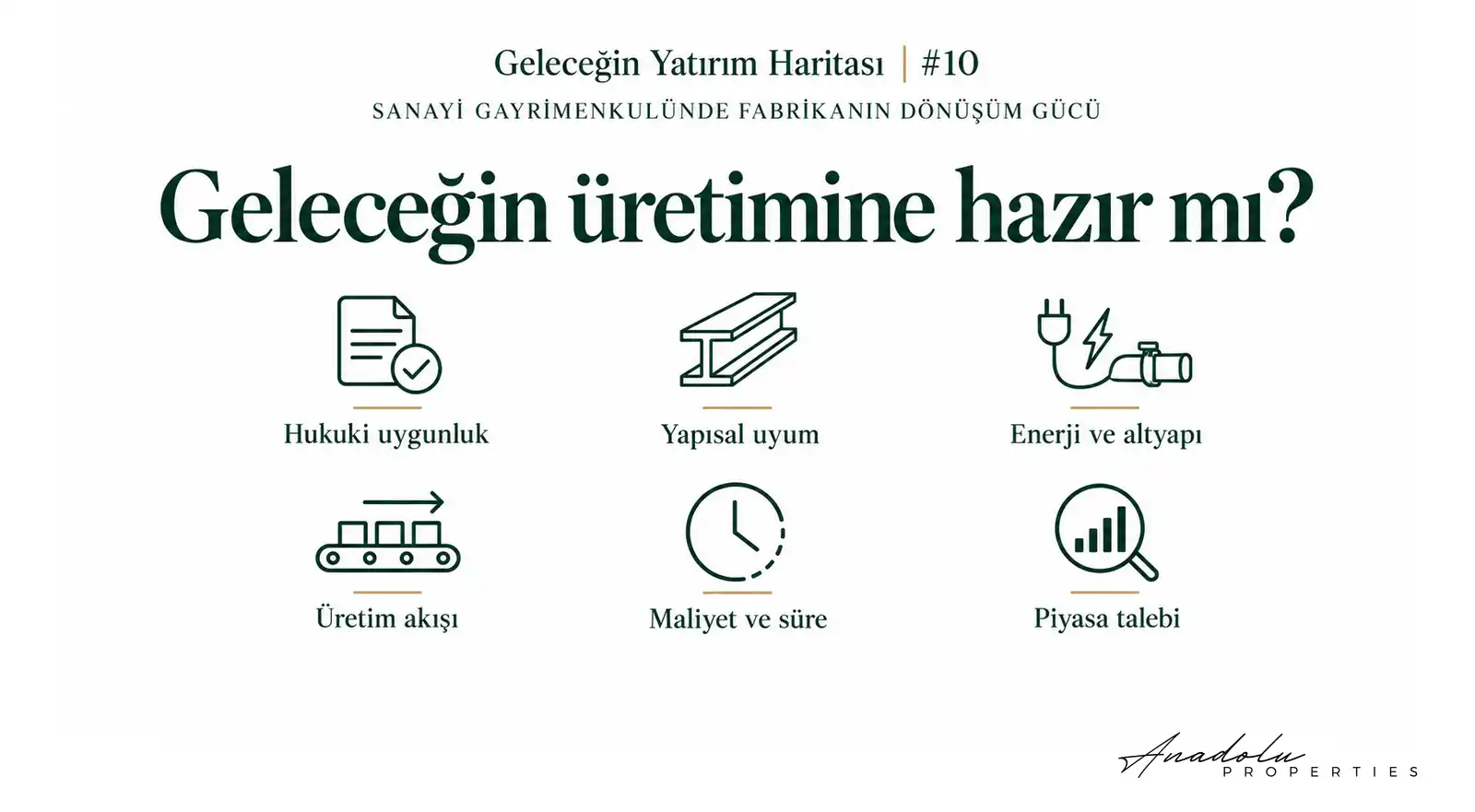
In this article, I use “Production Adaptability Threshold” to describe the legal, structural, technical, logistical and economic conditions an industrial property must meet to accommodate different or more advanced production. This approach is neither an official scoring standard nor a standalone calculation of market value.
1. Legal suitability for use
Zoning status, building permits, use authorisations, OIZ rules and restrictions on activities should be examined in relation to the planned production. A building’s apparent technical suitability does not, by itself, establish that the activity may legally be carried out there.
2. Structural suitability
Are floor load capacities, column spacing, ceiling height, the structural system and expansion possibilities suitable for the new production line? Any necessary strengthening or reconfiguration should be included in the cost and time assessment informing the conversion decision.
3. Energy and technical infrastructure
Transformer and power capacity should be assessed alongside water, ventilation, cooling, compressed air and automation infrastructure. The availability of the capacity required for new production should be investigated, as well as the existence of current connections.
4. Flexibility of production flows
Can raw material intake, internal handling, production, storage and dispatch areas be reconfigured? How will access, workflow and production continuity be maintained during a line change? The physical layout cannot be assessed independently of the business’s day-to-day operations.
5. Conversion cost and duration
The cost of adapting an existing facility should be compared with the option of a new facility. The calculation should include not only construction and equipment but also lost production, financing, permits and commissioning time. A conversion that appears quick may produce a different economic outcome if it requires a lengthy production shutdown.
6. Actual market demand
Technical adaptability does not automatically mean higher value. Completed sales and rental comparables, occupier demand and whether the market supports the cost of conversion should be examined. Technical feasibility and economic viability are separate questions.
Why the same floor area does not produce the same outcome
Consider a hypothetical example of two factories, each with 10,000 m² of land and 6,000 m² of enclosed floor area. The first has power infrastructure and a structural layout that accommodate different production lines; the second requires substantial strengthening, infrastructure renewal and a lengthy production shutdown.
This difference does not prove that the first factory is more valuable in every circumstance. Location, the tenant and lease, maintenance condition, environmental obligations and demand also enter the assessment. The example simply illustrates why floor area alone is not a sufficient basis for comparison.
Converting extending or building a new facility
For conversion of an existing facility, technical suitability, the conversion budget and production downtime are central. For extending an existing facility, development rights, the development capacity of the land and infrastructure capacity are decisive. For a new facility, land, construction, permits, infrastructure and the commissioning schedule are assessed together.
None of these options is superior in every circumstance. The decision depends on production requirements, the property’s characteristics, financing and market conditions. Investors should therefore ask about future adaptation costs alongside today’s price per square metre.
The verification framework from Anadolu Properties’ perspective
The K9 example illustrates the importance of assessing industrial growth beyond the search for new land. New OIZs and industrial sites can be on the agenda at the same time as the renewal of existing factories; the investigations they require for property assessment differ.
For a new site, zoning, infrastructure, ownership and construction costs are examined. For an existing factory, structural condition, technical conversion, production downtime, logistics flows and occupier demand must be added. Particularly when evaluating an investment remotely, a general account of the region should not replace property-specific investigation.
The investigation should consider legal use and permits; power and water capacity; machinery layout and strengthening requirements; the conversion budget and downtime; expansion, logistics and access to labour; environmental obligations; and completed sales and rental comparables together. An unverified technical score should not be presented as market value.
Making room today for tomorrow’s production
The production launch in Bursa highlights the importance of adapting an existing industrial facility to a new programme. The announced capacity and targets do not establish that all industrial properties in Bursa will appreciate. The connection between production growth and property demand must be established through specific occupier requirements and transactions.
Land size remains important to a factory’s future. Yet the cost, duration and feasibility of conversion must be added to the same enquiry: under what conditions can this facility adapt to tomorrow’s production?
Mustafa Yılmaz
CEO – Anadolu Properties
Europe–Türkiye Investment Bridge