The Investment Map of the Future | #09 AGRICULTURE’S NEW LAND ECONOMY
Why Do Price and Economic Value Differ in Organised Agricultural Zones?
Once we learn a property’s price per square metre, we begin forming an initial assessment. Yet the quoted figure may be a sale price, rent or an allocation price subject to specific conditions. These do not represent the same rights or cover the same costs. Investment analysis in Organised Agricultural Zones (OTBs) should begin with this distinction.
Agricultural land quality, irrigation, road access, size, slope, climate and comparable sales remain important. Modern agricultural production adds energy, heating and cooling, waste management, biosecurity, storage, cold chains, labour and market access. Each affects investment costs and the sustainability of the operation.
The OTB model aims to organise these activities within a planned area with shared infrastructure. According to the General Directorate of Agricultural Reform’s strategic investment guide announcement of 10 September 2026, 61 OTB projects had been developed across 42 provinces; 46 had acquired legal personality, infrastructure had been completed in 20, and production had begun in 16.
Project development, legal personality, completed infrastructure and production are separate stages. Seeing an area on the investment agenda does not show that every plot there is ready to operate today.
Source: TRGM, Strategic Investment Guide, 10 September 2026
What Do 690 Investment Areas Mean?
The Ministry’s announcement of 18 September 2026 covers 690 investment areas in 17 OTBs across 14 provinces. Of these, 280 were announced for plot allocation and 410 for preliminary allocation. Their total area is 16,954,000 m², or 16,954 decares.
This announcement does not mean that 690 investments have been completed or that this area represents agricultural land available for sale on the open market. The areas are offered to investors under specific legislation and allocation conditions.
Source: TRGM, announcement of 690 investment areas, 18 September 2026
How Should We Read the October 2026 Allocation Lists?
On 7 October 2026, the General Directorate of Agricultural Reform published separate lists for preliminary allocation and land allocation. We do not calculate a new total by adding the 690 September areas to the October lists. Repeated areas, additions and removals need to be compared separately.
The examples below are the prices in the annexes to the 7 October announcement; they are neither current sale offers nor open-market valuations. Before applying, the latest status and conditions should be confirmed with the relevant OTB.
Two Examples from the Land Allocation List
In Adana Karataş Aquaculture OTB, cadastral block 2991, plot 1 is listed as an operating site covering 100,872.31 m². The listed price per square metre is TRY 400.
In Adana Greenhouse OTB, cadastral block 181, plot 1 is listed for industrial use and covers 11,585.64 m². The listed price per square metre is TRY 1,000.
Two Examples from the Preliminary Allocation List
In Balıkesir Gönen Greenhouse OTB, the listed prices are TRY 2,000/m² for operating sites and TRY 3,200/m² for industrial sites. In Afyonkarahisar Çay–Çobanlar–Bolvadin Geothermal Greenhouse OTB, operating sites are listed at TRY 5,000/m².
Because production activities, infrastructure, rights and investment obligations may differ, we do not turn these prices into an investment ranking from “cheap to expensive”. An allocation price alone does not explain freely tradable ownership, transfer rights or the total investment cost.
Source: TRGM, announcement of 7 October 2026 and the two official allocation lists
Distinguishing Preliminary Allocation, Land Allocation and Ownership
The 7 October announcement refers to Article 54/A of the Implementing Regulation on Organised Industrial Zones for preliminary allocation and Article 55 for land allocation. Preliminary allocation and land allocation should be examined as different stages; preliminary allocation should not be read as an unconditional guarantee of final allocation.
Land allocation does not automatically mean unconditional and freely transferable ownership either. The contractual payment schedule, investment and completion deadlines, development conditions, resulting rights, cancellation conditions and restrictions on transfer or leasing require separate investigation.
Three Production Models, Different Cost Structures
Geothermal Greenhouse Production
A geothermal resource may create different cost conditions for the heating needs of controlled-environment production. Its existence alone is insufficient, however: temperature, flow rate, continuity, delivery to the facility, usage costs and technical permits must be examined together. In the Afyonkarahisar and Balıkesir examples, the actual state of energy infrastructure matters alongside the allocation price. A seemingly low cost of land access may be offset by high energy or connection costs.
Livestock Production
Feed supply, water, animal health, waste management, biosecurity, veterinary services and access to processing facilities affect the operation’s economics. We cannot assess a livestock fattening or dairy site as though it were an ordinary industrial plot. Suitability for construction does not, by itself, establish operational sustainability.
Aquaculture
Water quality, production technology, energy, environmental obligations and biological risks are prominent considerations. When reading the TRY 400/m² price in the Adana Karataş list, facility installation and operating conditions must also be assessed. The same price per square metre does not produce the same economic outcome across different production models.
Yozgat Yerköy: What Stage Does Planning Approval Represent?
The Ministry announced that the 1:5,000 master zoning plan and 1:1,000 implementation zoning plan for Yozgat Yerköy Geothermal Greenhouse Agriculture-Based Specialised Organised Industrial Zone were approved on 15 September 2026 and displayed publicly for one week from 23 September.
This is a concrete planning decision for a specific area. Planning approval is a legal and spatial stage; infrastructure completion is a technical stage; facility construction is an investment stage; and the start of production is an economic activity stage. All four need to be monitored separately to understand the potential for use.
Source: Ministry of Agriculture and Forestry, Yerköy planning approval, 23 September 2026
The Allocation-to-Production Gap
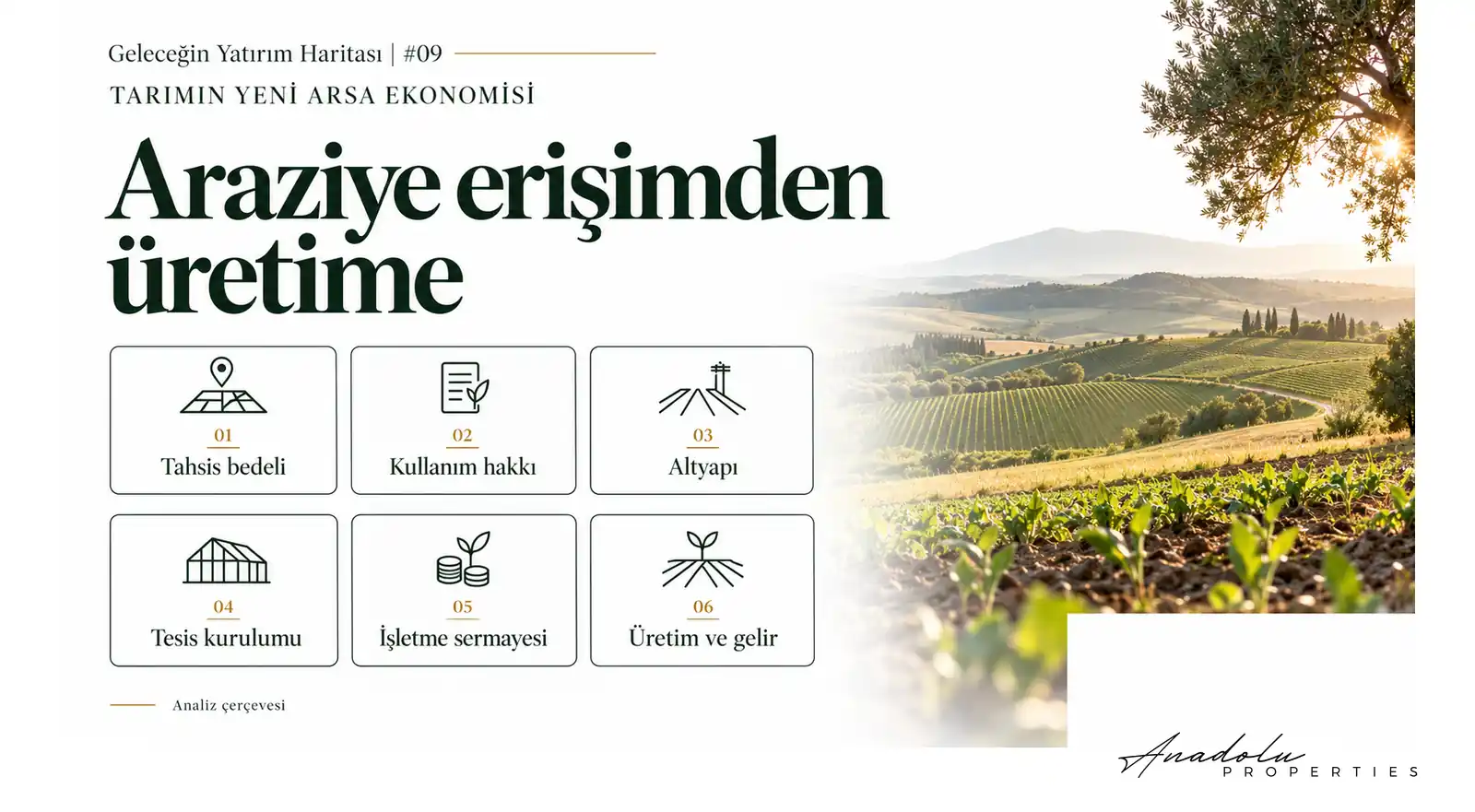
At Anadolu Properties, we use the “Allocation-to-Production Gap” as an analytical concept that makes visible the difference between the announced allocation price and the total investment burden required to turn the area into a legally, technically and economically operational production facility. It is not an official valuation standard, but a framework for examining the financial and operational distance between access to land and revenue generation.
1. Allocation Price
The nature of the quoted price, its payment schedule and the services it covers should be established. Sale, preliminary allocation and land allocation must not be confused; the allocation price must not be treated directly as market value.
2. Legal Right of Use
The contract, zoning and development conditions, investment completion obligations, permits, transfer restrictions and cancellation conditions should be reviewed. Continued economic use depends on a clear and enforceable legal position.
3. Infrastructure Readiness
It should be established whether electricity, water, heating, wastewater, roads, communications and production-specific systems are actually in service. A planned connection and usable infrastructure are not the same thing.
4. Facility Installation
Greenhouse structures, climate control, irrigation, automation, livestock equipment, aquaculture systems, storage and processing facilities entail different costs depending on the type of production. Comparing two areas solely by their allocation prices conceals these differences.
5. Working Capital
Staff, energy, water, seeds or seedlings, feed, maintenance, logistics and other costs incurred before the product is sold should be included in the financing plan. Having built the facility does not mean production can be sustained.
6. Actual Production and Revenue
The start of production, capacity utilisation, sales, coverage of operating expenses and continuity of cash flow should be examined. Whether actual revenue supports the overall investment becomes clearer at this stage.
Why Is a Low Allocation Price Not an Advantage on Its Own?
Consider two entirely hypothetical investments. In the first, assume an allocation price of TRY 10 million and an additional financing requirement of TRY 90 million for facility installation, connections and working capital. The total initial financing requirement is TRY 100 million.
In the second, assume an allocation price of TRY 20 million and other costs of TRY 50 million thanks to existing infrastructure and lower installation needs. The initial financing requirement is TRY 70 million. These figures do not represent the costs of any actual OTB; they merely illustrate the method.
The first investment has a lower cost of land access but a higher total financing requirement. Even so, we cannot conclude that the second is necessarily more advantageous: capacity, revenue potential, operating expenses and risks must also be compared. A low allocation price does not guarantee low total costs, and low total costs do not guarantee high returns.
Three Measures That Must Be Distinguished in Valuation
Allocation Price
This is the price announced by the relevant institution for access to an investment area under specified conditions. It cannot be interpreted independently of the allocation conditions.
Total Investment Cost
This includes access to land, infrastructure, facilities, equipment and other costs required to start operations. It helps establish the financing requirement.
Economic Value
This is assessed in light of the legal nature of the property or investment right, its possible uses, revenue-generating capacity, risks and market conditions. Whether freely transferable ownership exists may affect the valuation approach. Allocation price, total cost and market value cannot automatically be equated.
Risks to Monitor on the Path to Production
Water and energy: Continuity and usage costs matter as much as the existence of the resource. Infrastructure timetable: Delays in starting production can increase the financing burden. Financing: Covering the cost of access to land may not be enough to complete and operate the facility.
Production: Climate, disease, input costs, productivity and product prices affect performance. Legal conditions: Failure to meet contractual deadlines and obligations may affect investment rights. Market: Building a facility does not guarantee sales at the expected quantities and prices; processing, storage, logistics and marketing links should be examined.
Anadolu Properties’ Monitoring Framework
We do not view OTB developments solely as new land supply. We monitor the shift from the price of land to its function within a production system. Conventional agricultural land, property planned for controlled production and an investment area defined by allocation conditions do not serve the same economic function.
Accordingly, TRY 400/m² is not the market value of surrounding privately owned land; nor does TRY 5,000/m², by itself, indicate a more expensive or less efficient investment. The following ten data points should be considered together:
- Current preliminary allocation and land allocation lists.
- Legal conditions governing use and ownership.
- Approved zoning and land subdivision plans.
- The level of infrastructure completion.
- Water and energy supply conditions.
- Facility investments started on allocated sites.
- Actual production and employment.
- Operating costs.
- Market access for products.
- The investment’s economic sustainability.
From the Price of Land to the Economics of Production
Proximity to an OTB does not change the land-use status of surrounding privately owned land. Such land should not automatically be treated as industrial or commercial plots; agricultural land protection, zoning and ownership conditions require separate examination.
The September and October announcements are developments worth monitoring on Türkiye’s planned agricultural production map. Yet accessing an area, starting production and earning sustainable revenue are different processes. Each has its own costs and risks.
A production plot’s economic significance emerges through the rights under which it can be used, the total costs involved and its sustainable production capacity. Once we know the price per square metre, we should seek answers to three questions: What right do we acquire for this payment? How much funding is needed in total to start production? Is the operation economically sustainable?
This article is for general information. Preliminary allocation and land allocation prices should not be treated as open-market values; rights, obligations, zoning, infrastructure, financing and production conditions must be examined site by site. Announcements and incentives do not guarantee completion, profitability or appreciation of neighbouring properties.
Mustafa Yılmaz
CEO – Anadolu Properties
Europe–Türkiye Investment Bridge