TÜRKİYE’S NEW CORRIDORS SERIES 04 | KIRIKKALE–ÇORUM–SAMSUN HIGH-SPEED RAIL LINE: WHERE IS THE NEW CENTRAL ANATOLIA–BLACK SEA INDUSTRIAL AND LOGISTICS CORRIDOR EMERGING?
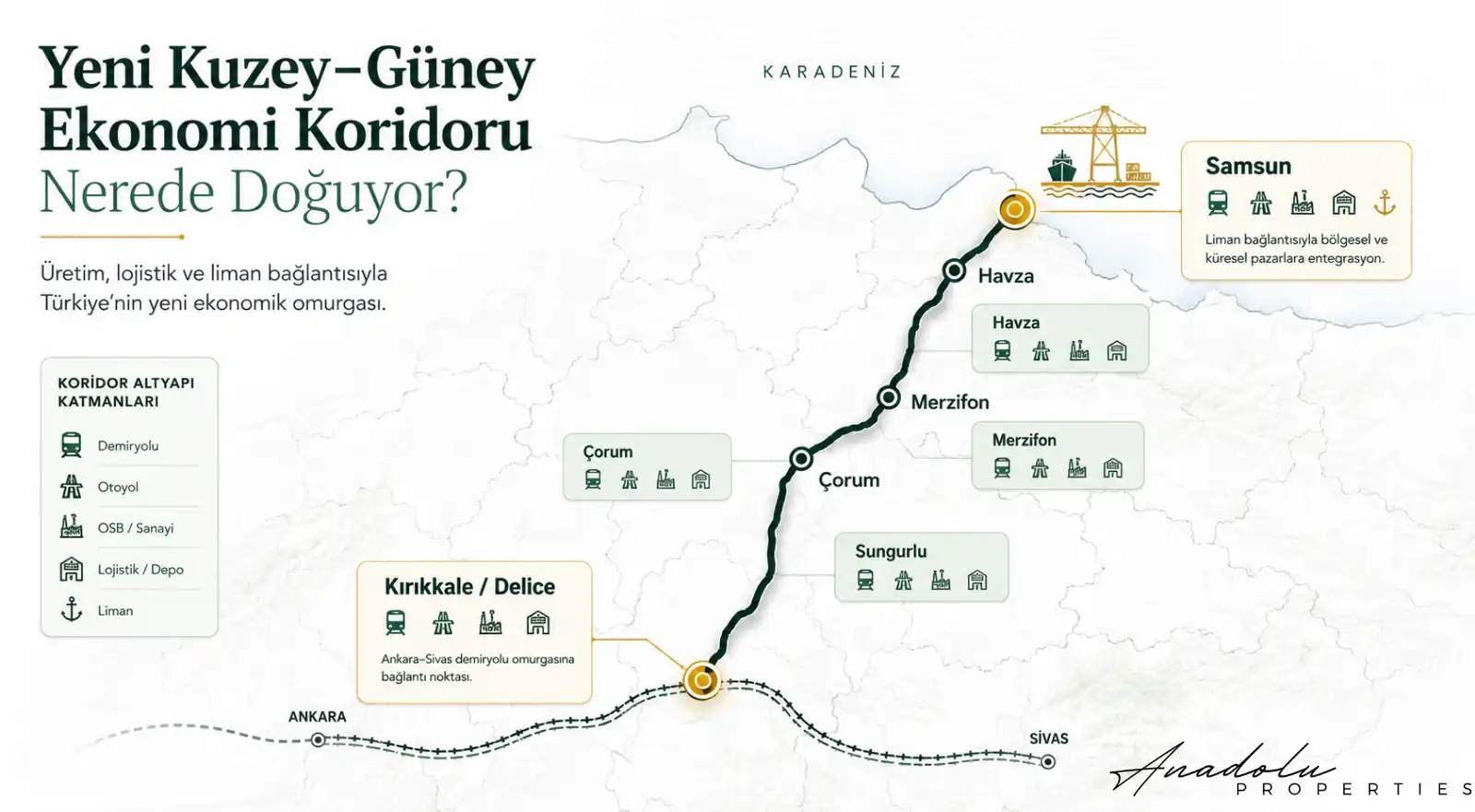
Why Is the 14 Million-Ton Freight Target More Critical Than 2.5 Hours?
In global trade, the value of transport corridors is no longer measured solely by how much they shorten the distance between two points. Access from production centers to ports, the ability of industrial zones to connect to different modes of transport, and the capacity of supply chains to operate through alternative routes are among the key factors determining regional competitiveness.
At a time when trade flows between Europe and Asia are being reshaped, the Black Sea basin retains its logistical importance, and rail is playing a growing role in low-carbon freight transport, Türkiye’s north–south connections should be assessed not only in terms of travel time, but also through the geography of production, logistics, and real estate.
The Ankara–Kırıkkale–Çorum–Samsun High-Speed Rail Project is a notable example in this respect. The project does not merely aim to reduce the Ankara–Samsun journey to approximately 2.5 hours. According to the Ministry of Transport and Infrastructure’s statement dated June 5, 2026, once the approximately 293-kilometer new line—starting from Delice and reaching Samsun via Çorum and Merzifon—is completed, it is expected to carry around 12 million passengers and 14 million tons of freight annually. (Republic of Türkiye Ministry of Transport and Infrastructure, June 5, 2026)
For a real estate investor, the critical data point emerges precisely here. Passenger transport changes the accessibility of cities, while freight transport can create a broader economic mechanism capable of influencing factories’ port preferences, the location of warehouses and logistics centers, the relationship between industrial plots and transport infrastructure, and the site selection of new production investments.
The line should therefore be read not merely as a high-speed rail route, but as a new north–south economic corridor that could open Central Anatolia’s production basins to the Black Sea. However, infrastructure investment alone does not mean an increase in real estate values. What should actually be monitored is where rail, highways, organized industrial zones, ports, production, storage, new investment, and planning decisions begin to intersect within the same geography.
The Project Has Moved from the Planning Stage to Physical Progress
In the 120-kilometer Delice–Çorum section, the first major segment of the project, it is now possible to speak not only of planning but also of physical progress on the ground. In its June 5, 2026 statement, the Ministry reported that overall progress had exceeded 25%, and that the tenders for the Çorum–Merzifon and Merzifon–Havza sections had also been completed. (Republic of Türkiye Ministry of Transport and Infrastructure)
In the system designed for speeds of up to 200 kilometers per hour, Çorum is expected to be connected to the railway network for the first time, the Ankara–Çorum journey time to fall to approximately 1 hour 20 minutes, and the Ankara–Samsun journey to decline to around 2.5 hours once all sections are completed. The same official statement also emphasizes the objective of creating a strong logistics axis between the Black Sea and the Central Anatolian and Mediterranean basins.
Kırıkkale–Delice: The Central Anatolian Gateway of the Corridor
The starting point of this economic story is not Samsun, but Kırıkkale and especially Delice. There is an existing connection to Delice on the Ankara–Sivas high-speed rail infrastructure, and the new line continues northward from here toward Çorum, Merzifon, and Samsun. (Ministry of Transport and Infrastructure, Directorate General for Strategy Development)
Rail investment is not the only infrastructure project in the same geography. Work is continuing on the Ankara–Kırıkkale–Delice Motorway. The Ministry describes Kırıkkale as a junction for routes opening toward the Central Black Sea via Çorum and toward the Eastern Mediterranean and Southeast via Kayseri, and expects the motorway to serve as a bridge between east–west and north–south road corridors. (Republic of Türkiye Ministry of Transport and Infrastructure, May 30, 2026)
From an investment-analysis perspective, the critical point is not a single infrastructure project, but the simultaneous advancement of high-standard rail and motorway investments in the same area. For this reason, around Kırıkkale–Delice, not only the housing market but also industrial areas, storage, logistics uses, connector roads, interchanges, and new planning decisions should be monitored together.
Sungurlu: An Intermediate Point on the Map, but Could It Become a New Economic Node?
Sungurlu is one of the centers that should be monitored at the micro level along the corridor. The district is already a transit point on the Ankara–Çorum road axis; new rail access could add a second transport layer to this existing structure.
The riskiest approach here, however, is the assumption that “the train is coming, so land values will rise.” To assess a possible economic transformation in Sungurlu, spatial and economic indicators should be examined before price movements:
- Where are the new station and railway infrastructure located in relation to the existing settlement, main roads, and industrial areas?
- At which points are road–rail connections being established or planned?
- In which directions are industrial and commercial areas expanding?
- Are new warehouse, production, or logistics investments emerging?
- Are municipal and public-sector plans showing a shift toward the new transport system?
If these indicators begin moving in the same direction, Sungurlu could move beyond being merely a transit point and acquire a new economic function. Whether this actually happens must be verified through official plans, investment decisions, and field data.
Çorum: The Existing Industrial Base Meets Rail for the First Time
Çorum is one of the corridor’s most important points of structural change. An existing railway line is not being upgraded here; Çorum is being connected to the railway network for the first time. This means adding a new logistics option to the city’s already established production economy. (Republic of Türkiye Ministry of Transport and Infrastructure)
The Çorum Governorship states that the city has an advanced production infrastructure with four organized industrial zones, industrial estates, a technopark, and R&D centers. The key question, therefore, is not “Will the railway turn Çorum into an industrial city?” Çorum is already a production center. The real question is how the railway will change the logistics mathematics of its existing production economy. (Çorum Governorship)
Stronger rail access for producers to the Port of Samsun and other production centers in Türkiye could diversify logistics options over time. Early signals in the real estate market are also more likely to appear first in the expansion directions of organized industrial zones, factory investments, warehouse areas, industrial plots, loading–unloading infrastructure, and connector roads rather than in housing prices.
For this reason, Çorum can be regarded as one of the centers along the corridor where early-warning indicators should be monitored most closely.
Merzifon: A Junction Where Agriculture, Food, Industry, and Transport Intersect
Merzifon has a different character from an investment-analysis perspective. The district is not merely an intermediate center between Çorum and Samsun; when considered together with the Amasya basin, its existing road connections, and surrounding agricultural production, new rail access has the potential to support regional distribution functions.
As of June 2026, the fact that the tenders for the Çorum–Merzifon and Merzifon–Havza sections had been completed indicates that this part of the corridor is also moving from the planning stage toward implementation. (Republic of Türkiye Ministry of Transport and Infrastructure)
Around Merzifon, the key issue to monitor is not merely passenger movement. More important is how agricultural production, food-processing activities, cold-chain and storage needs, industrial areas, and road connections will relate to the railway. In regions with a strong agricultural economy, logistics infrastructure can over time influence not only where products are grown, but also where they are processed, stored, and distributed.
Havza: An Intermediate Node to Watch at the Transition to the Samsun Hinterland
As the corridor reaches Havza, its spatial character begins to change. The line arriving from Central Anatolia is now approaching Samsun’s production and port hinterland. Adding a new rail layer to the district’s existing road-transit role could create new connectivity opportunities for industrial, storage, and commercial functions.
However, the conversion of this potential into real estate value is not automatic. What matters is whether organized industrial zone investments, new roads, interchanges, planning decisions, and private-sector investments intersect with rail access in the same geography. Havza should therefore be assessed as an intermediate node where “function” rather than “price” should be monitored.
Samsun: Where the Corridor Meets the Port, Rail, and Industry
Samsun is the city where the economic logic of the line becomes most visible. Here, rail, port, and industrial infrastructure converge within the same economic geography. According to Samsunport’s current terminal information, the port provides general cargo, container, and Ro-Ro services; the terminal has two rail gates and significant storage areas. (Samsunport – Terminal Information)
According to information published by the port operator, Samsun’s maritime hinterland extends to various Black Sea ports in Georgia, Russia, Ukraine, Romania, and Bulgaria. If production in Central Anatolia gains stronger rail access to the Port of Samsun, this creates a noteworthy basis for diversifying logistics options to European markets via the Black Sea. (Samsunport – Port Location)
Samsun’s industrial infrastructure reinforces this assessment. According to data published by the Samsun Governorship in November 2025, the Central Organized Industrial Zone is located approximately 1 kilometer from the road network, port, and railway. This proximity shows that the combination of organized industrial zone + port + railway + road already exists within the same economic environment. (Samsun Governorship)
The new Ankara–Samsun corridor could add a higher-standard access layer to this system from the direction of Central Anatolia. Focusing only on housing demand in Samsun could therefore miss the larger picture; industrial land, logistics areas, storage, the port hinterland, commercial uses, and transport nodes outside the city center should be monitored together.
Anadolu Properties Analysis: How Should the Corridor Economy Be Read?
For investors, the most important development in this project is not the arrival of high-speed rail in Samsun, but the possibility of strengthening a new vertical economic axis between Central Anatolia and the Black Sea. While Türkiye’s transport and economic map has for many years been read largely through east–west movements, the Kırıkkale–Çorum–Samsun line introduces a different layer that could strengthen north–south production and logistics connections.
The Ministry’s project approach does not end in Samsun either. Official statements envisage a broader rail corridor connecting the Port of Samsun with the Port of Mersin, with the aim of strengthening freight transport between the Black Sea, Central Anatolia, and the Mediterranean basins. (Republic of Türkiye Ministry of Transport and Infrastructure)
This broader picture also requires a different way of reading the investment map:
- Port of Samsun → maritime transport and foreign-trade connection
- Havza → transition to the Samsun hinterland and intermediate logistics functions
- Merzifon → intersection of agriculture, food, industry, and road connections
- Çorum → the strong production base meets rail for the first time
- Sungurlu → a micro-center where road access and new rail access may intersect
- Delice–Kırıkkale → connection to the Ankara–Sivas rail backbone and the new motorway
- Central Anatolia and the Mersin direction → the broader economic framework of the north–south freight corridor
If this system strengthens, not only travel times between cities but also the economic distance between production basins and ports could change. However, not every location along the high-speed rail line will be affected to the same degree; in some station areas, the expected economic transformation may never materialize.
Different Investment Profiles Along the Corridor
- Kırıkkale–Delice: The Central Anatolian distribution gateway where rail and new motorway investments are advancing in the same area.
- Sungurlu: A transit center that should be monitored at the micro level to understand how new rail access will integrate with the existing Ankara–Çorum road system.
- Çorum: One of the corridor’s most important structural transformation points because its existing strong industrial base will gain rail access for the first time.
- Merzifon: A junction where the agriculture, food, production, and road economy of the Amasya basin may meet the new rail system.
- Havza: An intermediate node where industrial and logistics functions should be monitored at the transition from Central Anatolia to the Samsun hinterland.
- Samsun: A foreign-trade gateway where port, rail, road, and industrial infrastructure converge in the same economic geography.
The early-signal system for this corridor can be read in the following sequence: railway → production → logistics → capital → planning and employment → real estate demand. Real estate prices are not the first data point in this chain; they are often among the indicators that emerge later.
The Less Visible Layer in the European Connection
The fact that Samsun Port’s existing maritime hinterland includes the ports of Constanța in Romania and Varna in Bulgaria shows that a European connection via the Black Sea already exists today. If the new rail system strengthens access from Central Anatolian production centers to the Port of Samsun, it could create one of the alternatives supporting Türkiye’s logistics diversification toward European markets. (Samsunport – Port Location)
This possibility is particularly worth monitoring in an environment where supply-chain security, alternative transport routes, rail’s carbon advantage, and the access time from production centers to ports are becoming increasingly important. Even here, however, a specific increase in trade volume or investment should not be assumed to occur automatically.
Track the Direction of Economic Functions Before Prices
For investors, the real importance of the Kırıkkale–Çorum–Samsun High-Speed Rail Line is not that Ankara and Samsun could be connected in 2.5 hours, but the economic geography through which the annual freight target of 14 million tons will move.
While motorway and rail investments converge in Kırıkkale and Delice, Sungurlu may gain a new layer of accessibility. Çorum will be connected to rail for the first time; Merzifon and Havza could become intermediate nodes in north–south movement; and in Samsun, the system will connect directly with port and industrial infrastructure. Yet none of these developments alone means an increase in real estate values.
Over the next 3–10 years, a more robust approach for investors is to track where economic functions are moving before monitoring where prices are rising. For this purpose, organized industrial zone expansions, new factories, warehouse and logistics facilities, rail freight connections, motorway interchanges, zoning decisions, employment, population movements, and the direction of port cargo flows should be assessed within the same dataset.
For those seeking to understand the investment map of the future, the key question is therefore not “Where will the high-speed train pass?” but “When Black Sea ports and Central Anatolia’s production centers become more strongly connected, at which new economic nodes will capital and production begin to concentrate?”
In major infrastructure investments, price is not the first indicator of opportunity; opportunity begins to emerge when freight, factories, roads, and capital start moving toward the same point.
Mustafa Yılmaz
CEO – Anadolu Properties
Europe – Türkiye Investment Bridge