WHAT DOES BLACKROCK’S “SCARCITY ECONOMY” THESIS SAY ABOUT TÜRKİYE’S NEW INVESTMENT MAP? | RESEARCH SERIES 03
1. What Does BlackRock’s “Scarcity vs. Abundance” Framework Actually Say?
The core approach in the BlackRock Investment Institute’s 2026 Midyear Global Outlook is quite clear: while the global economy is moving toward potentially major productivity gains from artificial intelligence, it is also encountering bottlenecks in the physical resources required to make that transformation possible.
BlackRock highlights five areas of pressure in particular: labor, energy, infrastructure, capital and raw materials. Under the heading “AI scarcity,” the report emphasizes that regardless of which AI model ultimately wins, the AI economy will require electric power, memory, chips and data centers.
A conceptual distinction is important here. “Scarcity economy” is not the name of an independent economic theory developed by BlackRock; it is an analytical Turkish rendering used to explain the report’s “Scarcity vs. Abundance” framework. BlackRock’s report also does not provide real-estate advice on any specific city, corridor or parcel in Türkiye. The assessments concerning Türkiye are inferences drawn from this global framework and must be tested separately against local data.
Artificial intelligence may be digital. But the economy of artificial intelligence is profoundly physical.
An AI model requires a data center; a data center requires high and uninterrupted electricity capacity; and electricity requires generation, transmission and distribution infrastructure. High-technology investments need fiber connectivity, major industrial investments need logistics, and all of them require land that is technically, legally and environmentally suitable.
This observation is critical for real estate. At the end of technological transformation, we return once again to geography.
2. The Digital Economy Could Create a New Land Economy
In the early years of the internet economy, a common idea was that “distance would matter less.” In the AI economy, a different reality is emerging. While distance may become less important in some areas, proximity to infrastructure is becoming more important.
A data center cannot be built on just any plot of land. Nor is a large-scale technology or manufacturing facility located somewhere simply because cheap land is available. For investors, the following questions are becoming increasingly decisive:
- Is the electricity supply and grid-connection capacity sufficient?
- Can substations and the transmission-distribution network absorb the new demand?
- Is fiber connectivity and redundant communications infrastructure available?
- What is the availability of water and cooling capacity?
- Is effective access to a major transport corridor, port or railway possible?
- Is there a developed industrial and service ecosystem nearby?
- Can the site be expanded, and are its zoning and ownership structures suitable for this?
For this reason, the future value of some land may be determined less by proximity to the city center than by functional access to energy, data, production and logistics nodes. Yet proximity alone does not create a right to connect or establish investment feasibility; technical capacity and planning decisions must be verified in official records.
3. The First Major Signal for Türkiye: The Data-Center Economy
For Türkiye, this transformation is no longer merely theoretical. In November 2025, Google Cloud and Turkcell announced a collaboration to establish a new Google Cloud region in Türkiye. Google’s official announcement describes a USD 2 billion investment plan spread over ten years in Türkiye, while the Investment Office of Türkiye states a combined total of USD 3 billion when Turkcell’s USD 1 billion plan for data-center and cloud technologies is included.
The main issue here is not only the size of the investment. The more important question is: What second- and third-order investments could form around this digital infrastructure?
Large digital infrastructures do not operate in isolation. Over time, additional demand may develop around them in areas such as:
- cloud services and data storage
- cybersecurity and telecommunications
- backup data centers and business-continuity solutions
- power generation, grid and energy-storage infrastructure
- technical maintenance, engineering and skilled labor
- corporate services, logistics and supply chains
However, it would not be appropriate to draw conclusions about specific districts or parcels until the exact location, connection structure and environmental effects of the announced investment are clarified through publicly available, verified data. Technology investments should therefore be assessed not only by where the facility itself will be located, but also by the areas in which surrounding economic layers could form and by the conditions required for those layers to materialize.
4. First Layer of the New Real-Estate Map: Energy and Grid Capacity
One of the most critical words in BlackRock’s thesis from a real-estate perspective is power — electricity. Energy, grid capacity, chips and data-center capacity stand out explicitly among the principal bottlenecks to the expansion of AI infrastructure.
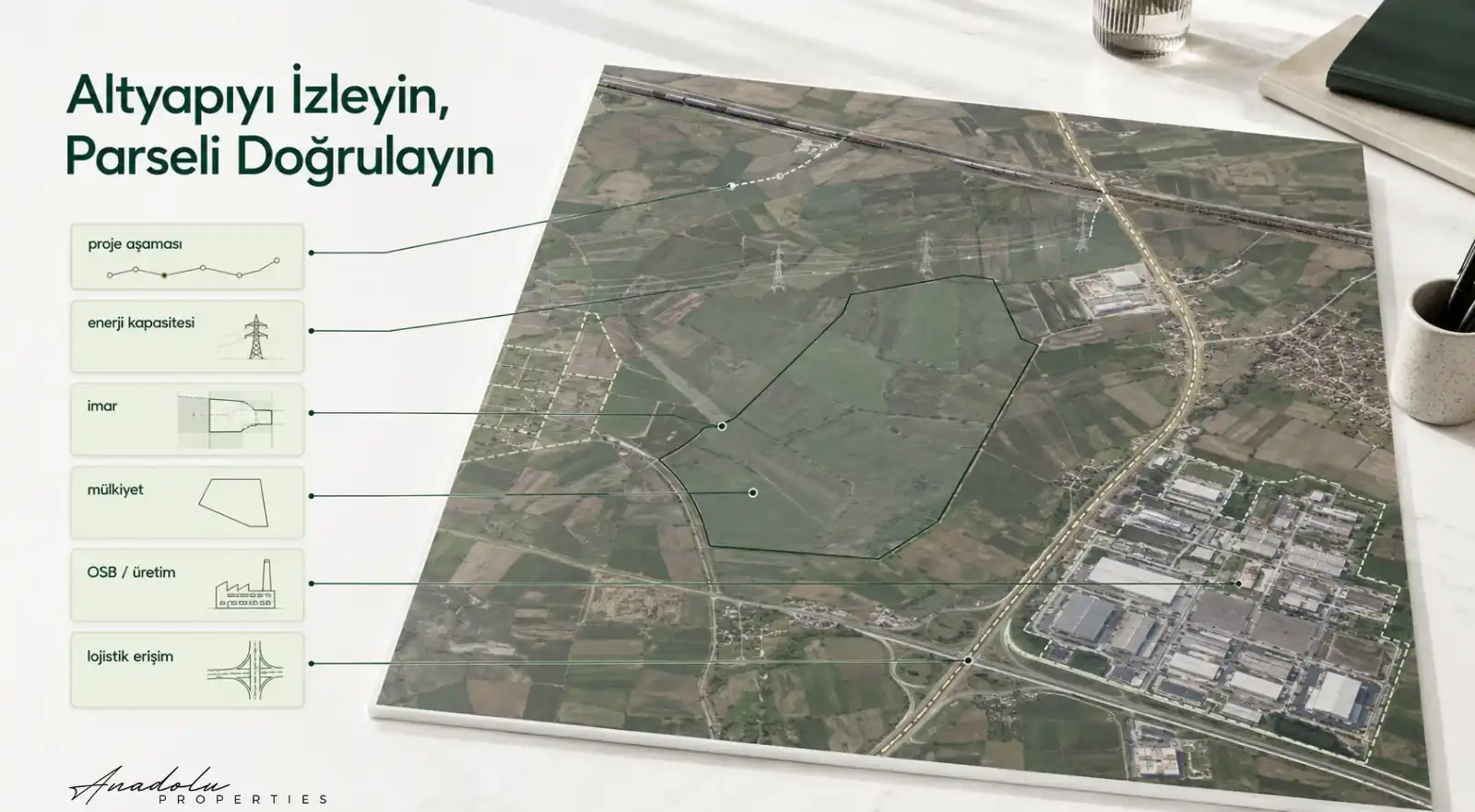
This leads to an important conclusion for Türkiye: some strategic land of the future may become important not merely because it is zoned for development, but because it can obtain access to high and reliable power capacity.
Regional analyses should therefore include the following indicators in addition to population and price movements:
- high-voltage lines and substations
- existing connection capacity and new capacity allocations
- power-generation and energy-storage facilities
- renewable-energy clusters
- industrial electricity demand
- planned transmission and distribution investments
The critical caution is this: proximity to a power line or substation does not automatically mean that connection capacity is available. Technical suitability, grid-connection opinions, investment schedules and the records of the relevant authorities must be examined separately.
5. Second Layer: Organized Industrial Zones and Production Corridors
After energy, the second major layer is production. Yet looking only at existing organized industrial zones is not enough. More meaningful questions include:
- Which organized industrial zone is expanding and experiencing occupancy pressure?
- Which one has an officially designated expansion area?
- Which one is receiving a railway connection or industrial siding?
- Which one is gaining a new motorway or divided-road connection?
- Which one is gaining stronger port access?
- Around which zones are energy and water capacities being developed?
The current size of an organized industrial zone tells us about the past. Its officially designated direction of expansion, new manufacturing investments and infrastructure capacity may generate signals about the future. For investors, therefore, the key issue is not only the province in which an industrial zone is located, but the micro-corridor toward which growth is moving.
Even so, proximity to an organized industrial zone does not mean that every surrounding parcel will be opened to industrial use. Agricultural-protection status, planning function, watershed restrictions, geological conditions, ownership and road access must all be checked at parcel level.
6. Third Layer: Railways Could Change Türkiye’s Industrial Geography
It would be incomplete to view Türkiye’s ongoing railway investments solely through the lens of passenger transport. New economic corridors may form particularly around freight-capable lines that connect industrial zones to ports and major production centers.
Bursa – Yenişehir – Osmaneli – Bandırma
The 201-kilometer Bandırma–Bursa–Yenişehir–Osmaneli line has the potential to connect Bursa’s strong production base to the Anatolian railway network and, via Bandırma, to the Marmara logistics system. The Ministry of Transport and Infrastructure has announced a target of putting the Osmaneli–Bursa section into operation in 2026 and the Bursa–Bandırma section in 2028.
Accordingly, not only central Bursa but also the Osmaneli–Yenişehir–Bursa–Karacabey–Bandırma axis can be monitored in terms of industry, warehousing, logistics and land use. The target dates, however, should be treated as official planning schedules rather than as already achieved commissioning dates.
Mersin – Adana – Osmaniye – Gaziantep
This approximately 312.5-kilometer line aims to bring the Mersin port system, Adana’s production basin, Osmaniye’s industry and Gaziantep’s export capacity together on the same transport backbone. The Ministry states that the line will be electrified and signaled and will be suitable for both passenger and freight transport.
Investment analysis should focus not only on station surroundings, but on industrial-rail-motorway-port intersections, siding connections and actual freight flows.
Yerköy – Kayseri
The Yerköy–Kayseri High-Speed Rail Line could integrate Kayseri’s production strength more closely with the Ankara–Sivas main railway backbone. In an August 2026 Ministry statement, overall physical progress on the project was reported at 53 percent.
This connection may require a long-term reassessment of the Kayseri–Yozgat–Ankara relationship. However, the effect on value should not be expected to be uniform across every settlement or parcel along the corridor. The main economic impact often emerges at nodes where freight connections, production capacity and logistics functions intersect.
7. Fourth Layer: Port Hinterlands and Effective Access
When BlackRock’s scarcity framework is adapted to Türkiye, another strategic capacity comes to the fore: logistics access. It is not enough for a factory to produce; its output must reach the market within predictable time and cost parameters.
For this reason, the port systems around Mersin, İskenderun, Aliağa, Bandırma, Ambarlı and Tekirdağ should be assessed not only by their coastlines, but by the economic hinterlands extending into inland regions.
For a real-estate investor, the right question is not “Where is land close to the port?” but “As a result of new transport investments, which area is seeing its effective access time and cost to the port decline?”
These are two different questions. A short distance on a map may fail to translate into economic access because of traffic, road standards, freight-terminal constraints, customs, warehousing or last-mile problems.
8. Türkiye’s New Strategic Intersection: Energy, Data, Logistics and Production
When evaluating regional investment potential in the coming period, particular attention should be paid to whether four indicators are strengthening at the same location:
- Energy: reliable power and grid connection
- Data: fiber, cloud and digital infrastructure
- Logistics: rail, port, motorway and warehousing access
- Production: organized industrial zones, factory investment, supplier networks and labor
When these four layers are overlaid on a map of Türkiye, a different economic geography may emerge from the conventional Istanbul–Ankara–Izmir-centered value map. Yet the presence of one layer does not mean the others are ready. A genuine investment thesis depends on the layers being able to function within the same time horizon and at the same micro-location.
9. Which Investment Corridors in Türkiye Should Be Monitored?
It would not be appropriate to say “buy land in this area.” It is, however, possible to identify types of corridors that warrant deeper research:
- Marmara production belt: Istanbul–Kocaeli–Sakarya–Bilecik–Bursa–Balıkesir
- Southern production and port belt: Mersin–Adana–Osmaniye–Gaziantep
- Central Anatolia production belt: Ankara–Eskişehir–Konya–Kayseri connections
- Aegean industrial and port belt: Manisa–Izmir–Aliağa and logistics links extending inland
- Thrace–Europe connection: Istanbul–Tekirdağ–Çorlu–Çerkezköy–Edirne/Kapıkule
Investment potential does not arise from the name of a city; it comes from the micro-location and a verified function. Within the same district, one parcel may establish a functional connection with a future infrastructure axis while another parcel a few kilometers away may be unable to benefit from the same transformation because of zoning, access or ownership constraints.
10. The New Question in Real Estate: Not “What Is the Price per Square Meter?” but “Where Is Infrastructure Going?”
For many years, real-estate investment decisions in Türkiye often began with the question “What is the price per square meter?” Future-oriented investment analysis requires a different order of questions:
- At what stage is the public investment, and where is it heading?
- Where are energy and grid capacities increasing?
- Where do railways, motorways and logistics systems converge?
- In which direction, and under which official decision, is the organized industrial zone expanding?
- Where are population, employment and production demand shifting?
- Which parcels lie within this transformation, and what is their legal status?
The price per square meter should come after these questions. Price often reflects a story that has already materialized or become embedded in expectations. Infrastructure may signal a transformation that is not yet fully priced in, but on its own it does not prove that the transformation will occur.
11. The Main Lesson Türkiye Can Draw from BlackRock’s Report
BlackRock looks at the world through the lens of capital markets. If we examine the same picture from the perspective of geography and real estate, the following hypotheses emerge:
- If energy is scarce, locations with access to real grid-connection capacity may become more important.
- If logistics capacity is scarce, functional intersections of transport corridors may become more important.
- If data-center capacity is scarce, the combination of electricity + fiber + suitable land may become more important.
- If industrial land is scarce, planned and expandable production areas may become more important.
- If capital is expensive, infrastructure advantages that shorten time to operation and reduce operating costs may become more decisive.
The scarcity framework is therefore not only a matter for financial markets; it is also a way of rereading the geographic distribution of economic capacity. Scarcity, however, does not mean automatic appreciation. Demand, financing, rights of use, project schedules and alternative costs must be assessed together.
12. How Should an Early-Warning System for Real Estate Be Built?
In real-estate investment, the difference may come not only from having information, but from the stage at which you see it and the level of accuracy with which you see it. Once infrastructure is completed, a road is opened or an industrial zone is full, the development becomes visible to everyone.
Indicators that can be monitored at an earlier stage include:
- Environmental Impact Assessment (EIA) processes and environmental permits
- expropriation decisions
- zoning-plan and plan-note amendments
- organized industrial zone expansion and preliminary allocation decisions
- energy-connection and capacity investments
- railway route, tender and on-site progress data
- logistics-center and rail-siding decisions
- major corporate investment announcements
- public investment programs and infrastructure tenders
A single signal is not enough. A genuine investment hypothesis becomes stronger when several independent signals overlap in the same geography, on compatible timelines and in a way that supports the intended use of the parcel.
13. The Anadolu Properties Perspective: From Macro Theme to Parcel-Level Verification
Real-estate analysis is not merely the calculation of today’s value. The central task is to understand where capital, infrastructure, population and production are moving, and then to test that movement against parcel-level realities.
BlackRock’s 2026 outlook encourages global investors to monitor scarce inputs and capacity constraints. For a real-estate investor in Türkiye, the equivalent is to monitor energy, railways, organized industrial zone expansions, data centers, port connections and major public-private investments together.
The next step is to bring these layers down from the city to the district, and from the neighborhood to the block and parcel. A macro corridor story does not become an investment decision until zoning status, ownership, encumbrances, co-ownership, road access, parcel geometry, agricultural and environmental restrictions, geological conditions and comparable values have been verified.
Türkiye’s real-estate story over the next decade may not be written solely in major city centers. The more important story may emerge in new investment corridors that appear ordinary today but could lie at the intersection of tomorrow’s energy, data, production and logistics networks. Whether this possibility turns into value will depend on accurate data, appropriate timing and parcel-level verification.
Looking for Future Value in Flows Before Prices
BlackRock’s “Scarcity vs. Abundance” approach provides an important framework: artificial intelligence may make the world more productive, but building this new economy requires highly physical investments such as power plants, electricity grids, data centers, fiber networks, factories, railways, ports and logistics centers.
All of these share a common requirement: the right geography and verified capacity. Investors therefore need to learn to read not only price charts but also infrastructure maps, project stages and parcel records.
For those seeking to understand Türkiye’s future investment map, the key question is this: where could energy, data, production and logistics intersect over the next decade, and which parcels located at those intersections are actually usable from a legal, technical and economic standpoint?
At Anadolu Properties, we believe that future real-estate value begins to become visible in tomorrow’s economic movements before it appears in today’s price. For that reason, it is necessary not merely to collect data, but to assess its source, timing, spatial impact and parcel-level relevance together.
This study has been prepared for general information and analytical purposes. It does not constitute a recommendation to buy or sell any real estate, security or other investment instrument.
Mustafa Yılmaz
CEO – Anadolu Properties
Europe – Türkiye Investment Bridge