WHY IS THE YERKÖY–KAYSERİ HIGH-SPEED RAIL PROJECT MORE THAN JUST A RAILWAY? LOGISTICS CORRIDOR, INDUSTRIAL AND REAL ESTATE IMPACTS | TÜRKİYE’S NEW CORRIDORS SERIES 01
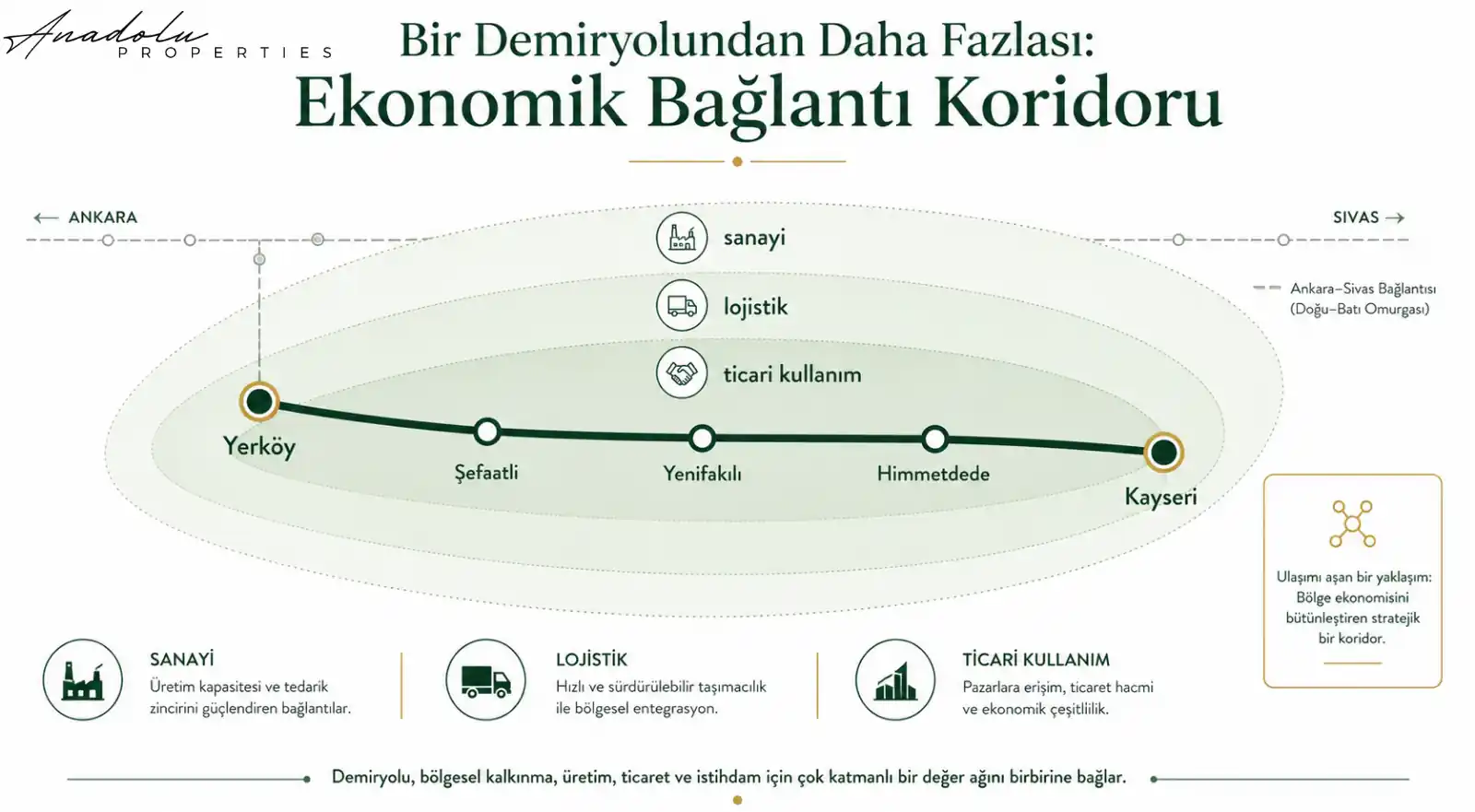
Why Is It Incomplete to Assess the Yerköy–Kayseri High-Speed Rail Project Only Through Travel Time?
Around the world, countries are no longer building only roads, ports or railways; they are creating transport corridors that support flows of production, trade and capital. The European Union’s TEN-T network, China’s Belt and Road Initiative, the Middle Corridor and accelerating regional logistics investments are making the role of transport infrastructure in economic competitiveness increasingly visible.
Türkiye is also seeking to develop its railway investments within this broader network perspective. Physical progress on the Yerköy–Kayseri High-Speed Rail Project has reached approximately 53%, and completion is targeted for the second half of 2028. At first glance, this shows that a major transport investment has passed the halfway point. However, explaining the project’s impact solely through the shortening of travel time between Ankara and Kayseri may mean overlooking the broader economic and spatial potential of the line.
The approximately 142-kilometre line is being built as double-track, electrified and signalled infrastructure; it is planned for integration with the Ankara–Sivas high-speed rail network and is targeted to provide annual capacity for 11 million passengers and 650,000 tonnes of freight. These characteristics bring the project’s industrial and logistics dimension to the forefront. The Yerköy–Kayseri line should therefore be viewed not only as today’s transport news, but also as an infrastructure indicator that could influence the production and investment map of the coming years.
From a Transport Project to a Corridor Economy
Transport infrastructure has historically done more than shorten the distance between cities. Railways, ports and major transport axes have also influenced where production is located, how trading centres develop and in which regions economic activity becomes concentrated. Today, this relationship is gaining renewed importance as supply chains diversify and logistics costs become more critical.
The increasing use of rail in trade flows between Europe and Asia makes Türkiye’s position on the east–west axis strategically important. The Yerköy–Kayseri line does not create an international corridor on its own, but when considered together with existing and planned railway connections, it represents a link that could support access by Central Anatolia’s production centres to wider transport systems.
How Could Kayseri’s Industrial Strength Intersect with the Railway Connection?
Kayseri has long been one of Türkiye’s important production and export centres. Its industrial infrastructure in sectors such as furniture, metalworking, machinery and textiles, together with Organized Industrial Zones, supplier networks and commercial activity, forms a strong production ecosystem.
For such production centres, improvements in transport infrastructure can affect not only passenger mobility but also the delivery of raw materials to facilities, the movement of products to domestic markets and foreign trade routes, warehousing needs and logistics costs. A stronger railway connection can increase logistics diversity by creating an alternative or complementary transport option to road freight.
However, it should not be forgotten that infrastructure investment alone is not sufficient. The scale of the line’s regional economic impact will be shaped together with freight-terminal connections, access from industrial zones, private-sector investment, intermodal transport opportunities and regional planning decisions.
Why Should Yerköy Be Monitored as a Strategic Connection Point?
Yerköy’s importance stems from its connection to the Ankara–Sivas high-speed railway line. Connecting the Kayseri line to this main backbone makes Yerköy more visible not merely as a transit point, but as a connection area where rail movements from different directions intersect.
Whether this will produce a logistics-hub effect over time is not an automatic outcome. The development of warehousing, distribution, service-sector or supporting commercial activities should be assessed together with station functions, road connections, industrial demand, freight-transfer capacity and local planning decisions.
For investors, what matters is not simply the information that “the line passes through here,” but whether this connection is supported by economic activities and how it is translated into land-use decisions.
Why Is Rail Becoming More Important in Europe–Türkiye Trade?
The European Union continues to be one of Türkiye’s largest partners in trade in goods. Production and export ties on this scale make logistics infrastructure more than a domestic transport issue. Supply-chain security, decarbonisation and multimodal transport policies in Europe are increasing the importance of rail in economic planning.
In this context, new railway connections being developed across Türkiye on east–west and north–south axes should be assessed through a network logic larger than any individual line. This is where the significance of the Yerköy–Kayseri line becomes clear: by linking Kayseri’s production capacity to the Ankara–Sivas high-speed rail backbone, the project could strengthen Central Anatolia’s integration with wider transport networks.
This development also has relevance for Turkish investors living in Europe. For investors assessing real estate or commercial investments in Türkiye from abroad, reading production, transport, logistics and zoning decisions together may provide a sounder approach than monitoring city-level price movements alone.
Where and How Could the Impact on Real Estate Emerge?
The effects of high-speed rail and major transport projects on real estate markets do not occur in the same way in every region. In some areas, commercial uses around stations may come to the fore, while in others demand for warehousing, logistics, light industry or mixed-use development may be more decisive. In residential markets, changes in accessibility, employment and lifestyle preferences can become influential over time.
For this reason, a linear assumption such as “the high-speed train is coming, so prices will rise” is not sufficient for investment analysis. A transport investment becomes a meaningful real estate indicator only when assessed together with zoning decisions, population and employment movements, industrial capacity, commercial demand, connecting roads and private-sector investment.
Especially in land and commercial real estate investments, proximity to the project route should not be an investment rationale on its own. The parcel’s zoning status, ownership structure, transport connections, infrastructure access, designated use and actual demand in the area should also be examined as core components of location analysis.
Anadolu Properties Analysis: Track the Direction of Economic Activity, Not the Price
The most important question regarding the Yerköy–Kayseri line is not how fast the train will travel, but which new centres may attract increasing economic activity over time. Stronger transport connections could create new demand around Organized Industrial Zones, freight-transfer points, warehousing areas, connecting roads and commercial uses near stations.
Investors should therefore monitor not only the project’s progress rate, but also the secondary indicators emerging around the line.
Indicators investors should monitor together
- Zoning-plan and land-use changes around stations
- Expansion and new parcel decisions by Organized Industrial Zones
- Investments in logistics centres, freight terminals and railway connections
- New connecting roads, ring roads and interchange projects
- Changes in demand for warehousing, light industrial and commercial uses
- Population, employment and workplace movements
- Supply of commercial land, transaction volume and marketing periods
When these indicators are assessed together, it becomes easier to determine whether the infrastructure project is merely a news headline or is evolving into a development axis that generates real economic activity.
The Key Question: Which Economic Layers Could This Corridor Transform?
The Yerköy–Kayseri High-Speed Rail Project should be considered not merely as an investment intended to accelerate transport between two centres, but as a connectivity project within Türkiye’s railway network, production capacity and regional development strategy.
For investors, what is decisive is not today’s project announcement, but which economic activities the line supports over time and in which locations those activities translate into lasting demand. For those seeking to understand the investment map of the future, the key question should therefore not be limited to “When will the train begin operating?” It should also ask, on the basis of data, “Which production centres, logistics hubs and real estate layers could this transport connection transform?”
Mustafa Yılmaz
CEO – Anadolu Properties
Europe – Türkiye Investment Bridge