Türkiye’s New Axes | #18 THE ÇERKEZKÖY–KAPIKULE RAILWAY AND DEMAND FOR LOGISTICS PROPERTY IN THRACE
The first link in a shipment from factory to European market
For a factory in Thrace serving the European market to benefit from rail, the journey from the factory gate to the freight wagon must also work. When terminal access, loading facilities and the train schedule fit the producer’s delivery timetable, the new line can offer a viable transport option.
Industrial production, road haulage, warehousing and foreign trade support one another in the region. To understand the line’s impact on the property market, we ask which of these activities requires additional space at a particular location. An occupier whose site borders the railway may still have to move the goods elsewhere to load them onto a train.
Which section of the Halkalı–Kapıkule project has opened?
The Transport Sectoral Operational Programme announced that the Çerkezköy–Kapıkule section opened on 9 October 2026. The European Union provided a €275 million grant for this section under the second Instrument for Pre-accession Assistance (IPA II). The programme identifies a stronger rail link between Türkiye and Europe and easier trade as project objectives. Opening announcement from the Transport Sectoral Operational Programme
Halkalı–Ispartakule and Ispartakule–Çerkezköy are the other sections of the project. Before the opening, the Ministry reported that construction was continuing on both. We therefore track each section’s operating status through its own announcements. The feasibility of an individual shipment also depends on available capacity, service frequency and the services offered at the terminal. Ministry of Transport and Infrastructure statement on the other sections
Which property types in Thrace warrant a closer look at demand?
Industrial facilities
The destination and volume of a producer’s shipments affect the decision to use rail. When assessing an industrial facility, we compare the cost of delivering the same freight by road with the total cost of reaching the terminal, transferring the load and moving it by rail. We also consider whether the delivery time fits the production and sales schedule.
Warehouses and logistics sites
Tracing where goods are held, transferred and dispatched helps identify where warehouse space is needed. Occupancy in existing warehouses, occupiers’ searches for additional space and signed leases provide evidence of whether the area around a terminal needs more capacity.
Commercial and residential property
As production and logistics activity expand, demand for local support services may change. We track this through business openings, employment and observed commercial activity. Housing calls for a more cautious assessment. Drawing conclusions about house prices from a change in freight transport requires evidence of demand and transactions in the housing market itself.
Depth of Economic Access
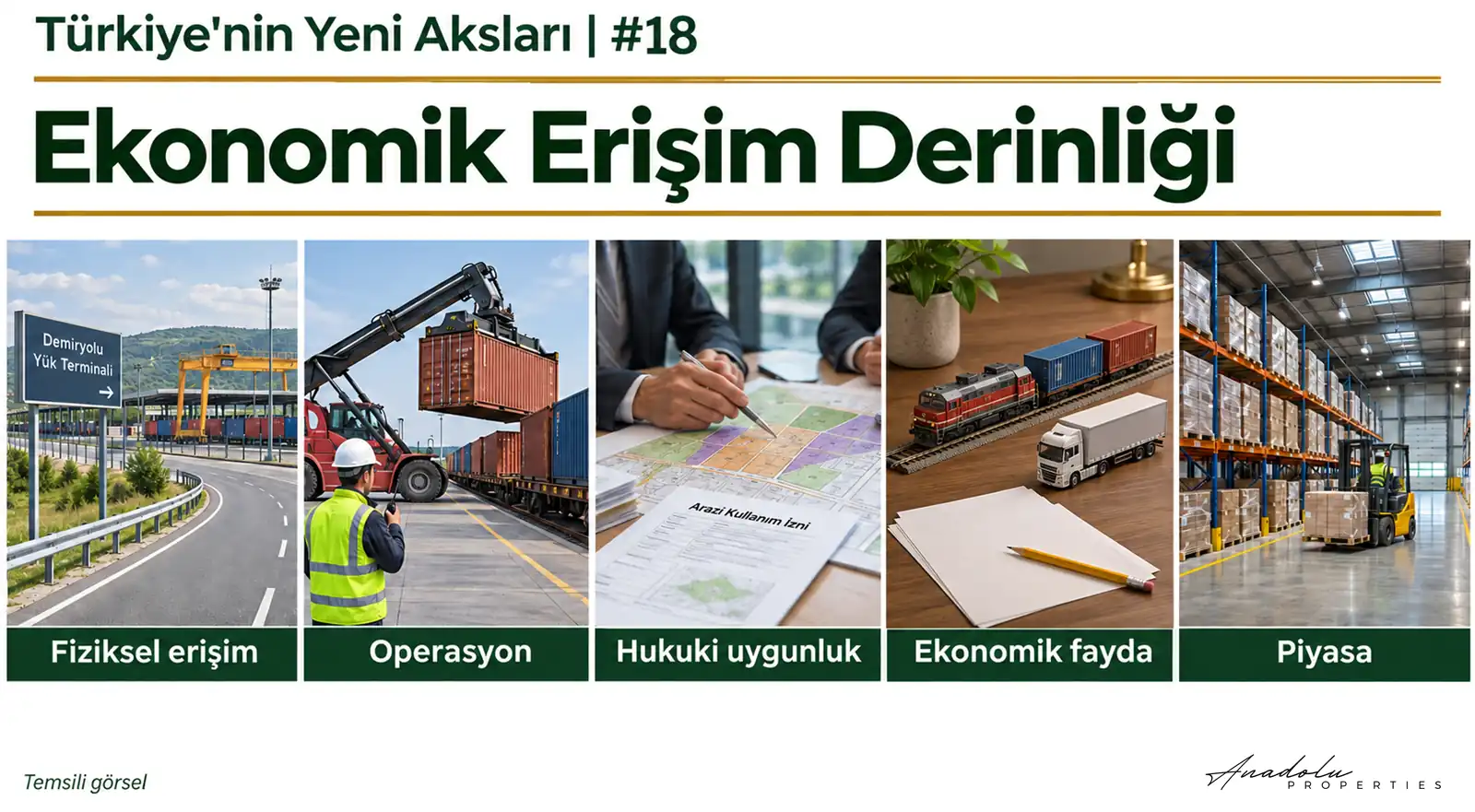
In this instalment, we at Anadolu Properties use five questions to examine the benefit a property might derive from the railway. We call this approach Depth of Economic Access. It is an analytical framework for investment decisions and has no status as an official index or approved valuation standard.
- Physical access. Which route and vehicle can be used to reach the station or freight terminal from the site? The assessment considers the route available to the freight vehicle and the point of transfer.
- Operational access. Does the terminal accept this type of freight? We assess line capacity, the type of service and the timetable against the company’s shipping plan.
- Legal suitability. Do the designated land use, licence, rights of use and required environmental permits allow the intended activity?
- Economic benefit. Once terminal access and transshipment are included, how do cost, delivery time and reliability compare with alternative routes?
- Market evidence. Do completed sales and lettings, occupancy and occupier demand support the benefit attributed to this location?
A property’s current value and future use in Thrace
For an owner, the first question is which business can use the property today and for what purpose. To assess current value, we look at completed transactions involving comparable uses. To examine future potential, we consider production volumes, freight flows, terminal connections and permitted use in light of a prospective tenant’s requirements.
The opening of the Çerkezköy–Kapıkule section provides a starting point for tracking Thrace’s production and trade links with Europe. At Anadolu Properties, we monitor which centres can use the line regularly and where that use leads to a new lease or investment decision. This general assessment draws on published official announcements. Decisions about buying, selling or valuing a property require a review specific to that property.
Mustafa Yılmaz
CEO – Anadolu Properties
Europe–Türkiye Investment Bridge