The Investment Map of the Future | #11 DECARBONISATION CAPACITY IN INDUSTRIAL REAL ESTATE
How can a factory’s readiness for low-carbon production be assessed?
A factory site may have room for new equipment. But can its grid connection supply enough power to run it? In steel, cement, aluminium and fertiliser plants, the answer can affect the cost of an investment and the production processes an existing building can accommodate.
When examining an industrial property, we start with the size of the site, the enclosed floor area, its location within an organised industrial zone and its transport links. For low-carbon production, we also examine the energy and water requirements of the existing process, where waste heat could be used and how new equipment would fit on the site. To understand what the technical solution contributes to the property, its installation cost must be assessed alongside expected operating savings.
Türkiye’s industrial decarbonisation plan
The Türkiye Industrial Decarbonisation Investment Platform (TIDIP) was developed in cooperation with the EBRD, IBRD and IFC under the coordination of the Ministry of Industry and Technology. Presidential Circular 2026/5, published on 22 May 2026, set out the national coordination framework.
The first version of the Investment Plan and Policy Strategy, published by the platform on 4 November 2026, brings together roadmaps, investment priorities and policy proposals for four sectors. The document was issued as a draft for subsequent revision. The terms on which a plant can obtain financing depend on its project and the financing institution’s assessment.
Source: TIDIP • Investment Plan and Policy Strategy, 4 November 2026
How should the figures for the 2030 target be read?
The opening of TIDIP’s announcement of 15 September 2026 sets targets of USD 5 billion in financing by 2030 and annual emissions reductions of more than 20 million tonnes. The same announcement also refers to euros. The EBRD’s platform page uses dollars, while its 2024 launch announcement uses euros. We therefore report the amount as a target and check the currency against the relevant financing document when making project calculations.
Source: TIDIP • Platform announcement, 15 September 2026
Source: EBRD • Country sector platforms
The ministry’s figure of more than USD 70 billion for the four sectors in the run-up to 2053 is an estimate of long-term investment needs. As of 7 November 2026, the platform’s international launch was planned as part of COP31, scheduled to take place in Antalya from 9 to 20 November.
What the four sectors need from a site
Energy supply and low-carbon processes are central to iron and steel, while emissions from clinker production and alternative technologies are priorities for cement. Energy efficiency and recycling are decisive for aluminium, as are ammonia production and low-carbon hydrogen for fertilisers. The space and infrastructure required for green hydrogen, carbon capture, renewable electricity and other climate technologies vary with the process selected.
From a financing target to property demand
The first possibility is modernisation within an existing plant. When a production line or electrical infrastructure is upgraded, the operator may continue production on the same site. A second possibility is an auxiliary facility for energy generation, storage, treatment, waste management or carbon capture. Additional space requirements can only be calculated once the equipment has been selected, the layout drawn up and the permits examined.
A third effect may arise through financing and competition. A viable project may broaden an operator’s financing options. Its financial position, environmental performance and credit terms also matter in a lending assessment. The platform’s overall target therefore provides insufficient information to calculate demand for land in a particular region.
The Anadolu Properties Decarbonisation Capacity Test
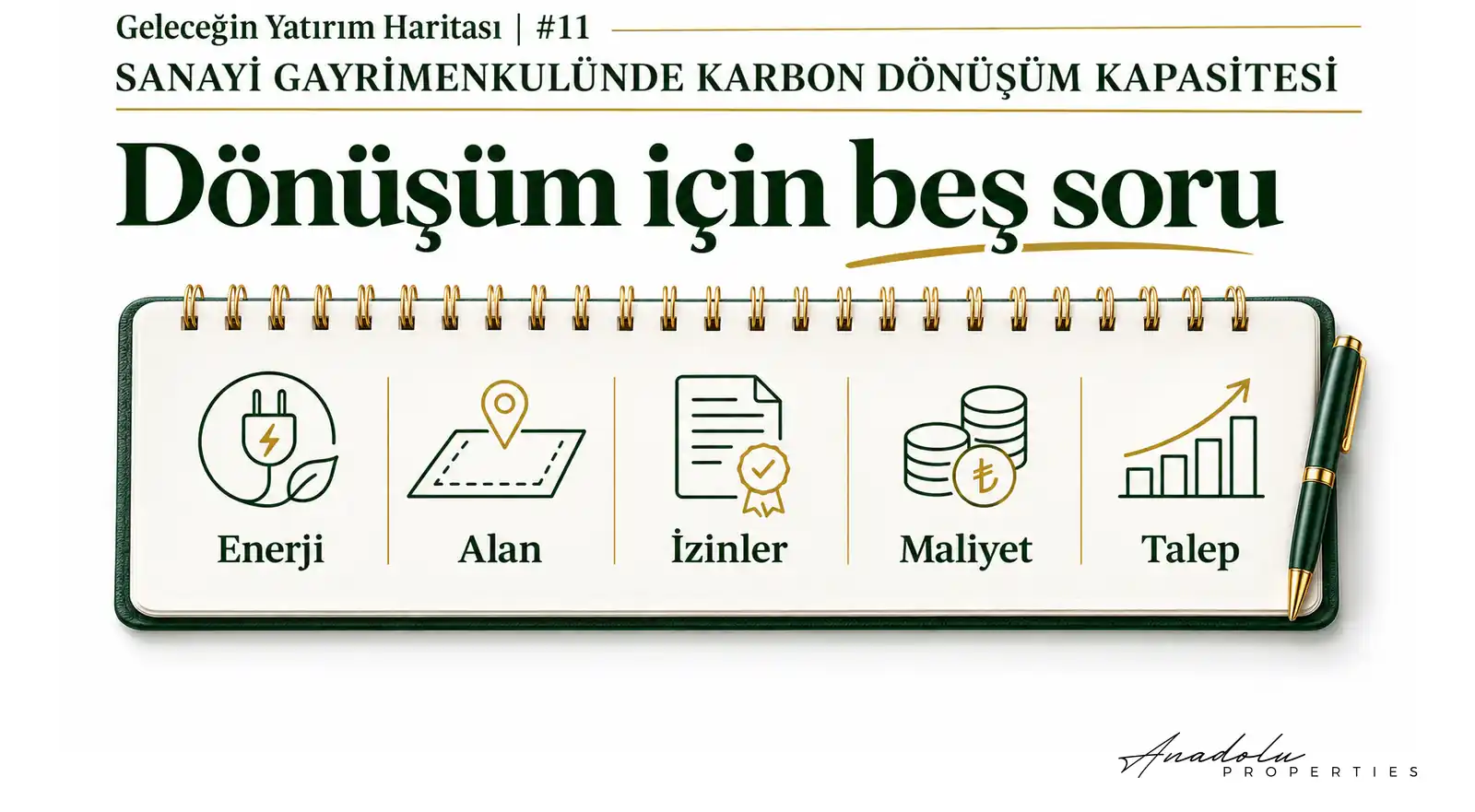
These five questions guide our investment analysis when we examine industrial properties. A plant’s certification status and market value are assessed using the records and evidence relevant to each.
1. Energy infrastructure
Can the electricity, natural gas and other connections support the selected technology? Existing connection capacity and the power required by the project should be compared in the same unit.
2. Physical adaptability
Where on the site could new equipment and auxiliary facilities be installed? The site plan should show how apparently vacant space relates to existing buildings, operational access routes and utility connections.
3. Permits and conditions of use
Do the zoning status, licences, environmental permits and technical regulations allow the proposed use? The availability of land that appears suitable for a renewable energy installation must also be verified for the particular project and parcel.
4. Conversion economics
What payback period follows from the investment and financing costs relative to expected operating savings? It should be clear who will bear the project cost and who will benefit from the savings.
5. Market evidence
How do tenants, occupiers or buyers value this feature? Any claim of a difference in price or rent should be examined against completed transactions for comparable plants and verified occupier demand.
The decision facing the owner
A large site may have insufficient grid capacity. At another plant with a strong power connection, the layout of existing buildings or an environmental permit may limit a new system. In both cases the assessment should identify the constraint affecting the project, the cost of addressing it and its impact on the property’s value in use.
At Anadolu Properties, we recommend examining a plant’s long-term uses before deciding to sell in response to a financing announcement. We base our view of any difference in value between a modern building and an older plant on conversion costs, operating benefits and completed market transactions.
Testing tomorrow’s production requirements at today’s plant
A specific investment decision makes it possible to assess the potential for low-carbon production at an industrial property. Which technology was selected? Does the project have sufficient power and space? Which documents substantiate permits, financing and operating savings? With these questions answered, owners can make a sounder assessment of the long-term value in use of converting an existing plant and the value the market attaches to it.
Mustafa Yılmaz
CEO – Anadolu Properties
Europe–Türkiye Investment Bridge