WHY DOES CAPITAL CONTINUE TO FLOW INTO TURKEY? WHAT DO THE APRIL 2026 IIP DATA TELL US?
What Do the April 2026 IIP Data Indicate for Turkey?
According to the April 2026 International Investment Position data announced by the Central Bank of the Republic of Turkey, Turkey’s external assets reached USD 406 billion, while its liabilities rose to USD 808.3 billion. As a result, Turkey’s net International Investment Position stood at negative USD 402.3 billion.
At first glance, this figure may be read merely as an indicator of a deficit. From an investment perspective, however, the picture carries a broader meaning. The International Investment Position shows a country’s financial relationship with the rest of the world through assets, liabilities, direct investment, portfolio investment and other financial positions taken together.
For this reason, IIP data should not be assessed only from a debt perspective, but also in terms of Turkey’s position within the global capital system.
Liabilities Do Not Only Mean External Debt
In Turkey’s case, a high level of liabilities does not point only to the external debt stock. This item also includes foreign investors’ company stakes, equities, bonds, deposits, loans and direct investment components in Turkey.
From this perspective, a high liabilities figure shows that global capital still holds a significant position in the Turkish economy. The point that must be noted here is that the IIP does not, on its own, mean a new capital inflow. Market values, exchange-rate movements and the revaluation of existing assets may also affect the table.
Even so, the core reality indicated by the data remains unchanged: Turkey is not an economy that global investors have completely left outside their scope; on the contrary, it remains a market that continues to be monitored across different asset classes.
Why Does Global Capital Continue to Monitor Turkey?
In recent years, international investors have not focused solely on developed economies. Growth potential, a young population, production capacity, strategic geographic location and logistics advantages along the Europe-Middle East-Asia axis keep Turkey among the markets that many investors need to monitor.
This interest may not always appear at the same pace or in the same asset class. At times, it manifests through portfolio investments, at times through company acquisitions, production investments, or the real estate and land market.
Therefore, to understand capital movements, it is necessary to look not only at short-term price changes, but also at macro data, financing conditions, infrastructure investments and regional development dynamics together.
The Impact of Capital Movements on the Real Estate Market
Real estate investment in Turkey is one of the areas most directly or indirectly affected by international capital movements. More accessible price levels compared with many European countries in foreign-currency terms, rental income potential and expectations of long-term value appreciation lead foreign investors to follow the Turkish market closely.
This interest is not limited to the residential market. Land investment, industrial land, logistics zones, tourism areas and locations close to infrastructure projects also generate important signals for understanding the direction of capital.
The investment activity observed today in regions such as İstanbul, İzmir, Muğla, Antalya and Çanakkale reflects not only local demand, but also the effects of broader capital flows.
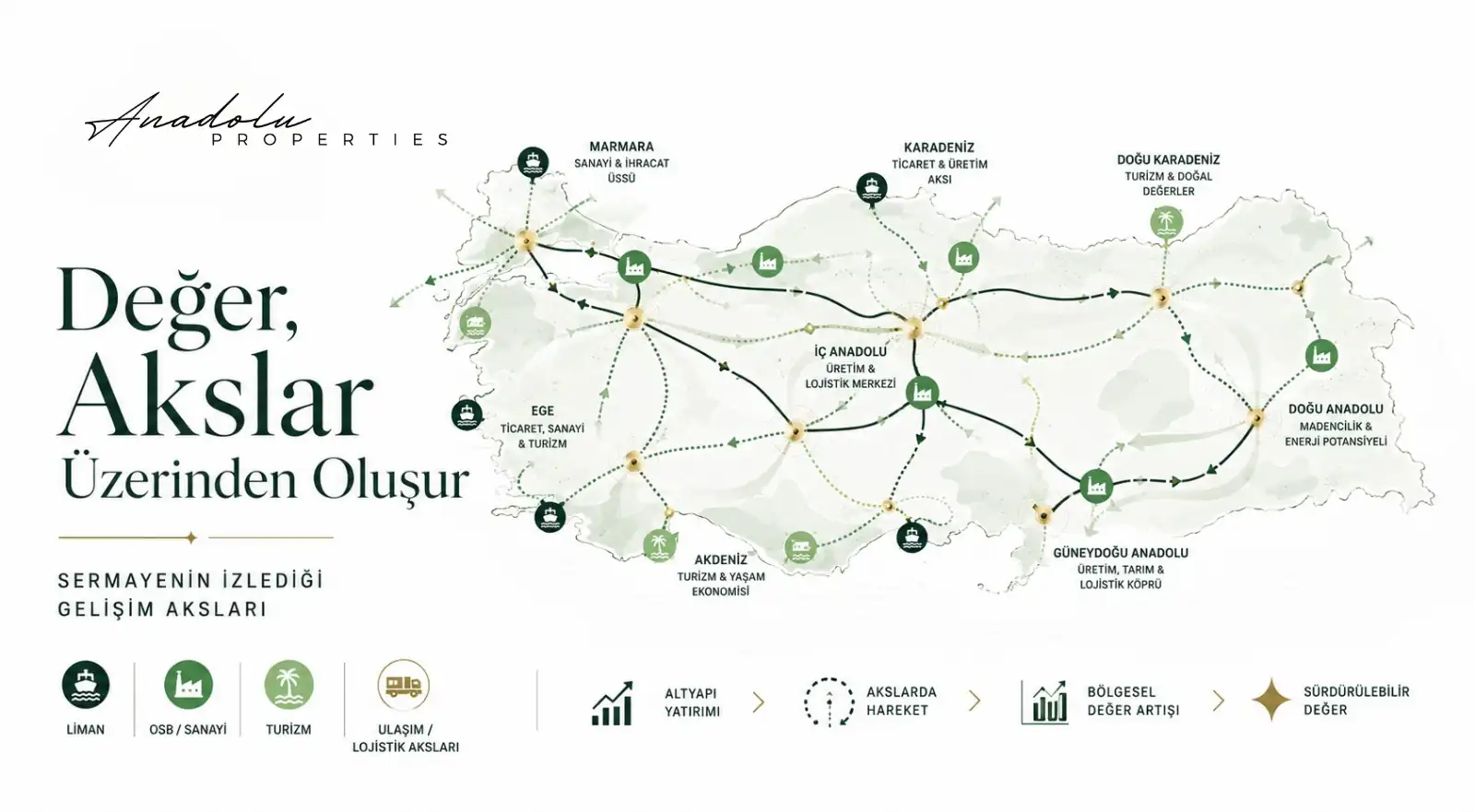
Regional Dynamics Supporting Value Appreciation
The factor that determines real estate value in a region is not only the price per square meter. Broader indicators that affect the direction of capital directly influence the quality of investment decisions.
- Infrastructure investments and transport connections
- Port projects and logistics corridors
- Organized industrial zones and production capacity
- Tourism investments and seasonal demand structure
- Population movements, demographic transformation and the rental market
- Zoning status, official records and the location’s place within the development axis
When these headings are assessed together, real estate investment moves beyond reading only today’s price; it becomes an effort to understand which economic flows will feed the region in the future.
Why Is Data-Driven Investment Reading Critical?
Macro data such as the International Investment Position do not produce a direct buy-sell signal for the investor. They do, however, help in understanding in which economies, in which asset classes and with what risk balance capital is positioned.
For this reason, when evaluating real estate investment in Turkey, it is not sufficient to look only at listing prices, regional hearsay or short-term market movements. Valuation reports, location analysis, zoning checks, regional development axes and official data should be read together.
This approach is especially important for Turkish investors living abroad. When making investment decisions remotely, information asymmetry increases; the right report, accurate data and sound field reading become essential tools for reducing risk.
Reading the Direction of Capital Correctly
The April 2026 IIP data show that Turkey’s relationship with global capital cannot be read only under the headings of debt or deficit. The data also reveal the scale of foreign investor positions in asset classes in Turkey and the economy’s link with the international financial system.
At Anadolu Properties, we believe investment decisions should not be made solely according to today’s prices, but by assessing capital movements, infrastructure investments, demographic transformation and regional development dynamics together.
Because the right investment is not only about reading today’s value correctly; it is also about accurately reading the datasets, risks and development direction that will create that value in the future.
Mustafa Yılmaz
CEO – Anadolu Properties
Europe – Türkiye Investment Bridge