TEKİRDAĞ ÇEŞMELİ PORT TENDER: MARMARA’S NEW 193.5 MILLION-DOLLAR LOGISTICS STORY
One of the common mistakes in the real estate market is to discuss only the outcome after a price increase has already appeared in a region. Yet the real reason behind a value movement is often linked to an infrastructure, production, transportation, or capital trend that began much earlier.
Major capital behaves differently at this point. It does not focus only on today’s price; it tries to read tomorrow’s economic flow. This is exactly where the impact of ports, organized industrial zones, logistics centers, and transportation connections on real estate value begins.
Major Capital Reads the Cause Before the Outcome
The recently announced Tekirdağ Çeşmeli Port tender has become a noteworthy example in this respect. Following the tender for the 45-year operating right of the former NATO Reception Port, which had remained idle for years, the total operating right fee was announced as 193.5 million dollars. However, the main issue to be read here is not only the figure, but the strategic perspective behind this investment decision.
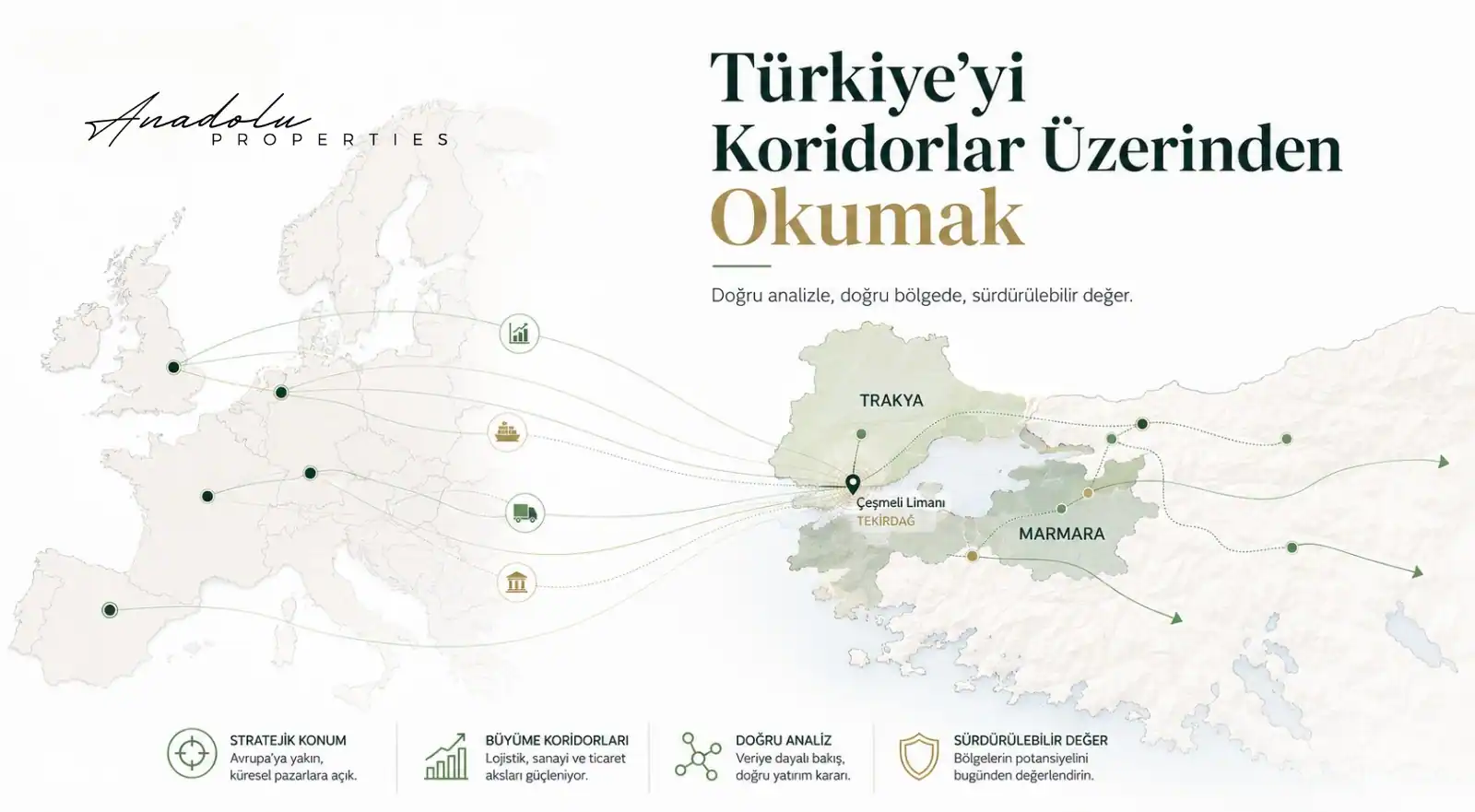
Because the investor did not bid only for a port. It positioned itself in the growing production belt west of Istanbul, in the industrial capacity of Thrace, in the trade corridors opening toward Europe, and in Marmara’s future logistics network.
For this reason, Çeşmeli Port is becoming an indicator that should be monitored not only in terms of maritime transport, but also in terms of real estate investment in Türkiye, industrial land values, warehouse areas, logistics centers, and regional investment analysis.
Why Is the Thrace Production Axis Coming to the Fore?
Today, Tekirdağ stands out as one of Türkiye’s quietly growing production regions. The Çorlu, Çerkezköy, Kapaklı, and Ergene line, with its organized industrial zones, production facilities, export connections, and proximity to Istanbul, forms one of the most critical parts of the Marmara production belt.
This line is important not only in terms of industrial investments but also in terms of logistics planning. Because where production increases, freight movement increases. Where freight movement increases, the need for ports, highways, railways, storage, and distribution grows. Each link in this chain creates a different value dynamic in the real estate market.
For this reason, logistics is no longer a topic limited only to the transportation sector. It has become one of the main factors determining where a factory will be established, in which region a warehouse will be located, and over what time horizon an industrial land parcel may carry value potential.
Çeşmeli Port Is More Than an Infrastructure Project
The reintegration of Çeşmeli Port into the economy is therefore important. The project carries the potential of an integrated center that can be read not only as a port where ships dock, but together with container, general cargo, dry bulk, liquid cargo, storage, and back-field logistics functions.
Such investments generate direct and indirect effects in the regional economy. A port connection may mean a cost advantage for industrial producers, operational flexibility for exporters, a need for new hubs for logistics companies, and new development axes that real estate investors should examine more carefully.
Of course, every infrastructure investment does not automatically mean value appreciation. Zoning status, ownership structure, environmental impacts, official plans, the implementation schedule of transportation connections, and market demand must be analyzed separately. However, the movement of major capital toward a specific corridor is a strong signal that investors should not ignore.
The Core Question for Investors Is Changing
The classic question in real estate investment is generally this: What is next to a land parcel today?
However, from the perspective of strategic investment analysis, the more accurate question is this: What will be on the economic map of this region five years from now?
Because real estate value is often determined not only by the building, but also by the transportation network. A road arrives, and the perception of value changes. A railway arrives, and the quality of access changes. An organized industrial zone expands, and the demand structure changes. A port becomes operational, and the economic function of the region differentiates.
A similar pattern can be seen in Türkiye’s major value movements in recent years. In examples such as the surroundings of the Northern Marmara Motorway, the Gebze industrial belt, the Bandırma line, the Aliağa logistics region, and the area around Mersin Port, value movements often began first with infrastructure and production decisions; the real estate market priced this transformation later.
Why Is Data-Driven Real Estate Analysis Critical?
For this reason, as Anadolu Properties, we do not evaluate a region solely through comparable prices. Comparable price is an important part of the decision-making process; however, it is not sufficient on its own.
When analyzing an investment region, we examine logistics connections, production centers, port investments, organized industrial zones, zoning plans, official institutional data, and the direction of capital together. Because a sound real estate investment requires reading not only today’s market snapshot, but also the region’s economic development scenario.
This approach is even more critical for Turkish investors living abroad and for investors who want to evaluate regional opportunities in Türkiye. In remote investment decisions, access to accurate information, location analysis, valuation reports, zoning checks, and transparent assessment of risks directly affect decision quality.
Reading the Future Value from Today
The Çeşmeli Port tender shows us once again: some investments are made not to meet today’s need, but to prepare for the trade map of the next 20 years.
The winning regions of the future are often not the places investors look at first, but the corridors where major capital quietly positions itself. Therefore, the real issue in real estate is not only seeing the price; it is correctly reading the economic dynamics, infrastructure decisions, and capital direction that will produce that price.
Mustafa Yılmaz
CEO – Anadolu Properties
Europe – Türkiye Investment Bridge