HOW COULD THE DEVELOPMENT ROAD PROJECT RESHAPE TÜRKİYE’S LOGISTICS AND COMMERCIAL REAL ESTATE MAP?
The Development Road Project and New Trade Corridors
As global trade networks are being reshaped, transport corridors are no longer viewed solely as freight transportation projects. Investments that integrate ports, railways, roads, energy, digital communications and logistics services within a single system are becoming strategic infrastructure capable of influencing the development direction of production centres, storage areas, industrial zones and commercial real estate markets.
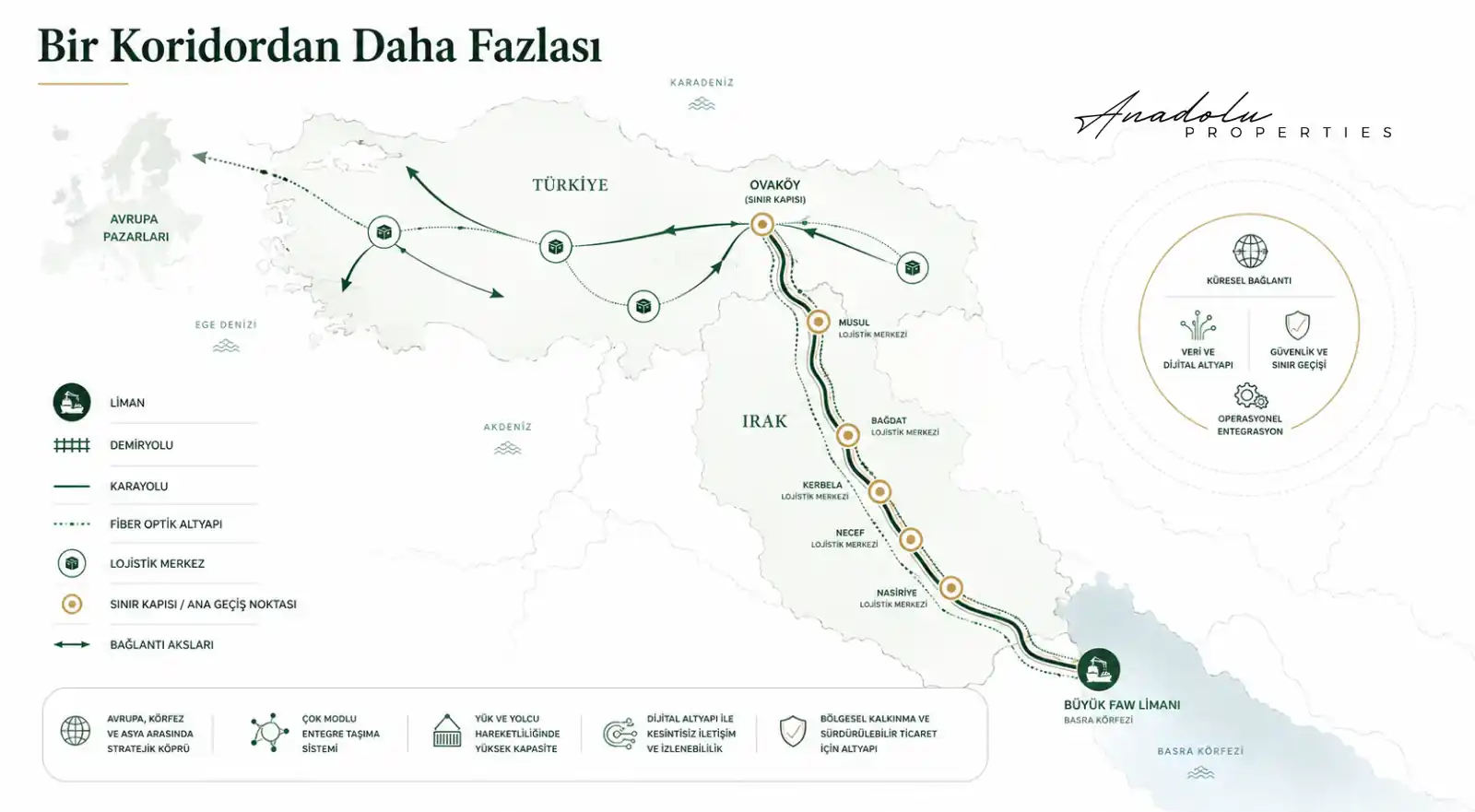
The Development Road Project being developed by Türkiye and Iraq is one of the most significant regional examples of this new-generation corridor approach. Planned to begin at the Grand Faw Port in the Persian Gulf, cross Iraq into Türkiye and then integrate with connections to Europe, the project addresses road, rail, communications and related infrastructure investments as an interconnected whole.
Its potential effects should therefore be assessed not only in terms of transport times or trade volumes, but also through demand for logistics facilities, industrial site selection, energy capacity, service areas and commercial real estate. Such an assessment requires official planning data and implementation progress to be considered together, rather than treating project announcements as direct evidence of value appreciation.
Next-Generation Corridors in Global Trade
Shortening transit times between production centres and consumer markets, diversifying supply chains and creating alternative routes during periods of crisis have become increasingly decisive in national transport policies. Modern trade corridors are therefore planned as a single ecosystem comprising the following elements:
- Port and intermodal transfer infrastructure
- Rail lines suitable for freight transport
- Road and motorway connections
- Logistics hubs, bonded warehouses and distribution facilities
- Energy and digital communications infrastructure
- Customs, maintenance, accommodation and commercial service areas
This structure can extend the impact of a transport investment beyond the route itself. As connections between the main corridor and production areas, ports, organised industrial zones and major consumer centres become stronger, the spatial distribution of logistics activity may also change.
Current Status of the Development Road Project
According to a statement made by Minister of Transport and Infrastructure Abdulkadir Uraloğlu on 21 July 2026, the project’s technical preparations are approaching completion. Decisions on the financing model are expected to be clarified through high-level talks between Türkiye and Iraq, and, if the process proceeds as planned, the project is targeted to begin during 2026.
This statement does not mean that construction has definitively begun. The current stage should be understood as technical preparations nearing completion, financing and implementation decisions being finalised, and political intent being expressed to take the first concrete step.
In addition to road and rail components, the project’s inclusion of fibre-optic and other communications lines indicates that the corridor is intended to develop not only the physical movement of freight but also digital connectivity. This integrated structure is important for the potential diversification of economic activity along the route.
Potential Effects on the Logistics Sector
If implemented as planned, the project could increase international freight movements, strengthen Türkiye’s southeast-to-northwest logistics connections and improve port-rail-road integration. Under this scenario, new capacity may be required in the following areas:
- Regional and international logistics hubs
- Distribution warehouses, bonded warehouses and cold-chain facilities
- Truck parks, maintenance and service areas
- Customs clearance, insurance, financing and transportation services
- Production- and export-oriented industrial areas
- Energy, data and communications infrastructure
Logistics demand should not, however, be expected to be distributed evenly along the corridor. Major junctions, border crossings, port connections, existing industrial clusters and high-capacity transport nodes may generate stronger economic attraction than secondary routes.
How Could the Commercial Real Estate Map Change?
Large-scale transport corridors do more than create demand for new buildings in commercial real estate markets; they can also affect land-use decisions, the characteristics required of industrial plots, warehousing standards and the location of service areas. In the context of the Development Road Project, the following asset types warrant particular attention:
- Logistics and warehousing facilities
- Organised industrial zones and industrial plots
- Production, assembly and light-industrial facilities
- Service areas related to customs and border trade
- Fuel, maintenance, accommodation and commercial service units
- Technical facility sites suitable for energy and digital infrastructure
The regions in which demand becomes sustainable cannot be identified by proximity to the corridor alone. The quality of transport connections, zoning function, plot size, ownership structure, energy capacity, labour access and environmental constraints will all be decisive.
Will Every Area Along the Route Experience the Same Impact?
Announcing an infrastructure project does not mean that all properties along its route will appreciate to the same extent. The impact area varies according to the relationship between the main line and its connection points, where freight is transferred, and the centres in which industrial and logistics plans are concentrated.
For example, an area may be geographically close to the corridor yet benefit only marginally if it lacks a direct connection, its zoning does not permit logistics or industrial use, or its energy and transport infrastructure is inadequate. By contrast, areas capable of integrating with existing production clusters, ports or intermodal hubs may encounter stronger user demand.
Investment assessment should therefore begin not with the question “Is it close to the project?” but with “How does it connect to the project’s functioning economic network?”
Data Investors Should Verify
When evaluating a commercial real estate or land investment associated with the Development Road Project, the following data should be reviewed together:
- The finalised project route and connection points
- Tender, financing and implementation timetable
- Expropriation boundaries and ownership status
- Higher-level spatial plans and implementation zoning plans
- Industrial, logistics, warehousing and commercial-use designations
- Integration of roads, railways, ports and border gates
- Electricity, natural gas, water and digital infrastructure capacity
- Environmental constraints, agricultural land status and development conditions
- Actual user demand, rent levels and comparable transactions in the region
Relying solely on project news before verifying this information through the relevant municipalities, land registry and cadastral records, ministry announcements, official plans and field inspections can create substantial investment risk.
Anadolu Properties Perspective: Data, Not Headlines
At Anadolu Properties, we do not treat large-scale infrastructure projects as standalone investment opportunities, but as multi-layered indicators of regional transformation. When assessing a corridor project’s impact on real estate markets, we examine official routes, zoning decisions, logistics nodes, industrial investments, energy capacity, site conditions and market data together.
This approach distinguishes short-term expectations from long-term user demand. The objective is not to measure the perception created by the project’s name, but the property’s actual function within the economic network and its potential to attract sustainable demand.
Reading the Corridor Correctly
The Development Road Project is a strategic initiative that could strengthen Türkiye’s role in international logistics networks and transform industrial and commercial real estate dynamics in certain regions. The scale and locations at which this potential materialises will, however, depend on financing decisions, the implementation timetable, connection projects and local planning processes.
For investors, the real value lies not in hearing a project announcement first, but in correctly analysing the route’s economic operation, official plans and the property’s functional capacity. Verified data, rather than expectations, is what turns major infrastructure investment into a sustainable investment decision.
Mustafa Yılmaz
CEO – Anadolu Properties
Europe–Türkiye Investment Bridge