TÜRKİYE’S NEW AXES | #09 THE IMPACT OF THE KARS–IĞDIR–DİLUCU RAILWAY AND THE NAKHCHIVAN CONNECTION ON THE REGIONAL ECONOMY
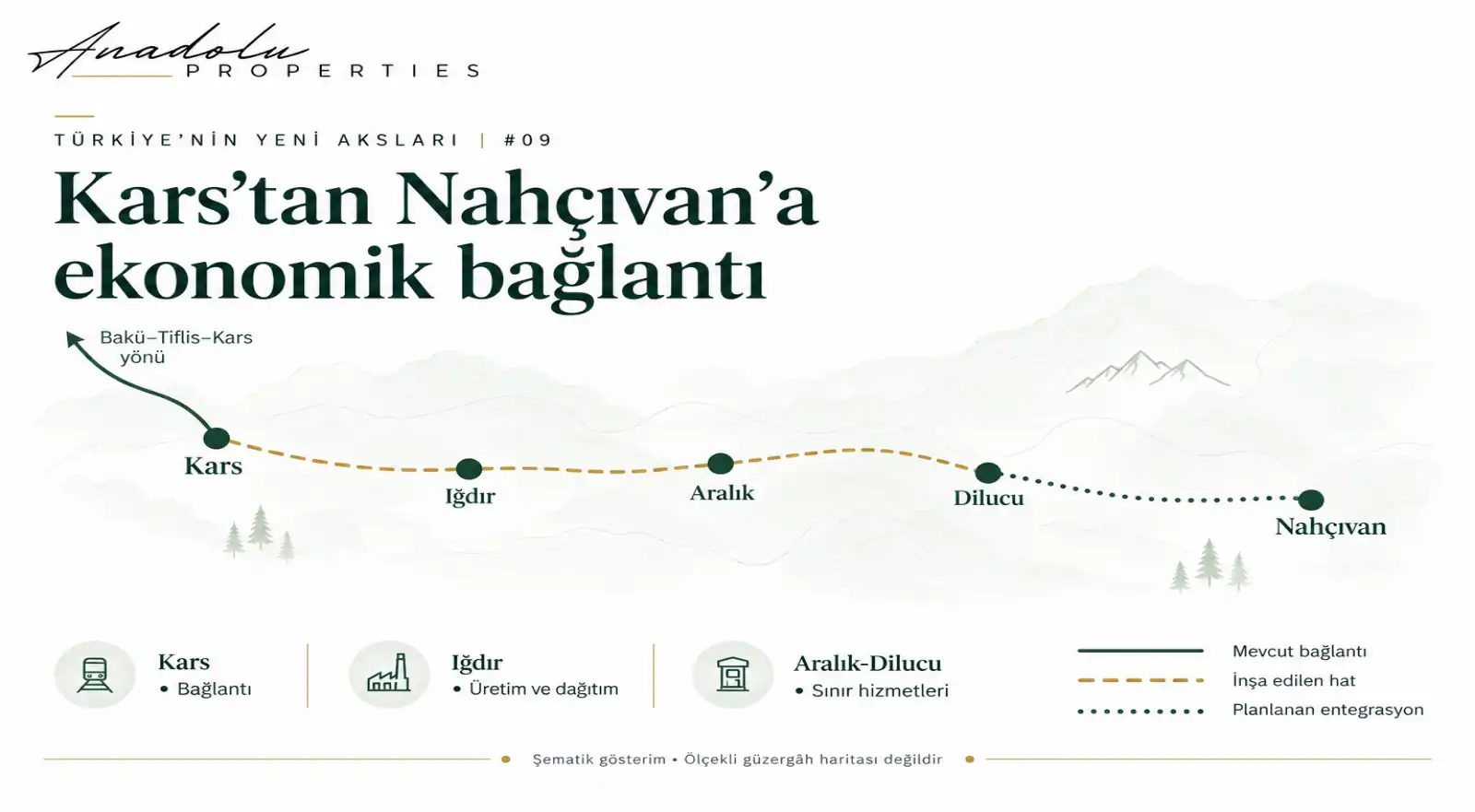
Türkiye’s Eastward Transport Map
The Kars–Iğdır–Aralık–Dilucu Railway Line aims to strengthen Türkiye’s transport connection towards Nakhchivan. Its main significance for the regional economy lies in its potential to change how production, storage and cross-border trade operate across the area stretching from Kars to Iğdır.
The 224-kilometre line, whose foundation was laid on 22 August 2025, is planned to have an annual capacity of 5.5 million passengers and 15 million tonnes of freight. In its statement of 23 January 2026, the Ministry of Transport and Infrastructure also confirmed that construction had begun. The announced capacity does not represent current passenger or freight volumes. Source: UAB project information. UAB statement from 2026.
The Baku–Tbilisi–Kars railway provides the existing connection through Georgia towards Azerbaijan and the Caspian. The new line could create a second connection from Kars through Iğdır, Aralık and Dilucu to Nakhchivan. Turning this into seamless international transport also depends on the cross-border lines and operating arrangements becoming functional.
The central question we explore in the Türkiye’s New Axes series is how new transport connections could change cities’ economic functions. Alongside the project’s construction, we therefore need to monitor the ability of local production and trade to make use of the railway.
Different Economic Roles from Kars to Dilucu
This axis can be viewed as a single railway investment. Yet each location could play a different role: Kars in connectivity and freight coordination, Iğdır in production and distribution, Aralık in transit services, and Dilucu in border procedures. Nakhchivan is an important link in the planned connection between Türkiye and the main part of Azerbaijan.
The development of these functions will depend on where freight stops, which services it uses and how it connects with local production.
Kars’s Role as a Railway Junction
Thanks to the Baku–Tbilisi–Kars line, Kars holds an important position in Türkiye’s international railway network. The addition of the Iğdır–Dilucu line could strengthen its role as a junction where freight can be routed towards Georgia or Nakhchivan.
This possibility calls for monitoring how transshipment, storage, maintenance, freight coordination and distribution activities develop. The economic impact will vary according to the terminals where freight is consolidated and the locations where industrial and logistics investments cluster. It is therefore unsound to assume that all land around the railway will appreciate to the same extent.
Agricultural Production and Logistics in Iğdır
In our view, Iğdır is one of the most notable locations along the line in terms of the local economy. Its economy is rooted in a plain that combines its position in the border region adjoining Armenia, Nakhchivan and Iran with agricultural and food production.
If the new railway can improve access for this output to western Türkiye and, once cross-border connections are operating, to wider markets, Iğdır’s economic role could strengthen. Cold storage, packaging, agricultural processing and distribution activities should therefore be closely monitored.
The sector information published by SERKA for Iğdır also identifies agriculture, foreign trade and logistics as components of the regional economy. However, translating existing production potential into demand for rail transport depends on which products producers can transport on the line and at what cost. Source: SERKA sectors in Iğdır.
The decisive question for Iğdır is this: which products and sectors will actually use this train? Assessments of property demand must likewise be grounded in the local economy’s ability to use the new transport option.
The Economy Behind the Border in Aralık and Dilucu
Dilucu is Türkiye’s existing road border crossing to Nakhchivan. If the rail connection and integration on the other side are completed, new activities combining road and rail transport could develop in the same area.
Where will customs clearance take place? In which areas will freight wait? Where will transfers between rail and road take place? Where will servicing and maintenance be concentrated? These questions are important for understanding the specific local areas around Aralık–Dilucu where economic functions could emerge.
As we also discussed in our Development Road analysis, proximity to a border crossing alone does not explain value appreciation. Whether the freight crossing the border generates demand for services, employment and commercial activity in the region must be examined separately.
The Current State of the Nakhchivan and Zangezur Connection
The statement issued by the Presidency of Azerbaijan on 11 August 2026 indicates that renewal work on Nakhchivan’s railway infrastructure is continuing. It states that an annual freight capacity of 15 million tonnes is envisaged upon completion of the railway projects associated with the Zangezur connection. The section from Sadarak to the Turkish border is also intended to be planned in technical alignment with the project in Türkiye. Source: Presidency of Azerbaijan.
The fact that the same capacity figure is cited as on the Turkish side does not, by itself, show that a continuous line is ready or that this volume of freight will be transported. Technical compatibility between the lines, border procedures and commercial demand must be assessed together.
The diplomatic framework for the planned connection through Armenia to the main part of Azerbaijan has also progressed. The Washington declaration of August 2025 was followed by the TRIPP implementation framework published in January 2026. TRIPP stands for the Trump Route for International Peace and Prosperity connectivity initiative; the framework is based on Armenia’s sovereignty and jurisdiction. Source: TRIPP implementation framework.
According to the Armenian government’s statement of 16 July 2026, the ratification process had been initiated for the intergovernmental framework agreement signed in June. The same statement notes that work on the project company’s shareholders’ agreement and charter was continuing. These developments indicate progress in implementation; they do not indicate that seamless rail transport has begun. Source: Armenian government.
Infrastructure construction, international agreements and actual operation therefore need to be understood as separate stages. To assess the economic impact of the complete connection, we must monitor operating conditions, customs arrangements and actual freight movements alongside the tracks themselves.
An Alternative Connection for the Middle Corridor
The Ministry of Transport and Infrastructure describes the Kars–Iğdır–Dilucu line as an investment that will connect the Middle Corridor to Türkiye through two separate border crossings. Once operational together with the cross-border connections, it could provide a new route into Türkiye for freight arriving via the Caspian. Source: UAB 2026 budget statement.
For regional development, the decisive issue will be what the freight contributes to the cities it passes through. Local economic transformation requires the development of storage, processing, distribution and links with regional production. Growth in international transit volumes does not mean that commercial demand will emerge to the same extent in every district along the route.
Indicators to Monitor from the Anadolu Properties Perspective
At Anadolu Properties, we assess this line through three economic thresholds: connectivity and freight coordination in Kars; market access for agricultural and food production in Iğdır; and the location of customs and transshipment services in Aralık–Dilucu.
Within this framework, alongside the pace of track laying, it is necessary to monitor developments at logistics centres, investments in warehouses and cold storage facilities, agricultural processing activities, customs areas behind the border and road connections. Employment trends and the translation of industrial land allocations into actual operations can also help reveal whether the economic impact is materialising on the ground.
In research into land investment and logistics property, these indicators should be considered alongside property-specific investigations. Zoning and ownership status, agricultural and conservation designations, the impact of expropriation, transport access, market comparisons and liquidity conditions must be assessed separately for each property.
For investors following the region from a distance in particular, proximity on a map is not sufficient. Official project information, field data and property valuation work should be read together. The central question today is which economic activities have actually begun to emerge around the corridor.
Understanding Change at the Eastern Gateway Through Data
Once the Kars–Iğdır–Aralık–Dilucu line and the cross-border connections are completed and brought into operation, a new transport option could emerge in eastern Türkiye. Kars’s logistics function, Iğdır’s production economy and the services behind the border in Aralık–Dilucu could be affected in different ways.
The scale of the transformation will be determined by private-sector investment, actual freight volumes, the functioning of customs procedures and the link between local production and the railway. For investors, the key question should be which economic function the new line will change, and in which city.
The lasting value of the Zangezur connection for Türkiye lies in enabling the area stretching from Kars to Iğdır to participate in the international trading system through its production and services. Assessing this potential properly requires testing infrastructure expectations against economic activity on the ground.
This study is intended for general information and research. Proximity to infrastructure investments does not guarantee that any property will appreciate in value; investment decisions should be assessed using property-specific investigations and current data.
Mustafa Yılmaz
CEO – Anadolu Properties
Europe–Türkiye Investment Bridge