HOW WILL THE TÜRKSAT GÖLBAŞI DATA CENTRE STRENGTHEN TÜRKİYE’S DIGITAL INFRASTRUCTURE? AN ANALYSIS OF COMMERCIAL REAL ESTATE AND REGIONAL DEVELOPMENT
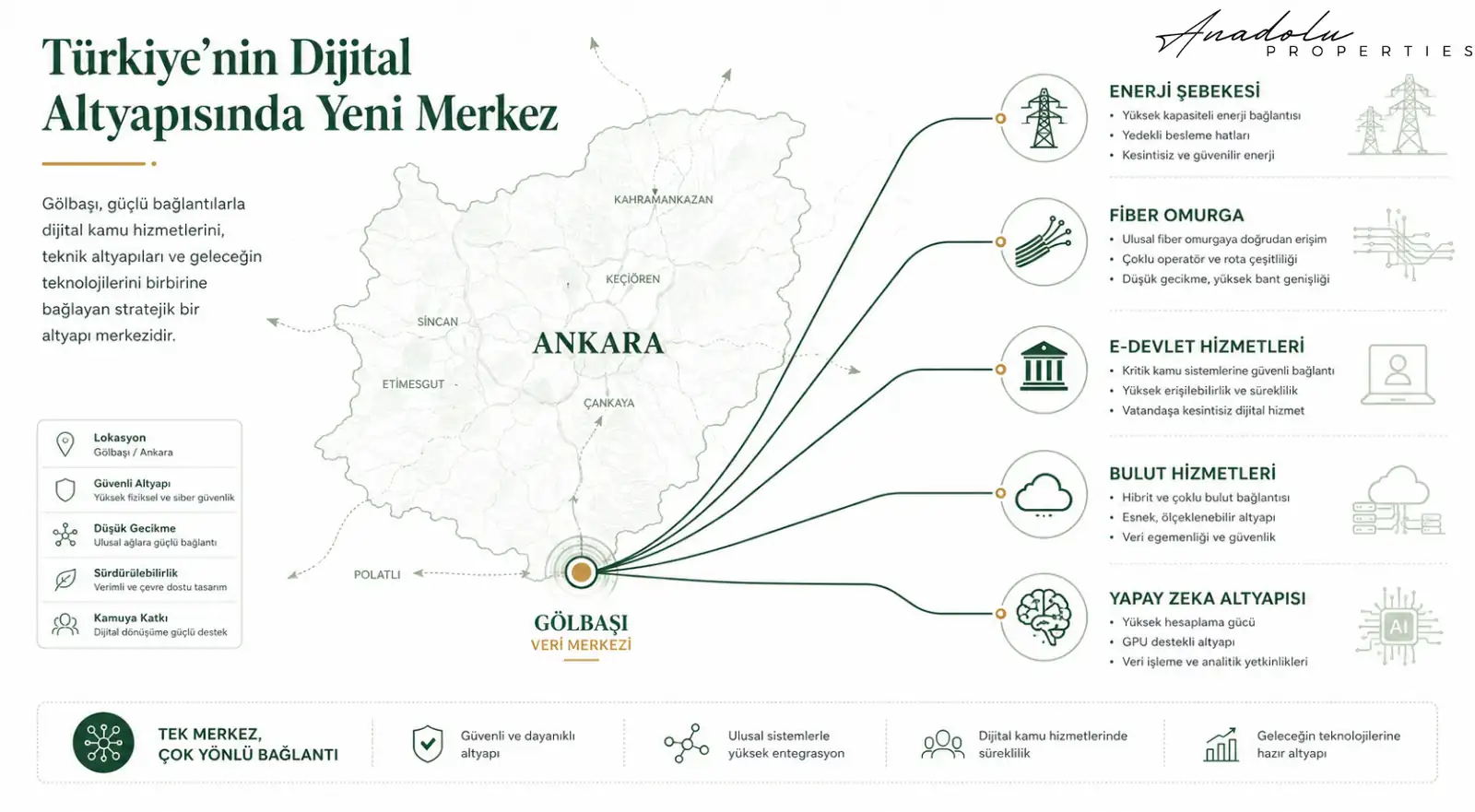
THE PHYSICAL FOUNDATION OF THE DIGITAL ECONOMY: DATA CENTRES
As digital transformation accelerates, data centres are becoming a strategic component not only of information technology infrastructure, but also of the energy, telecommunications, security, logistics and commercial real estate ecosystem.
Artificial intelligence, cloud computing, big data, financial technologies and digital public services require greater processing power and uninterrupted access. This need is directing countries towards next-generation data centre investments where data can be stored securely, processed and scaled when necessary.
It is therefore insufficient to view data centres merely as technical buildings that house servers. These facilities are special-purpose real estate investments that require energy supply, a fibre backbone, cooling systems, disaster resilience and technical service capacity to operate together at the same location.
CURRENT SCALE OF THE TÜRKSAT GÖLBAŞI DATA CENTRE PROJECT
The foundation of the TÜRKSAT Gölbaşı Data Centre was laid on 22 July 2026. The project stands out as one of Türkiye’s major digital infrastructure investments intended to expand the country’s public-sector data and cloud services capacity.
According to the latest project data announced by TÜRKSAT and the Ministry of Transport and Infrastructure, the centre is planned to include:
- 35,300 square metres of total area,
- 6,300 square metres of white space,
- six data halls,
- two high-performance rooms, each with capacity for 20 cabinets,
- 33 MVA of installed power capacity,
- office workspace for approximately 200 people,
- a threefold increase in physical capacity in the first phase and an increase of more than eightfold in the second phase.
The centre is intended to be developed to LEED Gold standards for energy efficiency and to comply with Uptime Institute TIER III and TSE 50600 data centre standards. It is also expected to provide the infrastructure required for artificial intelligence, deep learning, data mining and high-performance computing processes.
Construction is planned to be completed in approximately eighteen months, with the facility scheduled to enter service at the beginning of 2028. This scale shows that the project should be viewed not merely as a new public building, but as a long-term investment in digital capacity and business continuity.
WHY IS IT IMPORTANT FOR TÜRKİYE’S DIGITAL INFRASTRUCTURE?
The potential impact of the TÜRKSAT Gölbaşı Data Centre is not limited to creating additional server capacity. Its contribution to digital infrastructure can be assessed under four principal headings:
- Business continuity in public services: the creation of redundant infrastructure designed to support the uninterrupted operation of e-Government and critical public systems even under exceptional circumstances.
- Data security and digital sovereignty: the hosting of critical data within national borders in controlled systems that comply with applicable standards.
- Artificial intelligence and cloud capacity: the provision of scalable infrastructure for data analytics, model training and enterprise cloud services that require high processing power.
- Resource efficiency: the consolidation of selected services within a centralised and secure structure instead of each public institution establishing separate server rooms and duplicating hardware investments.
This approach transforms the data centre from a purely technical facility into a strategic infrastructure asset for Türkiye’s digital public services, cyber resilience and technological capacity.
WHY GÖLBAŞI? THE DISTINCT LOGIC OF DATA CENTRE LOCATION SELECTION
Location selection for data centre investments is based on a different set of decisions from those used for conventional offices, warehouses or industrial facilities. Plot size and transport connections are important, but they are not sufficient on their own.
The following factors must be assessed together when evaluating a data centre location:
- Energy capacity and redundancy: connection capacity capable of meeting high power requirements, transformer infrastructure and backup systems against outages.
- Fibre access and operator diversity: high bandwidth, low latency and redundant communications through alternative routes.
- Cooling and water infrastructure: resource availability, discharge arrangements and environmental management conditions suitable for the selected cooling technology.
- Disaster and ground risks: earthquake, flood, drainage and geotechnical conditions, together with emergency access.
- Physical security: controlled access, security buffers, perimeter arrangements and protection of critical infrastructure.
- Technical service access: the ability of maintenance, engineering, spare-parts and operations teams to reach the facility quickly.
The project’s location in Gölbaşı indicates that the area was evaluated within this framework. However, this choice does not mean that every surrounding plot is automatically suitable for a data centre or technology investment. Zoning, energy connections, fibre routes and technical feasibility must still be verified at parcel level.
POTENTIAL EFFECTS ON COMMERCIAL REAL ESTATE
Unlike conventional office or industrial investments, data centres can generate demand for specialised commercial real estate. This demand is generally directed not towards every property surrounding the facility, but towards sites that possess specific infrastructure characteristics.
Following an investment of this kind, the following property and use categories may gain greater importance:
- commercial or industrial plots with high-capacity power connections,
- sites with access to the fibre backbone and the ability to establish redundant communications,
- commercial units suitable for technical maintenance, engineering, security and operational services,
- storage and service areas capable of supporting suppliers of backup power, cooling, electrical and mechanical systems,
- controlled office and working environments for technology companies and specialist teams.
Nevertheless, geographical proximity to a data centre is not, by itself, an indicator of value appreciation. A property’s economic usability is determined by the availability of power allocation, its zoning designation, infrastructure connection costs, security requirements and future occupier demand.
The investor’s principal question should therefore not be, “How close is it to the data centre?” but rather, “Does this parcel genuinely meet the required technical, legal and infrastructure conditions?”
REGIONAL DEVELOPMENT: DIRECT AND INDIRECT EFFECTS
Large-scale data centre investments can contribute to regional development through both direct and indirect channels.
- Direct effects: project-based demand for construction, electrical, mechanical, telecommunications, security and facility management services.
- Infrastructure effect: the strengthening of electricity networks, fibre connections and technical access investments along specific corridors.
- Ecosystem effect: the development of specialist suppliers in cloud computing, cybersecurity, data management, maintenance and high-performance computing.
- Skilled workforce effect: greater demand for specialist personnel in engineering, information technology and facility operations.
- Business-attraction effect: stronger links between digital-service, R&D and technology-focused organisations and Ankara’s existing public-sector and university ecosystem.
The scale of these effects will not arise automatically. It will depend on the extent to which the local supply chain is integrated into the project, how infrastructure investment spreads to surrounding areas, the rate at which capacity is utilised and whether further technology investments follow.
For the same reason, the assumption that “a major investment means rapid value appreciation throughout the entire area” should be replaced by a distinction between the direct impact zone, the indirect impact zone and areas priced solely on expectations.
WHICH DATA SHOULD INVESTORS VERIFY?
When commercial land or property is assessed following news of a data centre investment, the decision-making process must move from the headline to parcel-level verification.
- Zoning status and plan notes: whether the parcel is genuinely permitted for commercial, industrial, technology, storage or technical infrastructure use.
- Title deed and ownership structure: annotations, easement rights, expropriation risks, utility corridors and any shared ownership structure.
- Power connection capacity: not merely whether a power line is nearby, but whether a connection can be provided technically and economically by the competent authorities.
- Fibre access and redundancy: whether uninterrupted connectivity can be established through different operators and routes rather than relying on a single line.
- Water, cooling and environmental conditions: resource requirements, discharge, noise and environmental permits according to the selected technology.
- Ground and disaster risk: geotechnical conditions, drainage, flood exposure, earthquake resilience and emergency access.
- Transport and security: technical-team access, service roads, security buffers and surrounding land uses.
- Market demand and liquidity: whether the property depends on a single use scenario and whether alternative use and exit options are available.
Making an investment decision solely on the expectation that “a data centre is being built” without carrying out these checks can cause infrastructure costs and use restrictions to be overlooked. Official zoning records, data from authorised energy and telecommunications bodies, title documents, site inspections and independent valuation should be considered together.
ANADOLU PROPERTIES ANALYSIS: FROM NEWS TO ASSET-LEVEL REVIEW
At Anadolu Properties, we do not assess data centre investments solely as technology or public-sector projects. We examine them together with energy infrastructure, fibre communications, zoning plans, transport, technical service capacity, environmental requirements and regional commercial real estate dynamics.
The purpose of this approach is not to assume a general increase in value around the project, but to identify which properties are technically and legally feasible for particular use scenarios. Unless location analysis, valuation reports, official-record checks and field data are used together, the difference between an investment announcement and genuine real estate value can easily be overlooked.
READING DIGITAL TRANSFORMATION THROUGH REAL ESTATE DATA
The TÜRKSAT Gölbaşı Data Centre represents a long-term capacity investment in Türkiye’s data security, business continuity in public services and artificial intelligence infrastructure. Its target of entering service at the beginning of 2028 indicates that its effects should be monitored gradually throughout the construction and operational phases, rather than being interpreted as a short-term reaction to a news announcement.
For commercial real estate, the critical distinction is this: value is created not merely by the existence of a major project, but by properties that can establish a real and verifiable connection with the infrastructure that project requires. Proximity does not become an investment rationale unless energy, fibre, zoning, ground, cooling, security and access conditions are met together.
A sound interpretation of data centre investments therefore requires technical feasibility before headlines, official data before expectations and parcel-level analysis before general narratives about an area. Growth in the digital economy may create new real estate opportunities, but sustainable value emerges only when the right questions are answered with the right data.
Mustafa Yılmaz
CEO – Anadolu Properties
Europe–Türkiye Investment Bridge