WHY IS TURKEY ON INVESTORS’ RADAR AS THE GLOBAL TRADE MAP IS BEING REDRAWN?
Turkey’s Strategic Position as the Global Trade Map Changes
As new trade corridors, energy investments and production chains extending from Europe to Asia are being reshaped, investors are now looking not only at today’s prices but also at tomorrow’s value map. Turkey, with its geographic position, industrial infrastructure, logistics connections and production capacity, stands out as a strategic transit point in this transformation.
Every day, hundreds of economic data points are announced and dozens of investment news items come onto the agenda. However, professional investors focus not on isolated headlines, but on the larger story these developments tell together. From the perspective of real estate investment, the real question is often this: Is a news item a short-term headline, or is it part of a broader transformation that could change a region’s future value dynamics?
The Common Theme of the New Period: Corridors, Energy and Production
When recent developments are considered together, a common theme becomes clear. The global economy is not only searching for new markets; it is also trying to build safer, more connected and more productive regional networks.
- Europe is working on new trade corridors and supply connections.
- Production chains are being reassessed around safer and more accessible hubs.
- Investments in energy infrastructure and interconnection lines are gaining strategic importance.
- Ports, organized industrial zones, logistics centers and storage areas are becoming more critical.
- Regional development programs are being evaluated together with industrial and transport infrastructure.
Although these developments may appear to be independent news items, they are in fact different parts of the same transformation: the world is building a new economic map.
Why Is Turkey Back on the Radar?
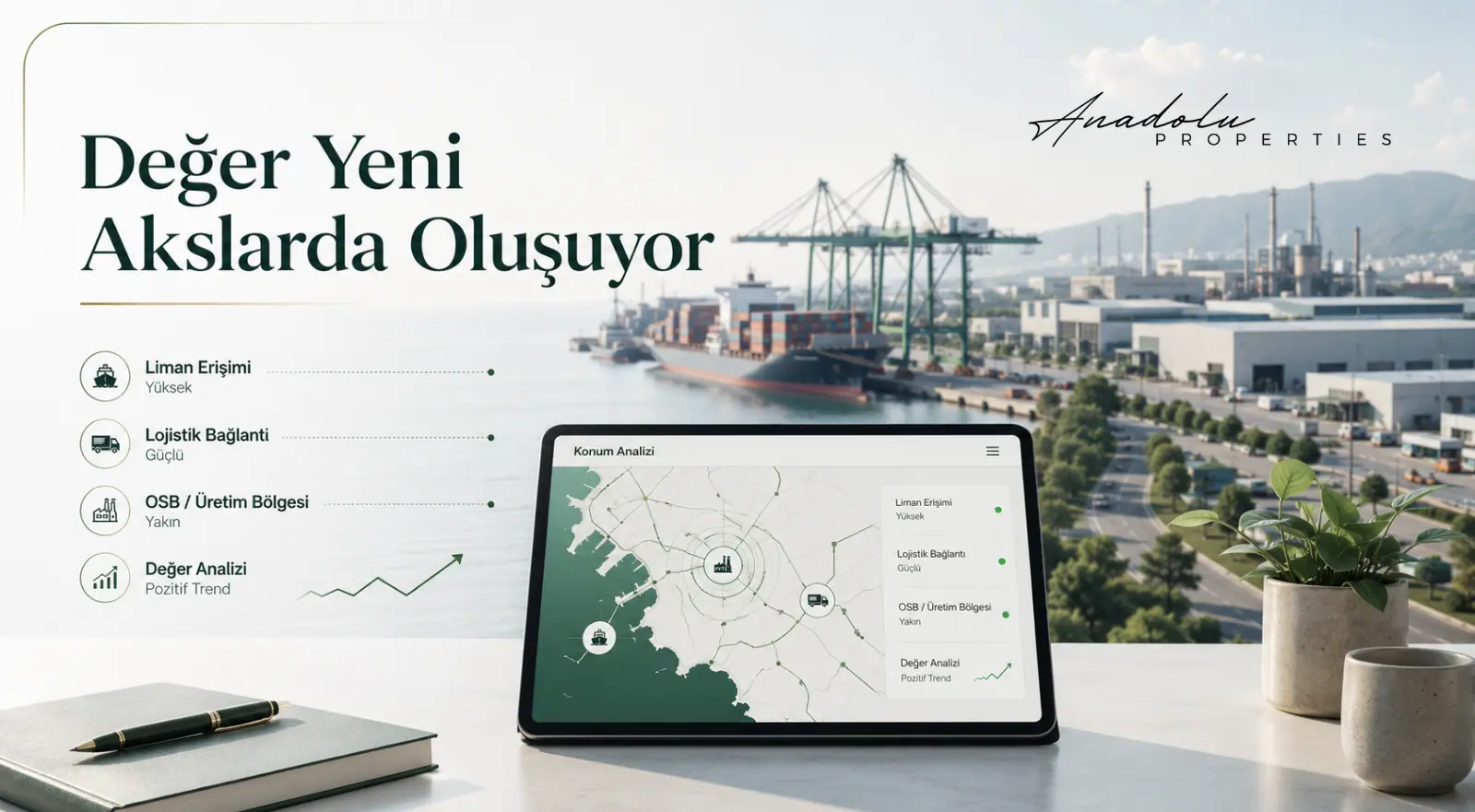
At the center of this transformation are transit points between Europe, the Middle East and Asia. Turkey, with its position along this route, its production capability, port connections, industrial zones and access to the domestic market, is becoming one of the countries receiving more attention in investment analyses.
Stronger trade initiatives between Europe and Asia, the repositioning of production chains, expanding cooperation in defense and technology, and financing discussions around energy infrastructure are different headings within the same story. All of these headings make it necessary to read real estate investment in Turkey not only through housing prices or square-meter values, but through infrastructure, industry, logistics and capital flow.
When Capital Changes Direction, the Real Estate Map Also Changes
When capital changes direction, not only factories but also port hinterlands, logistics centers, organized industrial zones, storage areas, transport routes and the land surrounding these areas begin to transform. For this reason, strategic real estate analysis should consider not only current market prices but also infrastructure and regional development data that may affect prices in the future.
In Turkey, location analysis for real estate, land and commercial investment decisions now requires a more multi-layered study. When zoning status, transport connections, industrial density, energy access, logistics advantages, regional incentives and demand structure are evaluated together, the real picture behind an investment decision becomes clearer.
Value Growth Often Appears First in the Data
In the investment world, value growth often appears first not in prices, but in data. A development that seems small today may become, a few years later, a key factor that changes the regional investment map.
- A new port investment is announced.
- A new metro or transport line is completed.
- A region is included within an incentive program.
- Financing is secured for energy investments.
- International trade corridors are redesigned.
These developments enter the news flow on the first day; over time, they become concrete data reflected in valuation reports, location analyses and investment feasibility studies. For this reason, as Anadolu Properties, we focus not only on current prices but also on the dynamics that could change prices in the future.
Why Is Data Critical for Turkish Investors Living Abroad?
For Turkish investors living abroad, investing in Turkey often brings with it the need for access to information, reliable analysis and accurate comparison. Seeing the market price alone is not enough; the zoning structure of the region, supply-demand balance, infrastructure projects, official data and field information should be evaluated together.
At this point, data-driven investment analysis does not push investors toward quick decisions; it guides them toward asking the right questions. As much as a location’s current price, it should also be examined which transport, production, energy and logistics needs that location may be able to serve five years from now.
The 2026 Picture: Connected Regions Are Standing Out More
As of 2026, the emerging picture is becoming increasingly clear. The world is repositioning production capacity, trade routes are being reshaped, and energy and logistics infrastructure are gaining strategic importance. Capital, meanwhile, is monitoring safe, productive and connected regions more closely.
Turkey is not a country outside this transformation; as one of the connection points between Europe, the Middle East and Asia, it is part of this new period. From the perspective of real estate investment in Turkey, this requires more careful analysis of port hinterlands, industrial axes, logistics connections, energy infrastructure and regions with development potential.
The Real Question: Not Which Place Is Valuable Today, but Which Region Will Be Needed Tomorrow?
The question investors should ask themselves today is not only “Which place is valuable today?” The more strategic question is this: “Which regions will the world, Turkey and regional trade networks need five years from now?”
Because the winners of the future will not be those who notice change only after prices have risen, but those who can read the bigger picture when the data begins to point the way. This is why making the right decision in real estate requires looking not only at the square-meter price, but also at the infrastructure, capital, production and logistics dynamics behind the location.
Mustafa Yılmaz
CEO – Anadolu Properties
Europe – Turkey Investment Bridge