MIDDLE CORRIDOR AND REAL ESTATE INVESTMENT IN TÜRKİYE: VALUE IS NOW CREATED THROUGH CONNECTIVITY STRENGTH
The Middle Corridor: Connectivity Strength Now Determines Value
The assessment of cooperation opportunities between Türkiye and the European Union in the areas of the Middle Corridor, connectivity and transport projects may at first appear to be a diplomatic agenda item. However, from a real estate and investment perspective, this subject is a strategic development that directly concerns Türkiye’s value map in the years ahead.
Because in the new period, countries gain value not only through their production capacity, but also through their position within global trade flows. At this point, the Middle Corridor positions Türkiye not merely as a domestic market, but as a central country linking production, logistics, energy and trade between Europe and Asia.
What Is the Middle Corridor and Why Is It Strategic for Türkiye?
The Middle Corridor is a multimodal trade route that starts in China and reaches Europe through Central Asia, the Caspian Sea, Azerbaijan, Georgia and Türkiye. This route should be read as a broad economic chain made up of railways, ports, roads, logistics centers and border crossings.
Therefore, the issue is not only “where goods pass through.” The real question is in which cities this flow can create new demand for production, storage, logistics and commercial real estate.
After the Russia-Ukraine war, global trade routes were reshaped. Geopolitical risks on the Northern Corridor increased interest in alternative routes between Europe and Asia. For this reason, the Middle Corridor is no longer merely a regional transport alternative; it has become a stronger agenda item in terms of supply chain security, continuity of foreign trade and the energy-political balance.
The European Union’s interest in this area should also be read from this perspective. Under the Global Gateway strategy, the EU aims to make the connections between Central Asia, the South Caucasus, the Black Sea and Türkiye more resilient. This is an important message for Türkiye: Europe is beginning to view Türkiye not only as a candidate country or trade partner, but also as an indispensable component of Eurasian connectivity.
How Do Trade Corridors Affect Real Estate Value?
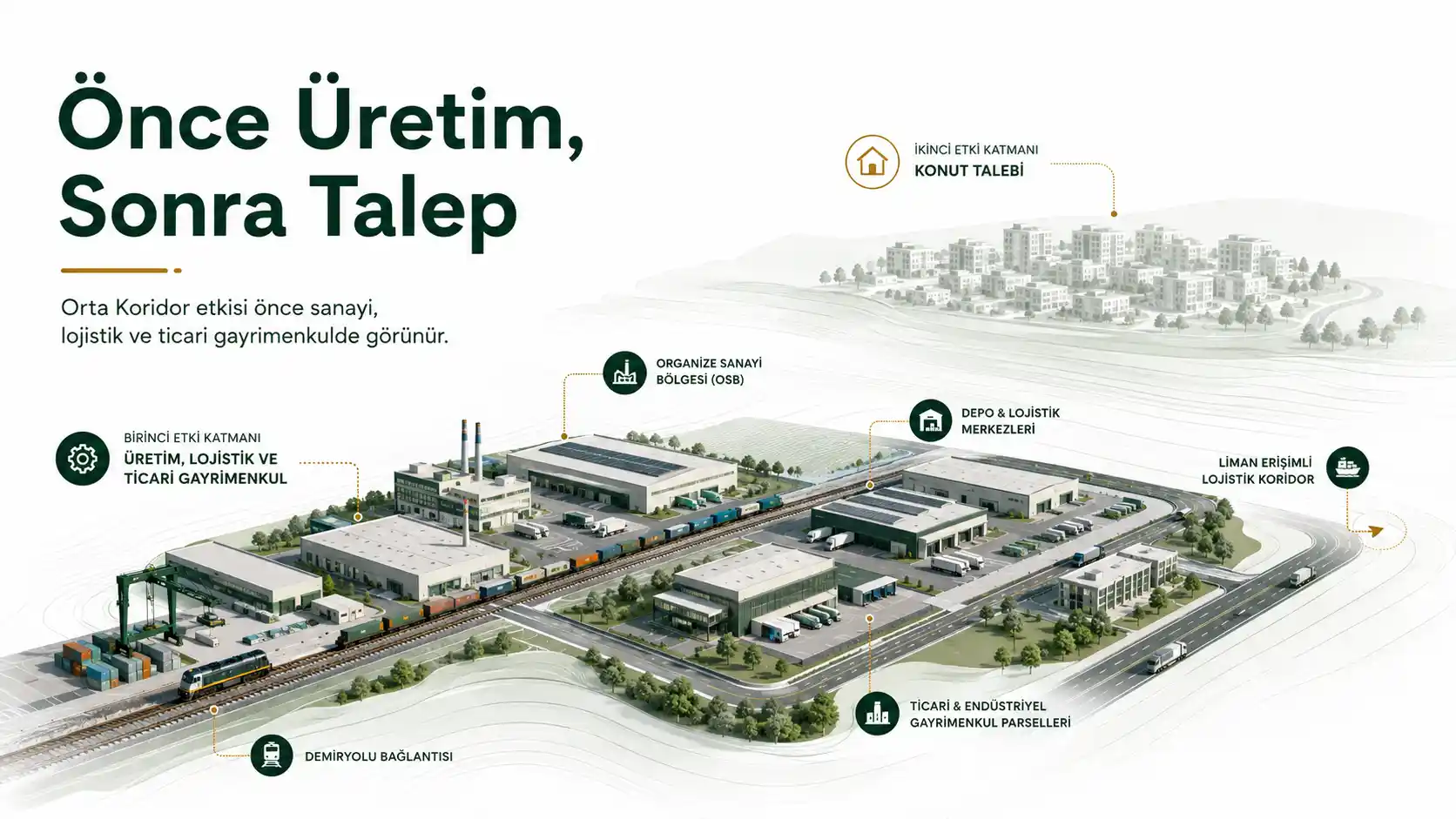
The strongest initial impact of this development on the real estate sector may be seen in industrial, logistics and commercial real estate. Trade corridors first change cargo flows, then storage needs, followed by production areas and finally the surrounding housing-demand balance.
The place where value first emerges is often not the housing market. Ports, organized industrial zones, warehouses, bonded warehouses, intermodal terminals, free zones and industrial parcels are the areas where this transformation gives earlier signals.
For this reason, when assessing the Middle Corridor from a real estate investment perspective, it is not enough to look only at the route through which the line passes. Value is created through connection quality, zoning status, cargo volume, industrial demand, port access, railway integration and planned development together.
Cities Are on the Same Corridor, but Not in the Same Function
The impact of the Middle Corridor in Türkiye should not be read as limited to a single city. Istanbul, Kocaeli, Bursa, Sakarya, Tekirdağ, Eskişehir, Ankara, Kayseri, Sivas, Erzurum, Kars, Mersin, Samsun, İzmir and Çanakkale can connect to this chain through different links.
However, not every city plays the same role. Some cities stand out as production bases, some as logistics transfer points, some as port connections and some as inland distribution centers. Any investment analysis made without this distinction remains incomplete.
For the investor, the critical question is not “The Middle Corridor passes through; where should we buy land?” The more accurate question is this: In which region will this corridor strengthen which economic function?
Because the existence of a corridor alone does not create value. Real value emerges when production, logistics, foreign trade, zoning plans and infrastructure connections converge at the same point.
What Do Global Examples Show?
Global examples offer a clear lesson on this subject. In the Netherlands, the logistics and industrial real estate around the Port of Rotterdam gained value not only because of the port’s size, but also because of its rail, road and inland waterway network connecting it to the European hinterland.
In Germany, when Duisburg became an important logistics hub in China-Europe rail freight transport, the surrounding warehouse and industrial areas emerged as a new investment class.
Similarly, Poland has become one of Europe’s notable logistics markets in recent years. Behind this were not only cost advantages, but also proximity to Germany, motorway-railway connections, e-commerce growth and the shift of supply chains toward Eastern Europe.
The common point in these examples is this: What increases real estate value is not a single project, but the trade flow becoming permanent and functional.
The Opportunity for Türkiye: Moving Beyond Being a Transit Country
For Türkiye, the greatest opportunity of the Middle Corridor lies in not remaining merely a transit country. If Türkiye uses this route only as a passageway for cargo, it will generate a limited economic impact.
However, a Middle Corridor integrated with ports, organized industrial zones, free zones, logistics villages, production centers and export clusters can become an economic backbone that directly supports real estate value and regional development.
At this point, real estate investors need to change their conventional perspective. In the past, investment decisions were often based on questions such as “Is the city growing, is the population increasing, is there housing demand?” In the new period, the following questions must also be added:
- Which trade route is this region connected to?
- Which port, railway or motorway axis does it access?
- Which production center does it serve?
- Which function can it carry, such as storage, bonded warehousing, cold chain or logistics park?
- Do the zoning status, planned development and official institutional records support this expectation?
Differences in Impact Across Housing, Industrial and Logistics Real Estate
The Middle Corridor’s impact on the housing market will be more indirect. In regions where logistics and industrial investments take place, employment increases first, then the service sector develops, and afterward the need for qualified housing emerges. For this reason, housing investors should not act hastily; they should first monitor whether the production and logistics movement is actually taking root.
On the industrial and logistics real estate side, the impact may be more direct. In particular, railway-connected organized industrial zones, port-back storage areas, industrial parcels near main road axes, logistics centers with strong truck access and export-oriented production regions may attract more investor interest in the coming period.
For land investment, the most important distinction is the relationship between zoning and function. The fact that a field-status land parcel is close to the corridor does not automatically make it industrial land. For this reason, zoning status, plan notes, environmental plan decisions and institutional opinions must be reviewed together.
Risks: The Line on the Map and Operational Reality Are Not the Same
The Middle Corridor is a multimodal, multinational structure that requires coordination. Caspian crossings, port capacity, customs processes, digital tracking systems, border crossing times and regulatory alignment between countries will determine the route’s real performance.
Therefore, a route that appears short on the map may not create the expected effect if it is not managed strongly from an operational perspective. For real estate investors, the most dangerous approach is to buy unplanned fields or unzoned land solely on the grounds that “the corridor passes through.”
In large corridor projects, the areas that create the most value are not always the parcels immediately next to the line. Real value is created at connection points, junction regions, planned production areas and centers where cargo is handled.
A Data-Driven Control List for Investors
For investors who want to read the Middle Corridor from an investment perspective, the applicable framework can be summarized under the following headings:
- Analyze the Middle Corridor not as a single line, but city by city and function by function. The role of Istanbul is not the same as that of Kars, Mersin, Kocaeli, Eskişehir or Tekirdağ.
- In industrial and logistics investments, look not only at distance but also at connection quality. Access to ports, railways, organized industrial zones, motorways and customs points should be measured separately.
- Do not act before the zoning status is clarified in land investments. Proximity to the corridor is not sufficient data to carry an investment decision on its own.
- When investing in housing, first monitor the employment effect. Pricing housing expectations early before industrial and logistics investments actually begin can create risk.
- Assess usage types such as storage, logistics parks, cold chain, bonded warehouses and commercial areas separately. The impact of the Middle Corridor may be felt first in these areas.
- Base the investment decision not on the headline, but on the data set. Cargo volume, connection investments, tender processes, port capacity, OIZ occupancy rates and rental data should be read together.
Reading the New Map of Value Correctly
The assessment of cooperation opportunities between Türkiye and the EU on the Middle Corridor is not merely a diplomatic meeting topic. This development should be read as an important signal that Türkiye’s strategic role on the Europe-Asia trade route may be repriced.
Within this framework, the Turkish real estate market requires a new-period reading. Value will not be created only in city centers, coastal regions or conventional housing markets. Logistics, production, foreign trade and connectivity will become one of the main headings of land and commercial real estate valuation.
In the new period, the winning investor will not be the one who only says “Türkiye will grow,” but the one who can read, based on data, which region of Türkiye can grow through which corridor and with which economic function.
Mustafa Yılmaz
CEO – Anadolu Properties
Europe – Türkiye Investment Bridge