IS A NEW WAVE OF CAPITAL COMING FROM EUROPE TO TÜRKİYE?
Is a New Wave of Capital Coming from Europe to Türkiye?
The topics recently discussed in Brussels and London should be read not only as part of the economic agenda for Türkiye’s real estate market, but also as signals of new capital movements.
One is the Türkiye-EU investment and trade agenda discussed in Brussels; the other is the UK-based discussions around Islamic finance and housing investment. Although they may appear to be separate themes at first glance, they point to the same issue: Türkiye is becoming more visible again at the investment table thanks to its proximity to Europe, production capacity and strategic transportation advantages.
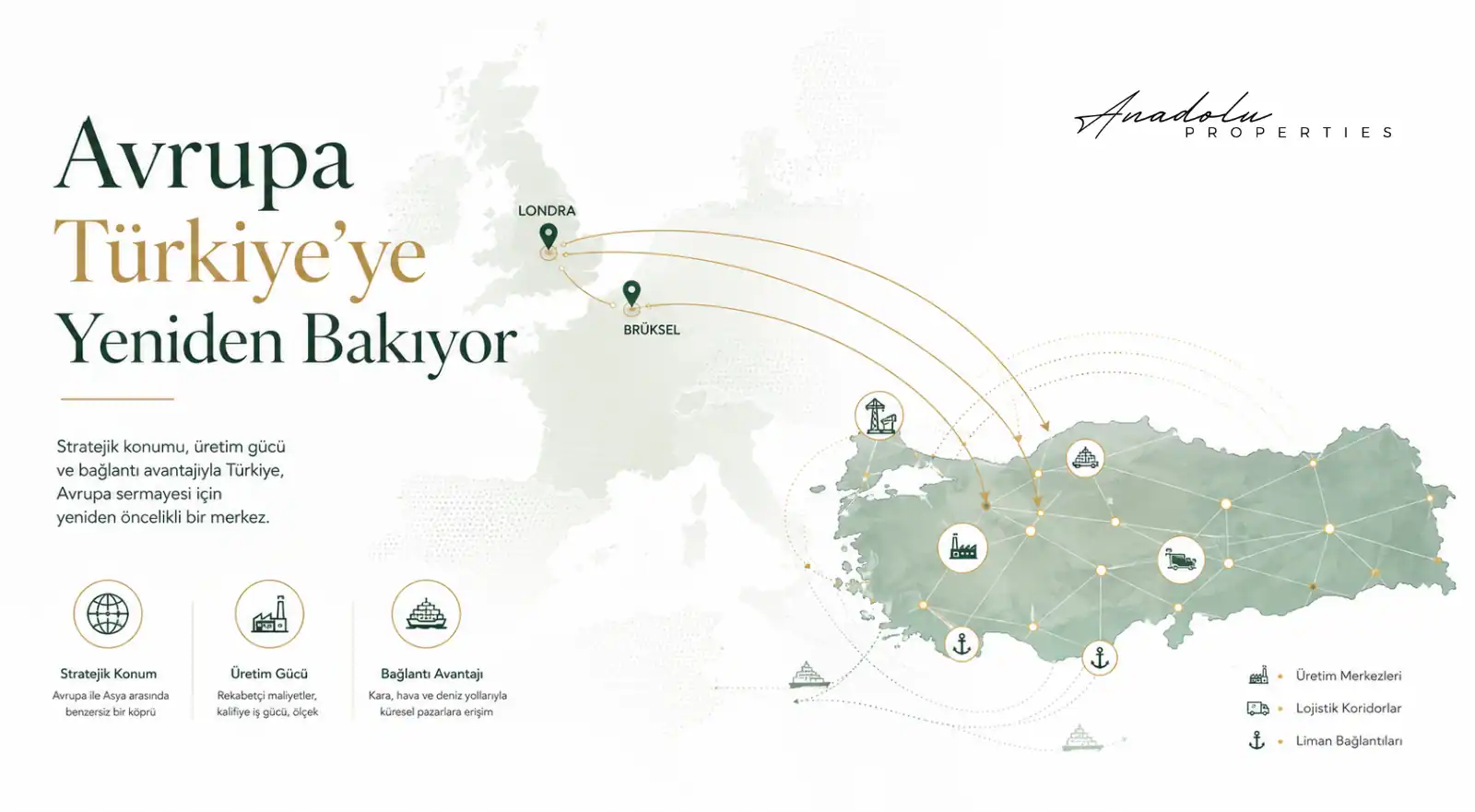
This picture shows that Türkiye is being reassessed not merely as a holiday destination or a low-cost housing market, but as a strategic investment hub positioned next to Europe .
The Message from Brussels: Türkiye Maintains Its Place in Europe’s Production and Investment Equation
In statements made within the scope of the EU-Türkiye Business Summit, it was emphasized that the commercial relationship between Türkiye and Europe remains strong and that European capital continues to be an important source of investment in Türkiye. The shared assessments stated that approximately 41 percent of Türkiye’s exports are directed to European Union countries.
For real estate investors, this data presents a framework that should be read directly. As European companies look for alternative production and logistics centers due to production costs, supply chain risk and proximity to market, Türkiye is once again standing out as a strategic option.
- European companies want to manage production costs in a more controlled way.
- Supply chains are shifting toward nearby markets outside China.
- Countries close to Europe, offering cost advantages and production capacity, are becoming more important.
- Türkiye is again attracting attention in this equation with its production, logistics and access advantages.
The renewed discussion around updating the Customs Union is not merely a political topic. It is an economic issue that may create medium- and long-term effects on logistics, industry, warehousing, production land, commercial real estate and the housing market.
What Do These Developments Mean for Real Estate Investors?
When long-term foreign capital moves into a country, its impact is not limited to factory buildings. A company arrives; employees, suppliers, logistics networks, office requirements, warehouse needs and new living areas form around it.
For this reason, production- and trade-oriented capital movements can affect different layers of the real estate market at the same time:
- Demand for production and storage areas around industrial zones may increase.
- Port-connected regions and ring road axes may be monitored more closely.
- Demand for housing and commercial areas near organized industrial zones may emerge.
- Land and plot investments around new transportation projects may become more strategic.
- Regional living areas may be supported not only by central cities, but also by surrounding production corridors.
This transformation is precisely why cities with strong production, port, logistics and transportation connections, such as Eskişehir, Balıkesir, Çanakkale, Bursa, Kocaeli and İzmir, are being discussed again today.
The Second Signal from London: Islamic Finance and Türkiye-Linked Real Estate
In UK-based financial circles, Türkiye-linked real estate investments and Islamic finance models are emerging as a separate theme. In assessments by Gatehouse Bank executives, it was emphasized that the high-income Muslim investor segment living in the UK maintains its interest in real estate investments through Islamic financing models.
This topic points to an important behavioral shift among Turks and Muslim investors living in Europe. Investors no longer want only to “buy a home” or “find an affordable property.” They are asking more fundamental questions:
- Which region is truly growing?
- Where is rental potential stronger?
- Which city is attracting industry and employment?
- Which data supports long-term value appreciation?
- Under which headings should the investment risk be controlled?
This shift is a sign of the transition from emotional purchasing to data-driven real estate investment. At precisely this point, tools such as location analysis, zoning review, market comparison and valuation reports are moving to the center of the investment decision.
The Investor of the New Era Wants to See Not Only the Listing, but the Future of the Region
For many years, Türkiye’s real estate sector progressed primarily with a sales-oriented approach. However, as the international investor profile changes, expectations are changing as well. Investors are no longer satisfied with only square meter, price and location information.
Before making a decision, investors want to see the following data together:
- Regional growth potential
- Transportation and infrastructure projects
- Demographic structure and migration movements
- Rent multiplier and payback period
- Industrial, logistics and trade impact
- Nearby investments
- Foreign capital movement
- Zoning status and legal control areas
Therefore, in the new period, a “good listing” alone is not sufficient. For the right investment decision, the region’s development story, official data, field information and risk headings must be evaluated together.
Why Is Türkiye Attracting Attention Again?
The world is looking for new production centers. In a period when supply chains are being reorganized, Europe is placing greater importance on nearby markets, and production security has become a strategic issue, Türkiye’s position is gaining importance again.
In international news flow, Türkiye is being viewed as a more critical partner for Europe because of its defense industry, production capacity and strategic geographical position. This development is not limited to the defense industry; it is also an indicator that should be monitored in terms of industry, logistics, qualified labor, regional housing demand and the commercial real estate market.
Within this framework, the following possibilities should be monitored more carefully:
- More companies and production lines moving toward Türkiye
- Foreign employees and supplier networks concentrating in certain cities
- Increasing demand for logistics and warehouse areas
- Housing, commercial space and land needs developing faster than expected in some cities
The real estate market is one of the areas that often feels the impact of major capital movements early. However, this impact does not occur in the same way in every region. Therefore, an investment decision must be examined separately through the city, district, axis, zoning status and surrounding investment dynamics.
Anadolu Properties Perspective: The Investor Who Reads Data Will Stand Out
In the coming period, the winning investor profile will not be the one that simply moves toward a region that appears inexpensive; it will be the investor who reads data, understands the regional story, follows infrastructure investments and correctly interprets capital flows.
Because the issue is no longer simply buying land, agricultural land or housing. The real issue is being able to evaluate the right axis, the right timing and the right data together.
In the Anadolu Properties approach, an investment decision should not be limited to listing information; it should be considered together with regional analysis, valuation reports, location checks, zoning review and market comparison. This method does not guarantee the investment decision; however, it helps investors make decisions within a more informed, measurable framework where risks are more visible.
Reading the Big Picture Through Data
The topics being discussed in Brussels and London today may be parts of a broader transformation that could affect tomorrow’s investment map of Türkiye. However, to read this transformation correctly, it is necessary to look not only at headlines but also at cities’ production power, transportation connections, zoning realities, capital movements and regional demand dynamics.
Major opportunities are often understood not when everyone notices them, but when they are still quiet and the data is read carefully. Therefore, the most critical question for investors in the new period is this: not how affordable a region appears today, but which economic flow it may become part of in the future.
Sources and Data References
This analysis has been prepared based on current news and data headings compiled from the Brussels EU-Türkiye Business Summit, Reuters economic news, Invest in Türkiye data, Gatehouse Bank and IFN UK Forum statements.
Mustafa Yılmaz
CEO – Anadolu Properties
Europe – Türkiye Investment Bridge