Türkiye’s New Axes | #13 DELICE ÇORUM SAMSUN RAILWAY AND THE BLACK SEA CONNECTION FOR PRODUCTION
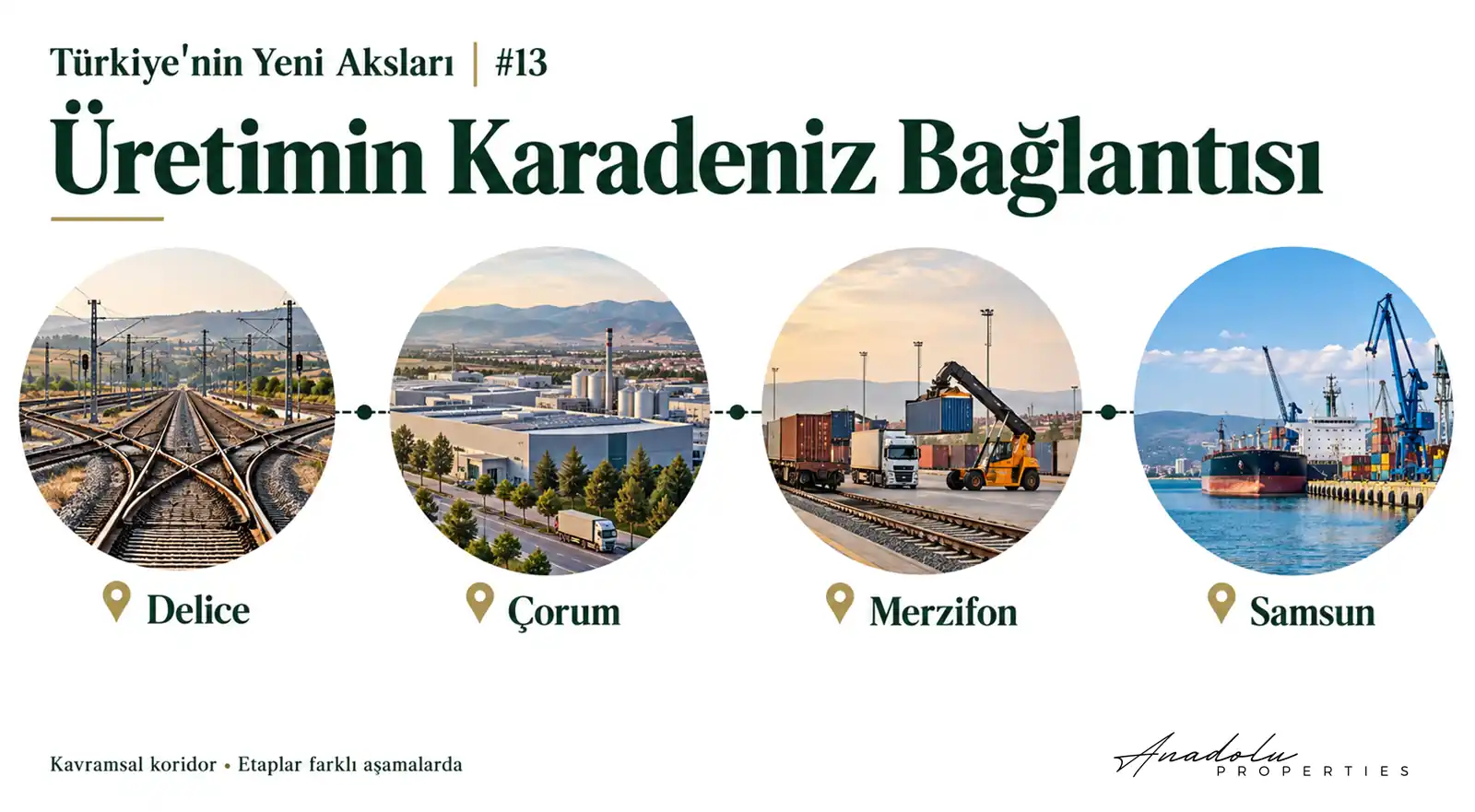
Rail Access to Ports for Çorum’s Industrial Production
When assessing the Delice–Çorum–Samsun corridor, our central question is how a new railway could change the economy that production centres can reach. For Çorum, the potential transformation lies in joining the national rail network and, once the onward connections are completed, gaining access to the Black Sea port system along a new axis.
Çorum has an established industrial base in sectors including machinery, metals, food and non-metallic mineral products. The investment guide published by the Middle Black Sea Development Agency sets out this sectoral structure. How this production base connects to the railway matters as much as passenger journey times. Source: OKA, Çorum Investment Guide.
The project described by the Ministry aims to connect Çorum to the rail network for the first time. The connection towards Kırıkkale and Ankara via Delice is the first step; extending to the Black Sea through Çorum, Merzifon, Havza and Samsun is the corridor’s broader objective. We cannot treat both scales of development as already complete.
Current Status of Delice Çorum and the Onward Sections
The official statements reviewed as of 12 October 2026 require the corridor’s sections to be assessed separately. Construction on Delice–Çorum, tenders for the onward sections and the announced plan for Havza–Samsun represent different stages.
Construction on the Delice Çorum section
On 4 March 2026, the Ministry of Transport and Infrastructure announced that physical progress on the 120-kilometre Delice–Çorum section was approaching 25 per cent. The detailed text of its statement dated 5 June 2026 indicated that overall progress had exceeded 25 per cent. These measurements relate to their respective dates; they cannot be presented as the current progress rate for October. Sources: Ministry of Transport and Infrastructure, 4 March 2026. Ministry of Transport and Infrastructure, 5 June 2026.
Tenders for the Çorum Merzifon and Merzifon Havza sections
In its 5 June statement, the Ministry reported that tenders had been held for the 66-kilometre Çorum–Merzifon and 37-kilometre Merzifon–Havza sections. It would therefore be incomplete to describe the onward connection merely as an uncertain future objective. Nevertheless, holding a tender is not the same as handing over a site, making construction progress or opening a line for service.
Announced plan for the Havza Samsun section
In its statement dated 3 September 2026, the Ministry said it planned to include the 70-kilometre Havza–Samsun section in the 2027 investment programme and begin work. The same statement also confirms that tenders had been held for Çorum–Merzifon and Merzifon–Havza. The intention to include a section in an investment programme should not be presented as an approved programme or a completed connection. Source: Ministry of Transport and Infrastructure, Samsun statement, 3 September 2026.
The national railway assessment dated 14 August 2026 also lists Kırıkkale–Çorum among the lines under construction. These records do not mean that the entire Delice–Samsun corridor is operational. We distinguish today’s access from the network effects that may emerge when the connections are completed. Source: Ministry of Transport and Infrastructure, railway network assessment, 14 August 2026.
Delice and the Connection to the National Network
Delice’s importance lies less in the size of its population than in how the new Çorum line will connect with the existing railway system. The function of this connection will be as important to its economic impact as the route’s starting point on the map.
We will monitor whether demand emerges for freight transfer, rail services and storage. Assessing new logistics functions requires confirmed facility and loading locations, together with evidence of actual use.
The Role of Çorum’s Production within the Network
Although Çorum is the endpoint of the first stage, it can be considered an intermediate node within the long-term corridor. The passenger connection towards Ankara and the freight and port connection towards Samsun may generate different economic effects.
If the onward connection to Samsun is completed and freight transport develops, Çorum could strengthen the links between production, the national network and the Black Sea. The change we will monitor is industry’s integration of rail into its actual supply and distribution processes.
Freight Use alongside Passenger Journey Times
The Ministry projects that the Ankara–Çorum journey will take approximately 1 hour and 20 minutes once the Delice–Çorum section is completed. This is a project target, not the current timetable of an operational line. Source: Ministry of Transport and Infrastructure, Ankara–Çorum journey time target, 4 March 2026.
From a property and production economy perspective, we should also examine freight use: how do raw materials arrive, how do products leave the factory, and at what total cost do they reach the port? How much road freight does rail replace? Is new demand for warehousing emerging, and do industrial companies consider rail access when choosing locations?
Project announcements cannot answer these questions. Transport choices, transfer times and costs after operations begin will show the economic function of the physical connection.
The Importance of the Samsun Port Connection
Samsun’s port and logistics infrastructure forms the corridor’s seaward end. Samsun Logistics Centre’s corporate profile also presents the city in terms of its road, rail and maritime connections. The new corridor’s arrival in Samsun should be assessed through its connection with this existing system. Source: Samsun Logistics Centre, corporate profile.
Efficient port access for production in Çorum and Central Anatolia requires functioning terminals and final connecting links as well as the completion of the onward sections. Progress on the Delice–Çorum line does not mean that a continuous new rail connection to Samsun’s ports is already available today.
It would therefore be inappropriate to assess properties as though the entire corridor and its freight connections were complete. We should use actual freight movements to monitor whether the new access delivers cost and time advantages.
Merzifon and Its Distribution Function
Merzifon is one of the important connection points along the corridor between Çorum and Samsun. What will matter is how road and rail come together in the future, whether a freight transfer function develops, and how industrial and warehousing investment responds.
To understand the economic importance of a junction, we need to examine the economic activity it can channel more than the number of roads passing through it. The development of the Merzifon–Havza section should also be monitored as part of the corridor’s continuity towards Samsun.
Understanding Economic Reach through Hinterland Depth
In this article, we use “hinterland depth” to mean the geographical and economic expansion of the markets, ports, industrial and logistics systems that a production centre can reach through its transport connections. This is the article’s analytical framework; it is not a calculated index or a coefficient of property value appreciation.
Distance in kilometres alone is insufficient. Proximity to a port and an efficient rail connection are not the same thing. Alongside asking “How many kilometres away is the port?”, we examine which economic systems the production centre can connect to, and under what time, cost and transfer conditions.
Five Indicators for Assessing Hinterland Depth
1 Connection to the national network
Can the production centre actually access the main rail and road systems? Proximity to a line must be distinguished from usable access.
2 Port connection
Can products reach the port directly or through efficient transfers? Terminal access and final connecting links are as important as the main line.
3 Freight capacity
Are the line and terminals suitable for freight services that meet the producer’s needs? Planned capacity and actual freight volumes should be monitored separately.
4 Logistics behaviour
Do industrial companies actually use the line? Changes in transport choices and supply chains provide evidence of the infrastructure’s economic impact.
5 Property function
Are new warehouses, logistics facilities, production sites or commercial service areas emerging? We cannot infer value appreciation from proximity to the railway without evidence of demand for use, completed transactions and liquidity.
Economic Activity to Monitor along the Corridor
In Delice, we will monitor the connection to the national network and new logistics services; in Çorum, producers’ use of rail. In Merzifon, distribution and transfer functions will matter, while in Samsun the focus will be on how the new corridor integrates with the existing port system.
This approach requires us to track economic activity rather than draw a single map of value appreciation. We do not assume that the same effects on use, demand or prices will emerge at every location.
Anadolu Properties Research Agenda
We see the corridor’s potential for transformation in the changing economic hinterland of Çorum. Alongside the laying of tracks, we will monitor the beginnings of change in producers’ logistics behaviour.
Our research agenda includes construction progress on Delice–Çorum, the contractual and on-site status of the onward sections, and confirmed station and loading locations. Industrial investment in Çorum’s organised industrial zone, warehousing facilities, final connections to Samsun’s ports and actual transport choices will complete this assessment.
When examining land and commercial property, each property’s planning, ownership, expropriation, agricultural and conservation status must be investigated separately. Potential at corridor level cannot be translated into an investment conclusion for an individual parcel without also assessing actual access, infrastructure, demand and liquidity.
Functioning Connections Change Economic Distance
Çorum’s distance from the sea will not change, but the conditions under which its production reaches ports and markets may. Realising this possibility depends on the completion of the sections, functioning connections and industry’s use of the system.
This is our central argument in the 13th article of the Türkiye’s New Axes series: we should assess a production city’s economic reach through the markets and ports it can connect to, as well as through its own boundaries. Transport and usage data will show how far the new railway extends its hinterland.
This article has been prepared for general information and research purposes. Project targets are not realised outcomes. Proximity to a railway or its route does not guarantee an increase in the value of any property or an investment return.
Mustafa Yılmaz
CEO – Anadolu Properties
Europe–Türkiye Investment Bridge