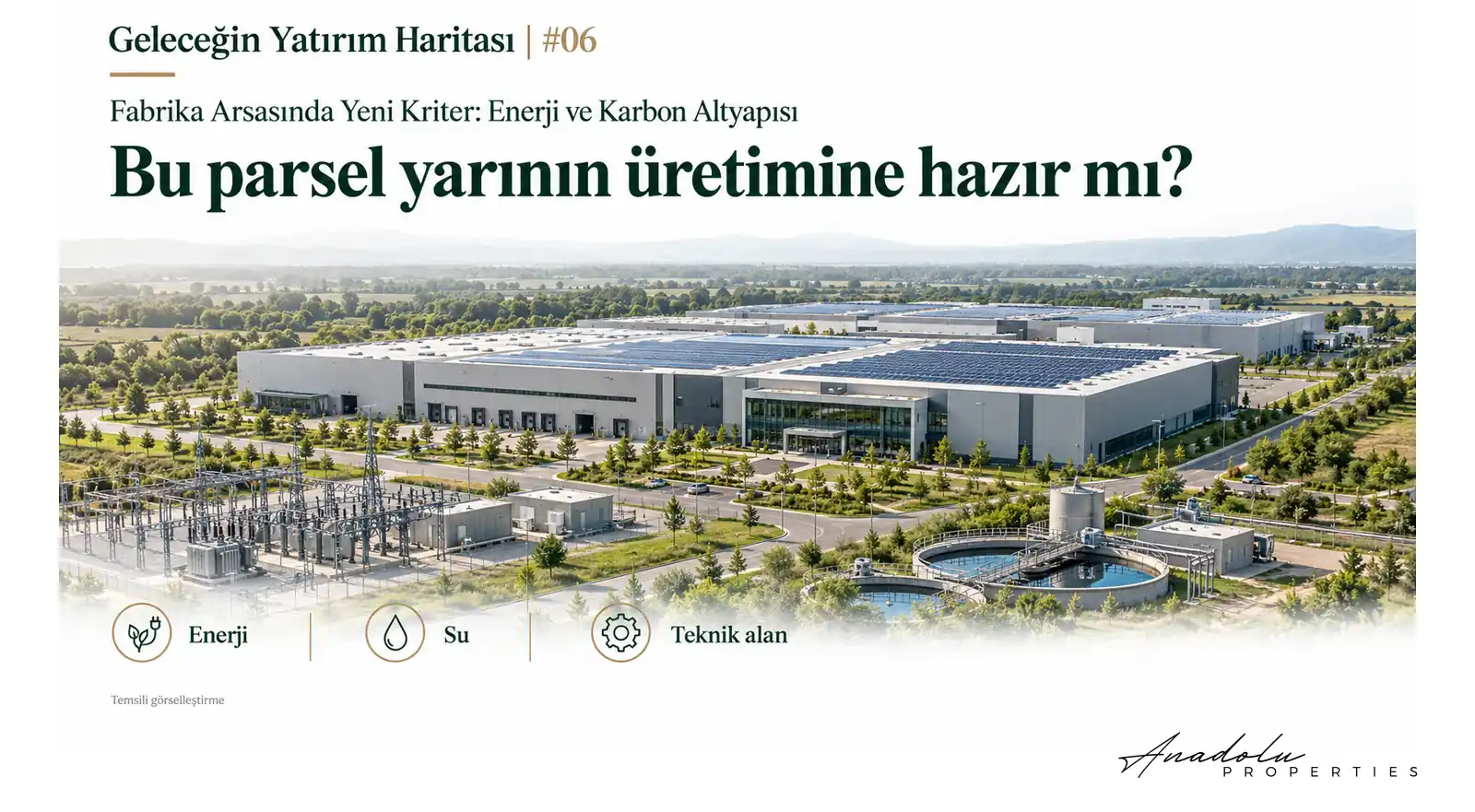
The Investment Map of the Future | #06 A NEW CRITERION FOR FACTORY SITES: ENERGY AND CARBON INFRASTRUCTURE
Industrial Land Buyers’ Needs Are Changing
A factory’s land requirement is not simply a matter of square metres on which a building can be constructed. The plot provides the physical and infrastructural foundation for the production system. While planning, energy, water, logistics and labour conditions remain important, the requirements of low-carbon production are also becoming part of this assessment.
Producers may need to assess access to renewable electricity, energy and water efficiency, waste management and carbon reduction together. Depending on the sector and technology, different infrastructure requirements, such as hydrogen or carbon capture, may also arise. Not every technology is suitable for every facility.
At Anadolu Properties, we therefore consider it insufficient to assess industrial real estate solely in terms of land and buildings. The scope of analysis is broadening: land, energy, water, logistics, environmental infrastructure and the investment’s ability to be prepared for financing should be considered together.
What Is TIDIP, and What Stage Has It Reached?
The Türkiye Industrial Decarbonisation Investment Platform (TIDIP) brings together the Ministry of Industry and Technology and international financing partners. EBRD records date the platform’s joint declaration to 25 November 2024. A news item published on the platform’s official website on 15 September 2026 states that the first meeting marking its operational launch took place on 22 April 2026. The publication date should therefore not be confused with the initiative’s start date.
Source: EBRD — TIDIP Secretariat, 24 September 2025
Source: TIDIP — Opening meeting on 22 April 2026; news published on 15 September 2026
The first Industry Workshop open to the public was held in Istanbul on 17 September 2026. This process shows that investment needs, technical assistance and financing sources are being addressed through a common platform. TIDIP is not a real estate allocation programme; it does not provide automatic loans to every factory or deliver appreciation in a particular region.
Source: TIDIP — Industry Workshop, 17 September 2026
Distinguishing Financing Targets from Realised Investment
The platform’s initial priority sectors are steel, cement, aluminium and fertilisers. Its investment focus areas include hydrogen, carbon capture, energy efficiency, renewable electricity and climate technologies. These areas should be assessed according to facilities’ transformation needs.
Source: TIDIP — Platform operation, sectors and investment focus areas
TIDIP’s official introduction dated 15 September 2026 sets targets of mobilising US$5 billion in financing by 2030 and reducing annual carbon emissions by more than 20 million tonnes. These are not realised investments or verified emissions reductions. Since EBRD’s founding and secretariat documents also express the financing scale in euros, the dollar amount used here is specifically attributed to the TIDIP announcement cited.
Source: TIDIP — Financing and emissions reduction targets, 15 September 2026
From a real estate perspective, what matters is which transformation project at which facility the announced financing translates into. Carbon reduction at a steel, cement, aluminium or fertiliser plant may require more than replacing machinery. Additional electrical capacity, a renewable energy connection, storage, water and waste infrastructure, technical plant space or different safety conditions may be needed. Not every factory site can meet these needs to the same extent.
As Industrial Areas Expand, Infrastructure Needs Also Change
The Industrial Areas Master Plan announced by the Ministry of Industry and Technology envisages increasing planned industrial areas from approximately 160,000 to 350,000 hectares and distributing production more evenly across Anatolia. The 350,000 hectares refers to the planned scale, not to completed areas already available for use.
Source: Ministry of Industry and Technology — Industrial Areas Master Plan announcement
Allocation and preliminary allocation notices for organised industrial zones (OSBs) were also published through the digital application system in September 2026. The relevant OSB notices gave an application period of 7–27 September 2026; as that period has now closed, current application and plot availability must be checked separately. An allocation notice does not mean that all infrastructure has been completed.
Source: Demirağ OSB — September 2026 preliminary allocation notice and Ministry link
Two processes are therefore moving forward together: planning new industrial areas and transforming existing production towards low-carbon systems. This is the intersection to monitor within The Investment Map of the Future.
Room for Transformation in New Facilities and Existing Factories
When a new facility is designed, its energy system, solar power where roof and site conditions are suitable, water reuse, electrical capacity and waste management can be planned together from the outset. In existing factories, however, site coverage, limited transformer capacity, an unsuitable roof, a shortage of additional technical space or inadequate OSB infrastructure may constrain transformation.
The properties of two factories in the same sector may therefore have different abilities to transform. That difference need not be visible in today’s price lists. For us, it is an indicator that first requires technical investigation, followed by monitoring of its effects on use and costs.
The Kütahya Example: From Production Building to Production Campus
The NG Kütahya 30 Ağustos Ceramics Factory, opened on 29 August 2026, provides a concrete example of this approach. The Ministry’s announcement states that the facility, on a site of 235,000 square metres, was designed with full automation, a zero-waste approach and heat recovery systems. A further 15 MW solar investment is also planned, with the aim of increasing the company’s total solar power capacity to 47 MW. The planned energy investment should not be read as commissioned capacity.
Source: Ministry of Industry and Technology — NG Kütahya factory opening, 29 August 2026
Ceramics is not one of TIDIP’s four initial priority sectors, and this example is not presented as an investment financed under TIDIP. The broader trend it illustrates is that a factory can be designed as a campus integrating energy, heat recovery, waste management and digital production. In such a system, the characteristics of the plot also become important.
Transformation Capacity: A New Perspective on Industrial Plots
Transformation Capacity is an industrial property’s physical and infrastructural ability to accommodate future energy, environmental, technological and logistics investments while maintaining its existing production function.
We propose this concept as an analytical framework; we do not use it as an established valuation standard or a calculated price premium. Having industrial zoning may not be the same as being adaptable to future production needs. Electricity and water capacity, renewable energy integration, room for expansion, logistics access and environmental infrastructure can give similarly sized plots different economic profiles.
How Can Transformation Capacity Be Examined Across Six Areas?
1. Energy Capacity
What is the existing electrical capacity, can it be increased, and under what technical conditions is renewable energy integration possible? Existing and planned capacity should be examined separately.
2. Physical Expansion Capacity
How much of the plot is in use? Is there space for new technical plant, storage or a production unit? Whether the intended use is feasible matters as much as the availability of vacant space.
3. Water and Environmental Infrastructure
What is the condition of wastewater, water reuse, water efficiency and waste management infrastructure? What additional demands could new production or transformation investment place on these systems?
4. Logistics Connectivity
What is access to railways, ports, motorways and logistics centres like? It is necessary to examine whether proximity on a map translates into a connection that the producer can actually use.
5. Technological Adaptability
Can infrastructure be developed for automation, energy monitoring and new production technologies? To what extent does the existing facility layout allow these changes?
6. Readiness for Financing
Can the planned transformation be developed into an investment project that can be technically measured and submitted for financing assessment? Such preparation does not constitute financing approval.
These areas do not carry the same weight in every sector. Steel and textile facilities may have different needs. Transformation Capacity should be treated as an assessment weighted by sector and facility, rather than as a single score applied to everyone.
The Connection Between Financing and Real Estate
One of TIDIP’s aims is to turn transformation needs into investment projects with technical support and connect them with suitable financing institutions. The physical characteristics of a property may be one of the prerequisites for this preparation.
Consider two factories in the same sector: one plot can accommodate transformation investment, while the other cannot. A project suitable for financing assessment may be prepared for the first facility, while the second may first need to resolve a site layout or infrastructure issue. The question is therefore not only whether the factory can produce today, but whether it can also accommodate tomorrow’s investment.
Anadolu Properties’ Perspective: Monitoring Industry’s Changing Site Requirements
We do not conclude from this that land in green OSBs will appreciate. It is too early for such a generalisation. The change we see is the addition of questions about energy transition, water management, carbon reduction, expansion, technology and financing readiness to the conventional examination of location, zoning, electricity and roads.
In the period ahead, we will monitor OSBs’ energy capacity, shared renewable energy systems, wastewater reuse and new connections. The sectors and regions where investments are actually financed under TIDIP, the infrastructure with which new factories are built and the locations where existing facilities expand will also form part of this assessment.
A strong real estate indicator is not merely a policy or financing announcement. It is manufacturers beginning to demand different land characteristics when choosing sites, and that demand being reflected in actual investments. For readers assessing investments in Türkiye remotely, it is important to verify this distinction through plot documentation, infrastructure information and field data.
A Plot That Makes Room for Tomorrow’s Production
If the expansion of planned industrial areas and the transition to low-carbon production advance together, the criteria for assessing industrial real estate may also change. Alongside accommodating a factory and providing road and electricity connections, a suitable industrial plot may enable changes to its energy system, water management, space for new technology and logistics connectivity.
The future value of industrial land may be assessed not only by what can be produced on it today, but also by the production system to which it can be adapted tomorrow.
This study is intended for general information and research. Announced financing, emissions reduction and industrial area figures, along with planned solar capacity, should not be confused with realised results. Energy and environmental infrastructure do not guarantee appreciation. Each property should be examined separately in terms of planning, ownership, energy capacity, environmental obligations, water, logistics, sector demand, investment costs and liquidity.
Mustafa Yılmaz
CEO – Anadolu Properties
Europe–Türkiye Investment Bridge