Türkiye’s New Axes | #11 TRANSPORT AND REAL ESTATE TRANSFORMATION ALONG THE KURTALAN SİİRT PERVARİ AXIS
Siirt’s Role in the Transport Network Could Change
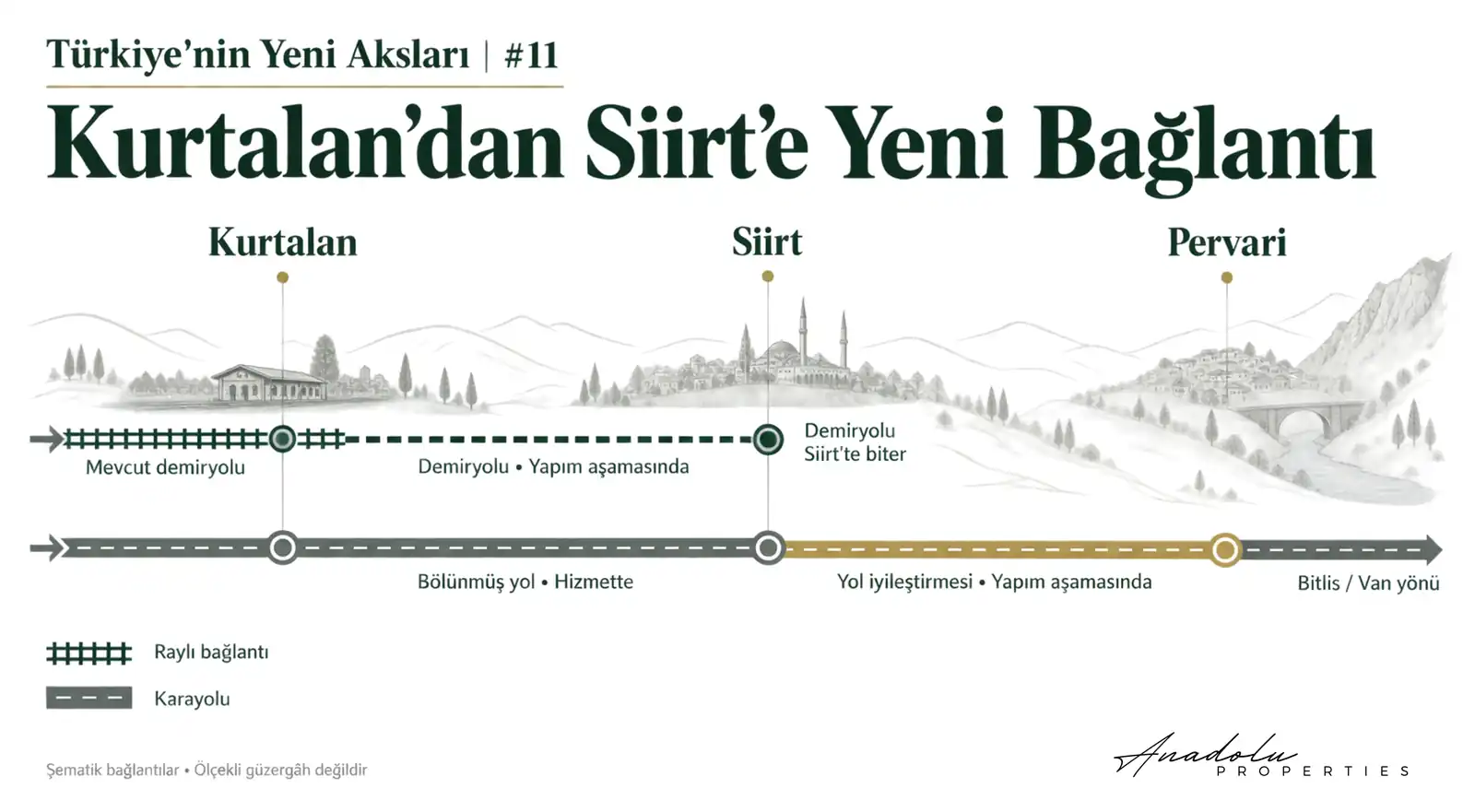
Rail, road and airport investments are progressing together along the Kurtalan–Siirt–Pervari axis. Their significance for the regional economy and real estate lies not only in making Siirt easier to reach, but also in the functions the city could assume within a wider network.
Viewing the Siirt–Kurtalan Railway merely as 34 kilometres of new track overlooks this relationship. Kurtalan is one of the endpoints of the existing railway network. As the new project extends the line to Siirt’s provincial capital, it aims to establish new connections between the airport, university, city centre and road network.
Our question is therefore not simply “When will trains reach Siirt?” Where will passenger and freight flows converge, where will transfers take place, and which services will see demand? Assessing meaningful change in real estate requires monitoring how these questions play out on the ground.
Current Status of the Siirt Kurtalan Railway
Included in the 2025 Investment Programme, the Siirt–Kurtalan Railway was designed as an extension of the Yolçatı–Diyarbakır–Kurtalan line. According to the Ministry’s statement of 23 September 2026, construction is ongoing and overall physical progress exceeds 30 per cent. Although the project has moved beyond the planning stage, it is not yet operational. Sources: Ministry of Transport and Infrastructure (UAB), 2025 project information. UAB, site update of 23 September 2026.
The 34-kilometre line is being built for a design speed of 160 kilometres per hour. It will have three stations: Yeni Kurtalan, Airport–University and Siirt. The design speed does not describe a train service available today or the operating speed of every journey.
The Ministry presents the project as making Siirt the 47th province directly connected to the railway network. The geographical distinction matters here: Kurtalan already provides an existing rail connection within Siirt province. The new investment aims to connect Siirt’s provincial capital directly to the national network for the first time.
The route’s geography requires substantial engineering structures. The official statement lists eight tunnels totalling approximately 18 kilometres, five cut-and-cover tunnels totalling 695 metres, and two viaducts totalling 590 metres. With tunnels accounting for roughly half the line, their completion also needs to be monitored when assessing construction progress.
The announced annual figures of approximately 370,000 tonnes of freight and 500,000 passengers are forecasts of transport potential with a 2030 horizon. They should not be read as freight and passenger volumes already achieved today.
The Pervari Connection Completes the System Beyond the Railway
Pervari, east of Siirt, is important for road connections towards Bitlis and Van. The Küçüksu–Hizan–Pervari Road and Beğendik Botan Bridge were previously opened, strengthening this access. The Ministry’s statement of 23 September 2026 reports that approximately 2 million vehicles have crossed the bridge since it opened. Source: UAB, Beğendik Bridge and regional connections.
The road standard on the Siirt–Pervari section is now being upgraded. The site update issued on the same date describes the new route as approximately 81 kilometres long. Around 17 kilometres were built earlier because of the Alkumru Dam; work continues on two sections of approximately 32 kilometres each, on the Siirt and Pervari sides.
By shortening the existing route of approximately 88 kilometres, the Ministry aims to reduce the journey from around two hours to one hour. The 88 kilometres in the statement refer to the existing road, while 81 kilometres refer to the new route. The one-hour journey is a target for after completion, not today’s travel condition. Source: UAB, Siirt–Pervari Road site update, 23 September 2026.
We therefore consider the wider system as Kurtalan–Siirt–Pervari together with the onward connections towards Bitlis and Van. However, transport modes must not be confused: the new railway is being built as far as Siirt; the connection discussed in this analysis for Pervari and beyond is by road. It would be incorrect to portray the Siirt–Kurtalan project as a railway extending to Van.
Considering Rail Road and Airport Connections Together
The road connection west of Siirt has also been upgraded. According to the Ministry’s statement of 21 April 2025, the Siirt–Kurtalan Road and Airport Link Road opened to traffic. The total project length of 21.2 kilometres includes the Reşat Baysal realignment and the 3-kilometre airport link. These lengths should not be added together to produce a different total. Source: UAB, Siirt–Kurtalan Road opening announcement.
At Siirt Airport, the renovated terminal was officially inaugurated on 23 September 2026; the airport had reopened to flights on 12 September. The terminal area was approximately tripled, while annual passenger capacity increased from 100,000 to 250,000. An increase in capacity does not mean that actual passenger numbers have risen to the same extent. Source: UAB, Siirt Airport terminal statement.
The resulting picture comprises investments at different stages: the Kurtalan divided road and renovated airport terminal are in service, while work on the Siirt–Kurtalan Railway and Siirt–Pervari Road continues. From a real estate perspective, the question is how these components could bring passenger, freight and service flows together once completed.
The Economic Role of the Terminal Station in Kurtalan
As Kurtalan has long been one of the endpoints of the railway, part of its economic function can be associated with activity around the terminal station. Extending the line to Siirt could change Kurtalan’s role within this system.
Some activities may shift to the new station; others may benefit from increased traffic along the line. It is therefore not possible to determine the positive or negative outcomes of this transformation with certainty today. For Kurtalan, we first need to understand which functions are relocating.
Where is storage activity emerging? Where is freight handled—that is, loaded, unloaded and transferred? At which station is commercial activity concentrated? Where does transfer between road and rail take place? Without answers to these questions, it would be unsound to identify any area as a certain winner in the real estate market.
A Potential Convergence of Flows at Airport University Station
Of the three planned stations, Airport–University Station stands out for its potential to bring different user groups into the same transport system. Relationships between airport passengers, students, employees and the city centre could change with the new rail connection.
This possibility does not automatically generate an increase in surrounding property values. The station’s economic impact can be understood through public transport integration, actual access to the airport and university, decisions on commercial uses, and the operation of daily passenger flows.
Factors to monitor include student and employee movements, new service areas, planning decisions around the station and the direction of urban development. The inclusion of the airport and university in the station’s name does not mean that all these connections are complete today or that they are located on the same land parcel.
The Real Economic Test in Freight Transport
Assessing the Siirt–Kurtalan line solely in terms of passenger transport would be incomplete. Siirt’s Organised Industrial Zone hosts production facilities in sectors including metals, food, machinery and ready-made garments. The Ministry also highlights Siirt’s zinc production infrastructure and aims for the new line to support the transport of industrial and agricultural products to the country’s production and consumption centres and onward to ports. Sources: UAB, Siirt’s production and logistics connection. UAB, 2025 assessment of industry and rail.
From our perspective, the economic test will begin with whether freight actually shifts to rail once the line enters service. Are industrial facilities changing their logistics choices? Are new storage areas emerging? Are there measurable changes in production capacity and transport costs? These indicators can test how the announced transport potential translates into the local economy.
A new railway line does not make every surrounding plot suitable for logistics use. Freight access to the station, transfer facilities and actual demand from businesses must be assessed alongside the conditions governing the property’s use.
What Transport Endpoint Transformation Means
In this article, we use “transport endpoint transformation” to describe how a location that has long been the endpoint of a transport network begins to acquire transit, transfer or distribution functions within a wider system through new connections. This is neither a finding that a transformation has already occurred nor a measured model of price increases; it is a conceptual framework used in our analysis.
We follow the framework through four stages: endpoint, new connection, a change in the direction of flows, and a new function. Building a road or railway to a location does not mean that the subsequent stages will occur automatically. If economic activity does not change, the way real estate is used may not change either.
In Kurtalan, this framework can be applied to the role of the existing railway endpoint; in Siirt, to the convergence of different transport modes; and in Pervari, to road access to a wider region. Siirt becoming the new railway endpoint and becoming a functioning distribution centre between different transport modes are separate processes.
Monitoring the Corridor Through Three Distinct Functions
Kurtalan as the Western Gateway
In Kurtalan, we will monitor how the economy around the existing station changes with the new line. Where storage, freight operations and road–rail transfers concentrate will help us understand the economic role of this part of the corridor.
Siirt as the Central Connection Point
In Siirt, we will examine the actual integration of the railway, airport, university and city centre. Planning decisions around the station need to be assessed together with passenger demand and demand for services.
Pervari as the Eastern Connection
In Pervari, we will monitor how access towards Bitlis and Van changes as the road standard improves. The extent to which journey-time targets translate into actual journeys and commercial activity will reveal this connection’s economic impact.
Investment Indicators from the Anadolu Properties Perspective
At Anadolu Properties, we do not assess the progress of transport projects along this axis separately from the economic behaviour around them. Siirt’s position within the network may change; actual activity will show whether that produces a meaningful effect in the real estate market.
After operations begin, we will monitor rail freight volumes, new industrial investments, occupancy and expansion in the Organised Industrial Zone, airport passenger traffic and planning decisions around stations. Investments in storage and logistics facilities, trade towards Pervari and actual transaction volumes in the property market will complete the assessment.
Research into land and commercial real estate must separately examine zoning, land registry and ownership, agricultural and conservation status, expropriation, topography, infrastructure, actual demand and liquidity for each property. Proximity on a map is no substitute for these checks.
A meaningful investment signal is a change in the behaviour of people, freight and capital around the new line. Alongside “Where does the new road run?”, we therefore also need to ask “Where do flows originate, where do they converge, and where do they continue?”
From an Endpoint to the Start of a New Connection
The Kurtalan–Siirt–Pervari axis illustrates how different transport systems can complement one another. The railway extension from Kurtalan heads towards Siirt’s provincial capital with the aim of providing access to the airport and university. The Pervari road connection being developed to the east could strengthen access to the existing system towards Bitlis and Van.
When these investments are complete, the decisive question will go beyond whether trains have reached Siirt: has the city become a functioning connection point where different passenger and freight flows converge? The answer will emerge from how local production, services and trade use the transport facilities.
A new axis can sometimes mean more than a new line on a map. It can turn the endpoint of one line into the beginning of the next connection. Understanding the lasting impact on real estate requires testing this possibility against economic activity on the ground.
This article is intended for general information and research. Project targets do not represent achieved results; proximity to transport investments or stations does not guarantee appreciation or investment returns for any property.
Mustafa Yılmaz
CEO – Anadolu Properties
Europe–Türkiye Investment Bridge