TÜRKİYE ACTIVE FAULT MAP: RISK ANALYSIS WILL BE THE CRITICAL DATA POINT OF THE NEW ERA IN REAL ESTATE
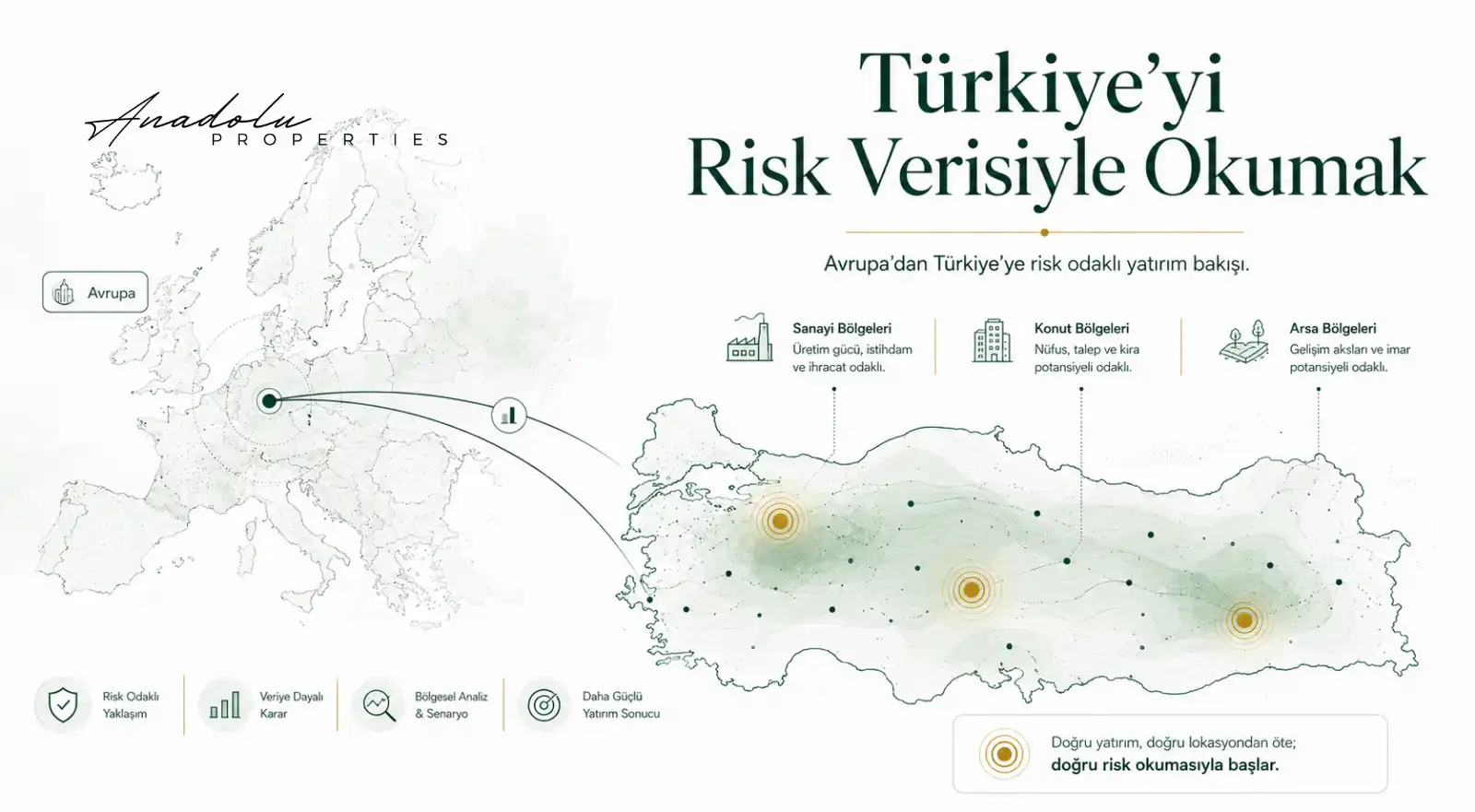
A New Measure of Value in Real Estate: Risk Becoming Visible
MTA’s Active Fault Map of Türkiye should not be seen merely as a technical subject concerning the field of geology. This map is becoming one of Türkiye’s most critical data layers for disaster management, urban planning, energy investments, industrial facility locations, and real estate valuation.
Until now, real estate investment decisions were often shaped first by questions such as: Is the region developing? Is the price attractive? Is there zoning? What could the rental return be? In the new era, a much stronger control point is being added to these questions: What is the ground and disaster risk of this investment?
In a country such as Türkiye, located on an earthquake belt, value cannot be measured by square meters alone. Two plots of the same size, two buildings in the same location, or two commercial properties with similar rental yields may have completely different risk profiles due to ground structure, distance to active fault lines, liquefaction risk, building quality, and infrastructure resilience.
What Does the Active Fault Map Mean for the Market?
The fact that active fault data is becoming more visible does not mean that Türkiye has suddenly become more exposed to earthquake risk. Its real meaning is this: risk is now becoming more visible, more measurable, and more open to detailed discussion. Risk that becomes visible to markets is eventually reflected in pricing and investor behavior.
For this reason, the real estate sector must change its perspective. An investor cannot decide solely because “this land is cheap.” A developer cannot produce a project only because “there is demand here.” An industrial investor cannot select a factory location merely because “it is logistically convenient.” Earthquake risk should not be a technical appendix at the end of feasibility work; it should be one of the primary control items at the beginning of the investment decision.
Global Examples: Disaster Data Is Part of Valuation
In developed markets, disaster data is not merely technical information used by public institutions. In California, active fault zones are directly considered in construction decisions. In Japan, disaster maps sit at the center of urban planning. In New Zealand, after the Christchurch earthquake, ground damage and liquefaction risk permanently affected property values and the insurance system in certain areas.
These examples point to the same conclusion: when disaster risk becomes visible, the real estate market begins to price not only current demand, but also future resilience and cost scenarios.
Why Should Risk Perception Be Read More Rigorously in Türkiye?
The 1999 Marmara Earthquake, the 2020 İzmir Earthquake, and the February 6, 2023 Kahramanmaraş-centered earthquakes all showed the same reality in Türkiye: weak ground, faulty construction, and unplanned growth create major losses not only in terms of life safety, but also in economic value.
Therefore, risk analysis is no longer a note left inside technical reports. It is a direct decision variable for homebuyers, land investors, industrial facility developers, warehouse investors, and institutions planning energy infrastructure.
How Is Earthquake Risk Priced in Real Estate?
In the real estate market, earthquake risk is priced through two main channels. The first is direct value pressure. Risky ground, old building stock, unclear licensing history, or proximity to active fault zones may reduce investor demand and change negotiating power.
The second is the value premium that may emerge in safer areas. Solid ground, buildings compliant with current regulations, lower disaster risk, strong infrastructure, and orderly urban planning can now be considered among the factors supporting higher prices.
For this reason, we are likely to discuss the concept of a “solid-ground premium” more often in the coming period. Just as sea views, metro proximity, port access, or proximity to an organized industrial zone can create value, low disaster risk, safe building stock, and proper engineering can also become a separate value component in real estate.
New Control Points in Residential, Land, and Commercial Real Estate
In residential investment, active fault and earthquake hazard data can make buyer behavior more conscious. Projects that comply with new regulations, have strong geotechnical studies, and are located in lower-risk areas may attract stronger demand based on trust. By contrast, pricing may become more selective in areas with dense old building stock, ground problems, or a high need for urban transformation.
Attention must be even greater in land and field investments. A property’s potential to be opened for future zoning should be assessed together with its disaster risk. Carrying a zoning expectation in an area with a fault zone, landslide risk, liquefaction potential, or high groundwater level can become a serious investment trap if proper analysis is not carried out.
In commercial real estate, risk pricing becomes more visible. In large-scale structures such as warehouses, shopping centers, hotels, factories, hospitals, and energy facilities, disaster risk affects not only property value, but also business continuity, insurance costs, and reconstruction costs.
Strategic Reading for Industrial, Logistics, and Energy Investments
Ground and earthquake risk is an even more sensitive issue in industrial investments. Building a factory on unsuitable ground affects not only building safety, but also production continuity, the supply chain, employee safety, insurance costs, and financing conditions. For this reason, the active fault map must be included in the decision process for organized industrial zones, logistics centers, warehouses, and production facility investments.
Geological data also has strategic importance for energy investments. Geothermal energy, oil and natural gas exploration, mining investments, dams, energy transmission lines, and critical infrastructure facilities are directly related to fault systems and ground conditions. In an energy investment, not only resource potential but also geological risk and operational safety must be analyzed.
Being Far from a Fault Line Does Not Mean Safety on Its Own
One of the most common misconceptions among investors is reading earthquake risk only through distance from a fault line. However, being far from a fault line does not mean being safe on its own. Ground amplification, liquefaction, landslide risk, filled ground, groundwater level, topography, building age, and engineering quality are at least as important as distance to the fault line.
For this reason, earthquake risk must be analyzed as a multilayered subject, not a single-layer metric. A sound investment assessment is not possible unless MTA active fault data, AFAD earthquake hazard data, municipal ground reports, parcel-based geological-geotechnical studies, building permits, damage records, and construction inspection history are read together.
Regional Differentiation May Become More Apparent
In Türkiye, investment decisions require more disciplined analysis especially in regions such as Istanbul, Bursa, Kocaeli, İzmir, Balıkesir, Çanakkale, Eskişehir, Hatay, Kahramanmaraş, Malatya, Erzincan, and Van. Not every area in these cities is risky; but the risk is not the same in every area either. Differentiation by neighborhood, ground conditions, building stock, infrastructure, and planning quality is inevitable.
This differentiation can make not only risky areas, but also correctly planned regions with safer ground characteristics more visible. Areas with solid ground, newer building stock, strong infrastructure capacity, and planned development may gain a higher perception of trust among investors.
Practical Control List for Investors
Active fault and earthquake risk data should not be treated as tools that determine investment decisions on their own, but as core components of professional valuation and technical due diligence. The main control points for investors are as follows:
- When making an investment decision, title deed and zoning information should not be the only data reviewed; MTA active fault data, AFAD earthquake hazard data, municipal ground reports, and parcel-based geological-geotechnical studies should be examined together.
- When buying a building, the building age, license date, construction inspection process, and the earthquake regulation period under which it was built should be checked.
- In land investments, ground class, liquefaction risk, groundwater level, topography, and zoning plan decisions should be evaluated together with proximity to fault lines.
- In industrial and logistics investments, earthquake risk should be calculated not only in terms of building safety, but also production continuity, insurance costs, financing conditions, and supply chain resilience.
- If an investment is to be made in a risky area, risk discount, transformation potential, strengthening cost, and redevelopment scenarios should be included in the price analysis.
- Lower-risk and solid-ground areas should be prioritized not only for safety, but also for their long-term value preservation capacity.
Cheap Does Not Always Mean Opportunity
This development also carries an important message for Anadolu Properties. In real estate, cheapness does not always mean opportunity. Sometimes a low price is the market’s silent pricing of a risk that is unseen or insufficiently analyzed.
A real investor reads not only the price, but also the reason behind the price. An investment remains incomplete without understanding why a property is cheap, why it is being sold quickly, why demand has weakened in a certain region, or why some projects carry a higher trust premium.
Reading the Value Beneath the Risk Correctly
MTA’s Active Fault Map of Türkiye may open the door to a more transparent and data-driven period in real estate investment. Transparency may create price pressure in some regions at first; however, in the long term, it can contribute to a healthier, safer, and more rational market.
In the new era, the right investment is not only the investment that generates returns. The right investment is one whose risk has been measured, whose ground has been read, whose structure has been questioned, whose infrastructure has been evaluated, and whose resilience against the future has been analyzed.
Therefore, the winning investor will not be the one who only asks, “Where is it cheap?” The real question is this: What risk, what ground, and what future scenario lie beneath this value?
Mustafa Yılmaz
CEO – Anadolu Properties
Europe – Türkiye Investment Bridge