NON-RESIDENTS’ INTEREST IN TURKISH ASSETS: FINANCIAL CONFIDENCE SIGNALS AND THE REAL ESTATE PERSPECTIVE
WHY ARE INTERNATIONAL CAPITAL FLOWS IMPORTANT?
International investors’ decisions are not merely technical movements concerning the financial sector. Which countries global capital flows into, with what maturity and through which asset classes provides important clues about confidence in the economy, risk perception and expectations for the future.
For this reason, non-residents’ transactions in Türkiye’s financial markets do not directly determine the real estate market, but they are among the macroeconomic indicators that should be monitored in order to understand the general direction of the investment climate. The main issue is not to draw firm conclusions from a single week’s data, but to assess the direction, continuity and asset-class concentration of capital flows together.
WHAT DO TCMB DATA SAY?
According to the TCMB data for the relevant week, non-resident investors made net purchases in Türkiye’s financial markets. The distribution of purchases was announced as follows:
| EQUITIES
USD 11.5 million |
GOVERNMENT DOMESTIC DEBT SECURITIES (DİBS)
USD 572 million |
PRIVATE SECTOR BONDS
USD 441.1 million |
The distribution for the relevant week shows that foreign investor interest was more pronounced in fixed-income debt instruments than in equities. This may be interpreted as a positive signal that risk appetite toward Turkish assets has increased; however, a single week of net purchases is not, by itself, proof of permanent or structural confidence. The meaning of the data becomes clearer when it is considered together with continuity, maturity preference, interest-rate expectations, exchange-rate risk and other economic indicators.
FINANCIAL INVESTMENT AND REAL ESTATE INVESTMENT ARE NOT THE SAME THING
Foreign capital directed toward financial markets and real estate investment are driven by different dynamics. Equities and debt instruments may have higher liquidity; investors’ entry and exit decisions can change rapidly depending on interest rates, exchange rates, returns and short-term expectations.
Real estate, by contrast, is assessed through asset-specific factors such as location, zoning status, ownership structure, regional demand, intended use, financing conditions and marketability. Therefore, foreign portfolio inflows do not mean that real estate prices will automatically rise. However, the confidence outlook in financial markets may indirectly affect the surrounding conditions of the real estate market through general investment perception, access to financing, the cost of capital and economic expectations.
HOW DO NON-RESIDENTS EVALUATE TÜRKİYE?
International investors do not evaluate Türkiye solely through housing, land or commercial real estate prices. Investment decisions are shaped through a broader data set:
- Inflation and interest-rate outlook: Affects real return expectations and the cost of financing.
- Exchange rate and volatility: Important for returns in foreign-currency terms and for capital preservation.
- Financial market liquidity: One of the key factors determining the ability to enter and exit investments.
- Predictability of economic policies: Affects medium- and long-term risk assessment.
- Asset-specific risk–return balance: Requires each investment instrument to be assessed within its own maturity, legal structure and market conditions.
The same discipline applies to Turkish investors living abroad. Social and economic ties with Türkiye may strengthen investment motivation; however, exchange-rate differences or past price movements alone are not sufficient investment reasons. A sound decision requires the macroeconomic outlook and the technical, legal and commercial qualities of the real estate asset to be analyzed together.
HOW SHOULD INTEREST IN DİBS AND PRIVATE SECTOR BONDS BE READ?
Government domestic debt securities and private sector bonds are assessed through a specific maturity and return structure. The concentration of foreign purchases in these instruments during the relevant week shows that fixed-income assets came to the fore more than equities.
However, this interest should not be read as a one-directional and definitive judgment about the future of the economy. Investor preferences may be shaped by a combination of many factors, including yield levels, maturity, liquidity, exchange-rate risk, monetary policy expectations and the need for portfolio diversification. Therefore, the important point is not only that foreign capital comes to Türkiye, but which instrument it flows into, for what duration and with what risk expectation.
HOW SHOULD A REAL ESTATE INVESTOR READ THIS DATA?
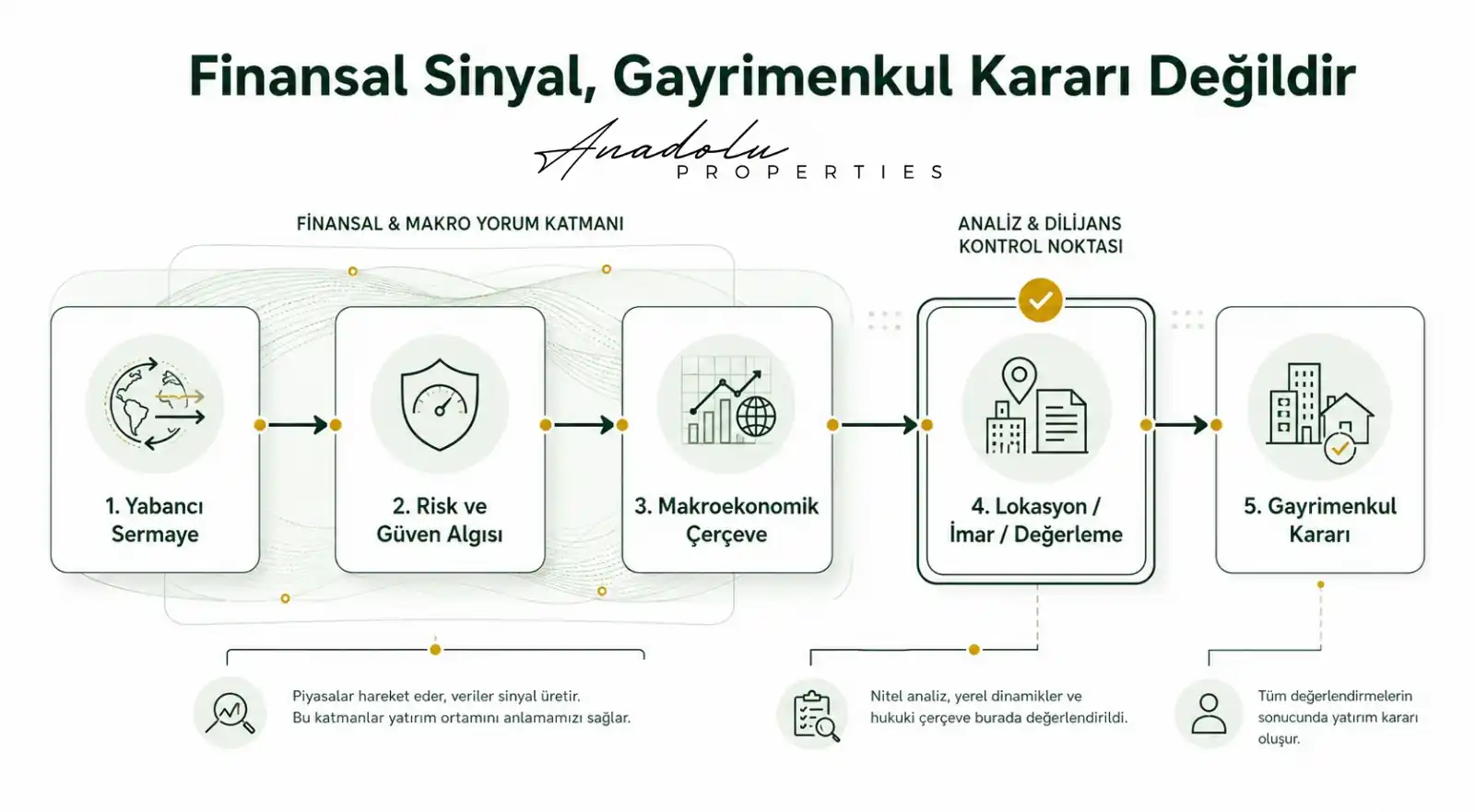
Foreign investment movements in financial markets are not a direct purchase or price signal for real estate investors. These data should be used as an analytical layer that helps explain how the investment environment in Türkiye is perceived.
- Do not use the data alone as a price indicator. No automatic relationship can be established between portfolio inflows and the value of housing, land or commercial real estate in a specific city.
- Look at the continuity of the trend, not a single week. For a durable investment perception, the time-distributed direction of capital flows and their asset-class distribution should be monitored together.
- Combine macro data with asset analysis. Location, zoning status, title-deed records, market comparisons, use potential and valuation reports should be at the center of the decision.
- Calculate exchange-rate and liquidity risk. For those investing in foreign-currency terms, not only the exchange-rate advantage at the time of purchase but also the exit scenario and sale period should be assessed.
ANADOLU PROPERTIES PERSPECTIVE: FROM MACRO DATA TO ASSET ANALYSIS
In discussions with investors living abroad, not only real estate prices but also the general outlook of the Turkish economy is evaluated. Interest rates, inflation, the exchange rate, foreign interest in financial markets and capital flows form the external framework in which the investment decision is made.
Nevertheless, the quality of the asset to be acquired should always remain at the center of the decision. In the Anadolu Properties approach, macroeconomic indicators are considered together with official data, location analysis, zoning and title-deed checks, comparable market assessments and valuation studies. The aim is not to direct the investor based on a single headline or a single price figure, but to build a data-driven decision process that makes risks and potential visible within the same framework.
INTERPRETING THE CONFIDENCE SIGNAL CORRECTLY
The net purchases by non-resident investors in equities, government domestic debt securities and private sector bonds are a noteworthy development for monitoring international interest in Turkish assets. However, this data alone does not explain the direction of the real estate market and is not sufficient for an investment decision.
The real meaning emerges in the continuity of capital inflows, the nature of the preferred instruments and their relationship with macroeconomic indicators. For real estate investors, the correct approach is neither to ignore financial-market signals nor to convert them directly into price expectations, but to make them part of a broader investment analysis read together with location, zoning, valuation, demand and liquidity data.
Mustafa Yılmaz
CEO – Anadolu Properties
Europe–Türkiye Investment Bridge