HAZELNUT EXPORTS OF 5,981 TONS FROM DÜZCE TO EUROPE: ARE AGRICULTURAL LANDS THE PRODUCTION CAPITAL OF THE FUTURE?
How Are Düzce Hazelnut Exports Redefining the Value of Agricultural Land?
In a report dated July 8, 2026, Anadolu Agency stated, based on data from the Düzce Provincial Directorate of Agriculture and Forestry, that 5,981 tons of shelled hazelnuts were sold to European Union countries in the January-June period of 2026. This figure is a current regional indicator that makes Düzce’s position in the agricultural production and foreign trade chain more visible.
At first glance, the issue may appear to be simply an export success. Yet from the perspective of real estate and land investment, the real issue is the production ecosystem that makes this export possible: agricultural know-how, processing capacity, storage, logistics, quality control, and access to foreign markets. The ability of a region to regularly send products to international markets shows that land should be evaluated not only as a physical asset, but also as part of an economic system.
Nevertheless, export data does not directly lead to the conclusion that “every agricultural parcel in the region has high investment potential.” Although regional trade strength is an important signal, an investment decision must be made at parcel level by jointly examining title deed and cadastral status, soil quality, slope, water resources, access, existing crop pattern, maintenance needs, and operating economics.
Why Does Export Data Matter to Land Investors?
In land investment, the market price shows the visible value, while production capacity reveals the economic function of the asset. When a product such as hazelnuts, which is traded internationally, creates a production, processing, and export network in a specific region, agricultural lands can be treated not merely as real estate to be sold in the future, but as an asset class capable of generating income and added value.
This approach does not invalidate the question “what is the price per square meter?”; however, it makes that question insufficient on its own. In long-term investment analysis, alongside price, it is also necessary to assess what the land can produce, at what costs production can be sustained, and which markets the product can reach.
Agricultural Land Is Not Merely an Asset Waiting for Appreciation
In housing, office, or commercial real estate, value is mostly created through use, rent, and market demand. Agricultural land, however, also has biological production capacity. With the right crop, proper maintenance, and an appropriate operating model, land can become a direct input of economic activity.
While hazelnut production stands out in Düzce, different regions of Türkiye may create different production models with walnuts, olives, grapes, almonds, lavender, black cumin, and medicinal-aromatic plants. However, crop selection should not be based solely on market trends. Production assumptions made without considering climate, altitude, soil structure, water access, disease risk, labor needs, and sales channels may overstate the real potential of the land.
What Does Access to the European Union Market Indicate?
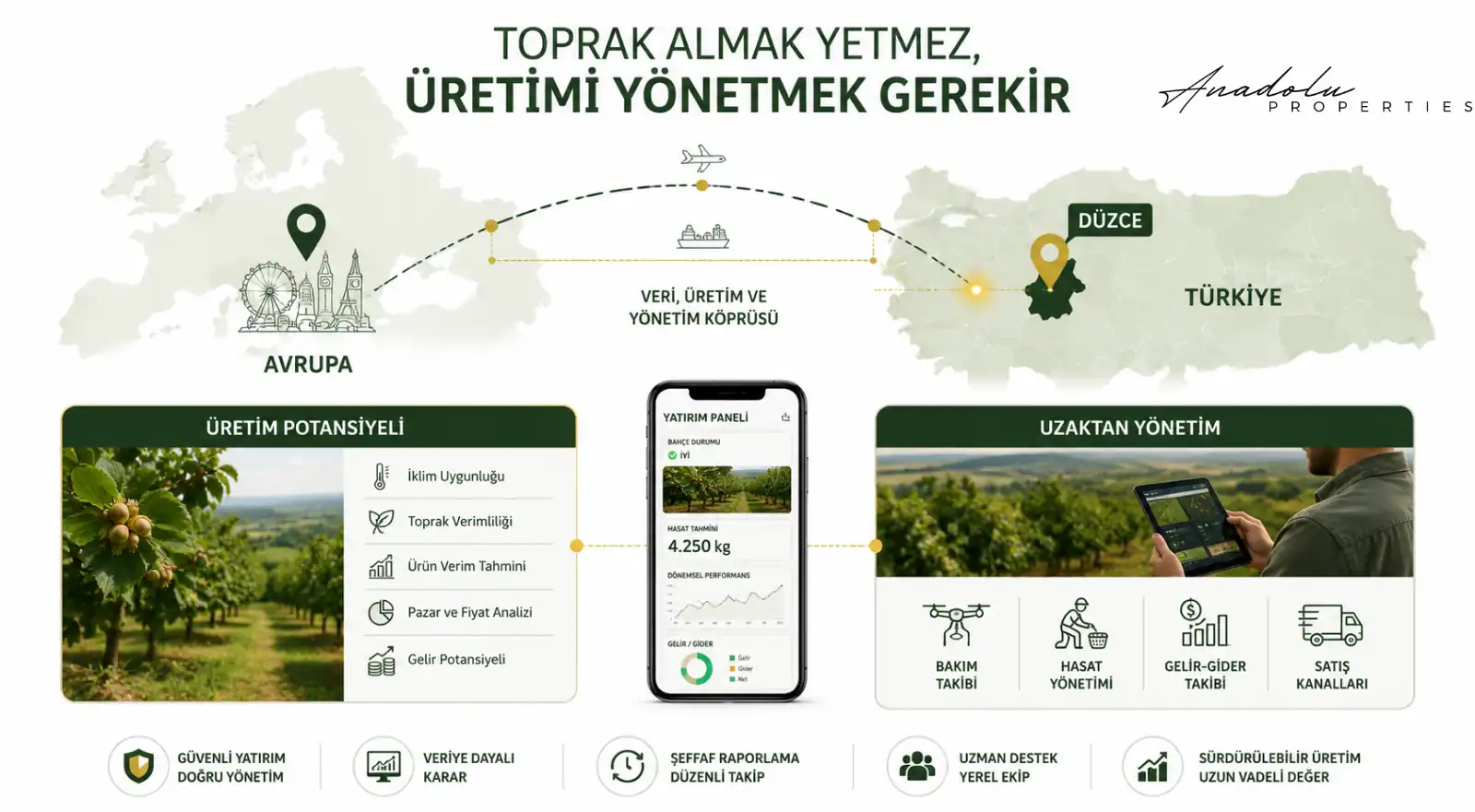
Regular exports to European Union countries require product standardization, analysis and quality processes, packaging, storage, logistics organization, and commercial connections. Therefore, shelled hazelnut exports from Düzce reflect not only the performance of producers, but also the region’s agricultural trade capability.
For a land investor, the important point here is not to convert the export figure directly into an expectation of price appreciation, but to understand the infrastructure that connects the region’s production to the market. Access to processing and storage facilities, main transport routes, buyer networks, and the marketability of the product are factors that affect the economic use of agricultural land.
How Does Production Power Affect the Regional Economy?
The hazelnut economy is not limited to production in the orchard. Harvesting, drying, sorting, processing, packaging, storage, transportation, and export processes form an interconnected value chain. This chain affects a broad economic environment, from producers and seasonal labor to agricultural machinery, logistics companies, storage areas, and export firms.
A strong production ecosystem can support rural employment and commercial activity. However, in land investment, relying solely on a regional growth narrative is not sufficient. Production sustainability must be addressed together with risks such as climate variability, input costs, diseases, yield fluctuations, and product prices.
A New Perspective for Turkish Investors Living Abroad
For Turkish investors living in Europe, buying land in Türkiye often comes to the agenda with the motivation of long-term value preservation or maintaining family ties. When an agricultural production perspective is added, the nature of the investment changes: land ceases to be an asset dependent only on expected appreciation and, under the right conditions, becomes an active capital element that requires a production plan, operating model, and marketing channel.
At this point, distance is a significant management risk. Before purchasing, an investor living abroad must answer the following questions: Who will manage the land, how will maintenance and harvesting be monitored, how will income and expense records be kept, and to whom and under what conditions will the product be sold? Manageability is as fundamental to the investment decision as production potential.
The Questions to Ask When Buying Land Are Changing
A professional land investment analysis must go beyond price comparison. The following headings help build a healthier investment decision:
- Title deed, cadastre, and use qualification: Is the legal status, boundaries, co-ownership structure, and agricultural use conditions of the parcel clear?
- Soil and climate compatibility: Are soil analysis, altitude, slope, frost risk, and microclimate suitable for the selected crop?
- Water and infrastructure access: Do irrigation possibilities, electricity, road access, and logistics connections support the production model?
- Existing orchard or crop pattern: Are the age, health, yield history, and maintenance needs of the trees known?
- Processing and sales channels: Can connections be established with storage, drying, processing facilities, cooperatives, or buyers?
- Operating model and cost: Have maintenance, labor, harvesting, insurance, and marketing expenses been calculated realistically?
- Risk scenario: How will the investment be managed in the event of yield decline, changes in product prices, or climate-related losses?
Each of these questions aims to understand whether a land parcel is functional and sustainable before determining whether it is “cheap” or “expensive.” When necessary, verification should be carried out through title deed, cadastre, municipality, Agriculture and Forestry directorates, and relevant official institutional records.
Anadolu Properties Perspective: Reading Value Beyond Price
The real potential of agricultural land can be understood by jointly evaluating not only price, location, and legal status, but also production capacity, regional trade network, logistics access, natural resources, operating costs, and long-term sustainability. Düzce’s hazelnut exports are a current example showing why this multi-layered analysis is necessary.
In the Anadolu Properties approach, land investment is not read solely through listing price or general regional expectations. Parcel characteristics, official records, market comparisons, production scenario, and risks are examined together. The aim is not to steer the investor toward a specific product or region, but to make the purchase decision more transparent and manageable through measurable data.
The Value of Land Lies in the Future It Can Produce
The export of 5,981 tons of shelled hazelnuts from Düzce to European Union countries makes Türkiye’s production capacity and the link between the rural economy and international markets more visible. This data reminds us that agricultural lands are not merely dormant real estate assets, but assets that can generate economic activity under appropriate conditions.
However, the land investment of the future cannot rely solely on the assumption that “land always appreciates.” The real value lies in being able to read the quality of the land, the production model, market access, operating costs, and risks together. For the investor, the critical question is no longer only how much the land is worth today, but under what conditions it can turn into a sustainable economic value.
Mustafa Yılmaz
CEO – Anadolu Properties
Europe–Türkiye Investment Bridge