BURSA TEKNOSAB SME OIZ MOVE: A NEW VALUE MAP IN INDUSTRIAL REAL ESTATE
How Could the TEKNOSAB SME OIZ Affect Bursa’s Industrial Value Map?
The implementation of the SME OIZ within TEKNOSAB in Bursa may appear at first glance to be news about a new production area for industrialists. However, when the subject is read through the lens of real estate investment and regional value formation, it points to a broader field of transformation.
Organized industrial zones are not composed only of factory parcels. Production, logistics, storage, employment, trade and the value of surrounding settlements move together around the same economic center. For this reason, the TEKNOSAB SME OIZ should be closely monitored not only from the standpoint of Bursa’s industrial policy, but also from the perspective of the industrial real estate market.
Bursa’s Search for a New Scale in Industry
Bursa has long been one of Türkiye’s strongest industrial cities. With automotive, textile, machinery, furniture, food and supplier-industry production, it is part of the production backbone of the Marmara Region. However, the city’s current need is not merely more production space; it is to establish more planned, more efficient, more scalable production ecosystems with strong logistics connections.
For this reason, the SME OIZ project within TEKNOSAB stands out as a strategic topic. Moving SMEs out of dispersed, infrastructure-limited or growth-constrained inner-city production areas into a planned production zone may both increase operational efficiency and reduce industrial pressure within the city.
In this respect, the issue is not only an industrial investment. It is also a structural transformation that should be read through urban planning, logistics management, employment mobility and the real estate value map.
Why Does the SME OIZ Fill a Strategic Gap?
While large-scale industrial investments can find a place in areas such as TEKNOSAB, small and medium-sized enterprises are often caught between two options: inadequate production areas within the city and high-cost large industrial parcels.
At this point, the SME OIZ model can respond to the need for an intermediate scale. The creation of cost-effective, infrastructure-ready areas with strong transport and logistics access for businesses that are not large enough but want to grow may fill an important gap in Bursa’s production chain.
This transformation affects not only producers’ capacity, but also the real estate demand that will form around them. As planned production areas expand, related warehouse, workshop, service, office, showroom, supply and auxiliary service functions also gain strength.
Real Estate Impact: Land, Warehousing and Commercial Function
The potential value impact around TEKNOSAB should be read directly through land and industrial real estate. When the OIZ, logistics storage areas, organized trade zones and specialized food production areas are considered together, the region does not generate only a need for production parcels.
Warehouses, bonded warehouses, high-ceiling production spaces, parcels suitable for truck access, showrooms, service units, cold storage facilities, packaging plants, offices and auxiliary service areas also become part of this value chain. For this reason, industrial real estate requires a different analytical logic from conventional residential investment.
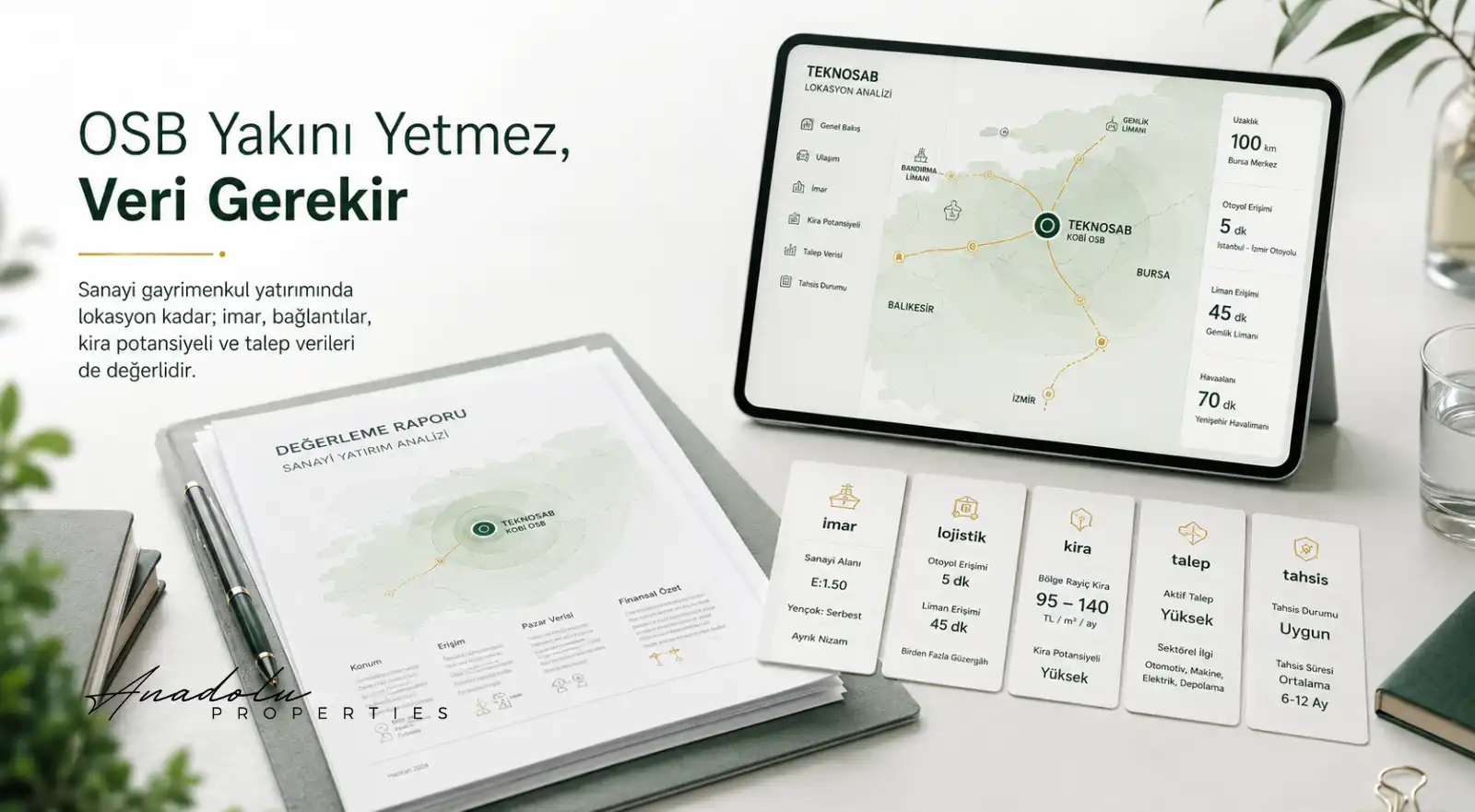
The critical distinction here is this: every OIZ news item does not automatically make every surrounding parcel valuable. Value is formed together with zoning status, road connection, parcel size, infrastructure capacity, distance to the OIZ boundary, logistics access, environmental plan and actual industrial demand.
TEKNOSAB’s Location and the Value of Logistics Connectivity
TEKNOSAB’s location offers an important advantage for Bursa. Its position in an area that remains accessible to Bursa’s center but is farther from urban pressure may take the project beyond the conventional OIZ logic because of its access to the Gemlik and Bandırma ports, its connection to the Istanbul-Izmir motorway and its relationship with the Marmara production axis.
However, distance alone is not sufficient for logistics value. It is just as important how a parcel actually reaches a port, motorway or OIZ entrance as whether it is nearby. Road width suitable for truck movements, turning capacity, infrastructure capacity, ease of loading and unloading, and zoning function can directly affect pricing.
Therefore, the expression “close to TEKNOSAB” should not be a stand-alone investment rationale. The right question is whether the parcel carries a real economic function within the production and logistics chain.
The Main Difference Between Industrial Real Estate and Residential Property
In the Bursa context, this project may have three main effects. First, demand for planned industrial parcels may strengthen. Second, rental and sale values may be supported in areas suitable for logistics and storage functions. Third, the need for housing and commercial space in nearby settlements may increase as a result of industrial worker, manager and supplier mobility.
However, investors should not read this development hastily through the residential market. The impact of industrial investments on housing is often indirect. Production comes first, then employment increases, the service sector develops and, later, qualified housing demand strengthens.
Residential investments made without understanding this chain may carry risk because they price expectations too early. In industrial real estate, however, the impact can be read more directly; especially rentable production areas, logistics warehouses, small and medium-sized workshops and commercial parcels suitable for truck access may become stronger subjects of analysis.
The Investment Meaning of Organized Trade and Specialized Food Zones
Organized trade zones are also important because they allow production areas and commercial functions to be planned together. The region may turn into a structure that does not only produce goods, but also displays, sells, distributes and connects them to foreign markets. This model may carry Bursa’s industrial strength into commercial real estate value as well.
Specialized food zones represent a different investment topic. The food sector requires cold chain systems, storage, hygiene standards, logistics speed and energy infrastructure. For this reason, new demand may emerge around these areas not only for factories, but also for cold storage, packaging, distribution and supply facilities.
Which Data Should Investors Look at Today?
The TEKNOSAB SME OIZ move should be read through a long-term production and logistics value chain rather than through short-term speculative land movement. For this reason, the main points investors should monitor are as follows:
- Parcels should be analyzed not only by location, but also by zoning function and usability.
- It should not be forgotten that industrial, storage, commercial and agriculturally classified areas do not have the same risk-return structure.
- For logistics value, not only distance but also connection quality should be measured.
- Demand collection, expropriation, parceling and allocation processes should be followed according to the implementation calendar.
- In industrial real estate, not only land value appreciation but also rentability and producer demand should be calculated.
- The employment effect in the surrounding residential market should be evaluated together with social facilities, transport and quality of life.
Value Is Created by Function, Not by News
The implementation of the SME OIZ in TEKNOSAB does not mean only a new industrial area for Bursa. It creates a broader transformation field in which production, trade, logistics and real estate value may be reshaped along the same axis.
In the new period, the strong investor will not be the one who only looks for “near the OIZ”, but the one who can read where the production chain will grow, where logistics will concentrate and which parcel carries a real economic function. To read this transformation in Bursa correctly, zoning, transport, rental potential, demand structure and official implementation processes must be evaluated together rather than relying solely on the news flow.
Mustafa Yılmaz
CEO – Anadolu Properties
Europe – Türkiye Investment Bridge