800 NEW COMPANIES AND A 75,000-JOB TARGET IN SAKARYA: HOW COULD REAL ESTATE TRANSFORM IN THE MARMARA PRODUCTION CORRIDOR?
Why Sakarya’s Industrial Growth Should Be Read Strategically
The announcement by the Sakarya Chamber of Commerce and Industry (SATSO) that approximately 800 new companies are expected to begin production within the next five years through ongoing Organized Industrial Zone projects, creating around 75,000 additional jobs, should not be evaluated merely as a regional industrial news item. This target signals a strategic transformation that could have long-term implications for the Marmara Region’s production capacity, logistics infrastructure and real estate market.
Behind this announcement lies a strong industrial infrastructure that has developed over many years. Sakarya has become one of Türkiye’s prominent production centers in automotive, defense industry, machinery, metal processing, rail systems and agro-based industries. New OIZ investments may go beyond expanding existing capacity and make the city’s role in the Marmara production corridor more visible.
Which Areas of Real Estate Are Affected First by OIZ Investments?
The impact of Organized Industrial Zone investments on the real estate market often develops gradually. The first effect is usually not felt in housing, but in industrial land, production facilities, logistics warehouses, bonded storage areas, distribution centers and commercial real estate.
As new production facilities become operational, additional demand emerges for supplier factories, service areas, office uses, storage solutions and transport infrastructure. This demand makes zoning structure, transport connections and commercial functions in the region more critical.
The impact on the housing market generally appears later. As employment growth, population movement and income continuity strengthen, demand for rental housing, qualified living areas, education, healthcare, retail and social facilities also begins to increase. Therefore, there is a natural time lag between industrial growth and housing demand.
What Do International Examples Tell Us?
International examples show that real estate value in regions where production clusters grow is not formed only through factory parcels. Baden-Württemberg in Germany, the Katowice Special Economic Zone in Poland and the Brno production clusters in Czechia are among the examples where industrial investments develop together with logistics, trade, technology centers and demand for qualified housing.
In these regions, the real value does not come solely from the increase in production capacity, but from how production connects with logistics networks, supply chains, human capital and commercial services. A similar reading can be made for Sakarya: value will be shaped not only by the opening of new OIZ areas, but by how strongly these areas are integrated into the production and logistics ecosystem.
Sakarya’s Advantage in the Marmara Production Corridor
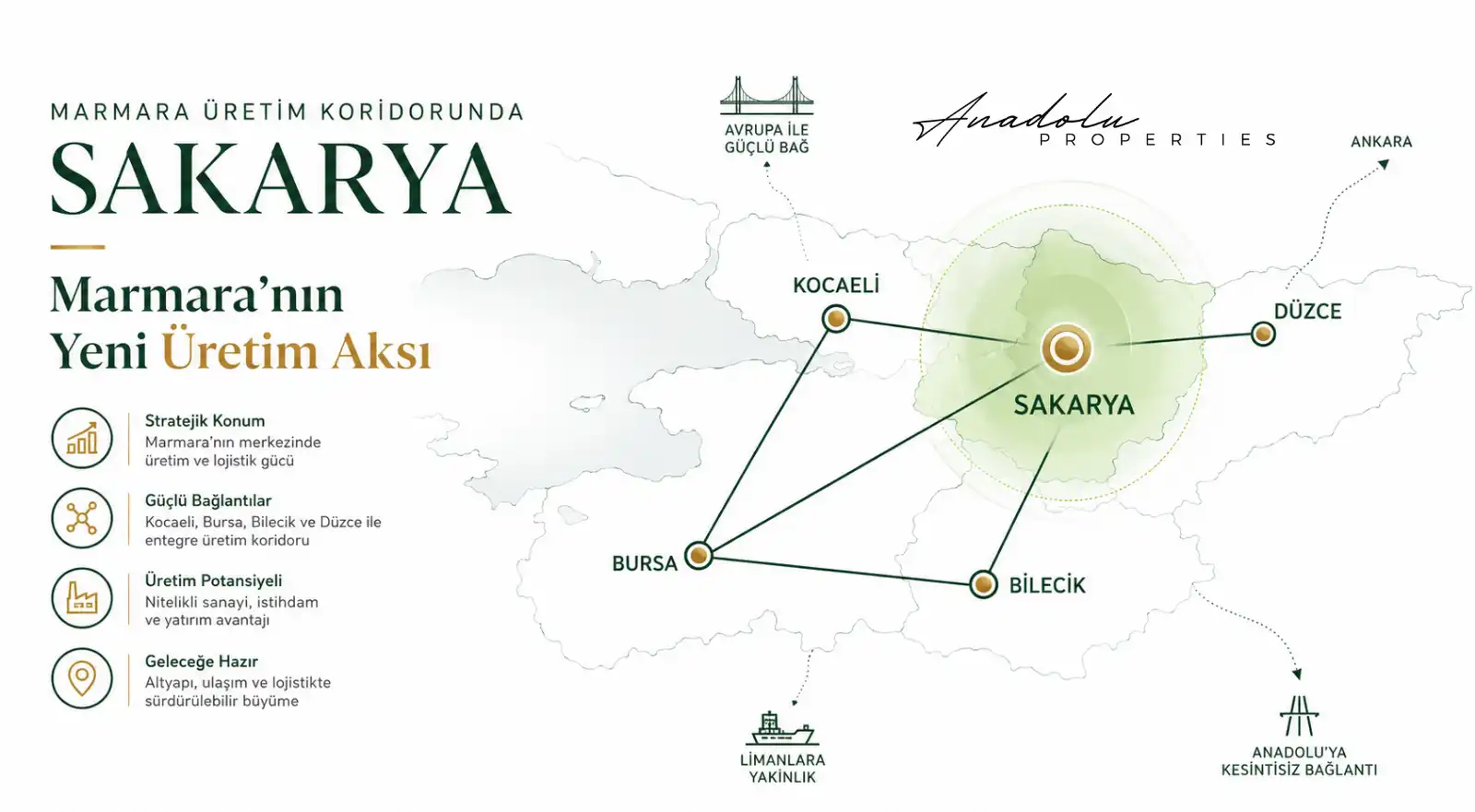
Sakarya’s advantage is not limited to new OIZ investments. Its proximity to Istanbul, the Northern Marmara Motorway, the D-100 Highway, railway connections, port access and strong supply chain in the automotive industry place the city at a strategic point within Marmara’s production and logistics axes.
This infrastructure requires new investment decisions to be evaluated not only in relation to Sakarya, but within a broader production ecosystem that includes nearby production centers such as Kocaeli, Düzce, Bilecik and Bursa. Therefore, industrial growth in Sakarya should be read from the perspective of the Marmara production corridor, not only at the scale of a single city.
In particular, the production infrastructure created by the automotive and defense industries may make it easier for new investors to choose the region. Stronger railway and port connections may also support the development of the logistics sector and add a new layer to commercial real estate demand.
Why Is Value Growth Selective?
An important distinction should be made here: the fact that 800 new companies are expected to begin production does not mean that every parcel, every dwelling or every commercial area in the city will appreciate at the same rate. Industrial investments create selective value in the real estate market.
Real value is formed through access to organized industrial zones, logistics connections, zoning status, infrastructure capacity, parcel function, commercial use potential and regional planning. For this reason, investment analysis should not be limited to price comparison; location, transport, zoning and production function should be assessed together.
As Anadolu Properties, we evaluate this development not only in terms of new OIZ investments, but as a new period that must be read through data in industrial real estate investments. Particularly in terms of industrial land, logistics warehouses, production facilities and commercial real estate, Sakarya appears to be one of the regions that should be closely monitored in the coming period.
Which Data Should Investors Monitor?
At the same time, investment decisions should not be based solely on employment targets or company numbers. It is necessary to analyze together which OIZs these targets will be realized in, the completion process of infrastructure investments, transport projects, investment incentives, the distribution of production sectors and actual occupancy rates.
- Regularly monitor the phases, infrastructure level and occupancy rates of new OIZ investments.
- In industrial land, evaluate not only the price, but also transport connections, zoning status, infrastructure capacity and production function together.
- Conduct regional demand analyses for logistics storage areas, distribution centers and commercial real estate.
- In housing investments, read the impact of industrial growth on employment, population movement and rental demand from a long-term perspective.
- Analyze the impact of the Northern Marmara Motorway, ports, railways and main road connections on investment areas together.
- Evaluate Sakarya not on its own, but as part of the Marmara production corridor together with Kocaeli, Bursa, Bilecik and Düzce.
Reading Marmara’s New Production Map Correctly
Sakarya’s rising production power is one of the dynamics that could reshape the industrial map of the Marmara Region. New capacity in automotive, machinery, defense industry and high value-added production areas may support not only exports, but also regional logistics networks and the commercial real estate market.
In the coming years, competition in the Marmara Region will not be built only on producing. How quickly production can be transported, how strongly it is connected to the supply chain and how effectively logistics costs are optimized will also determine investment decisions.
For this reason, the target of 800 new companies and 75,000 jobs in Sakarya should be read not merely as an industrial growth headline, but as strategic data that could affect the production, logistics and real estate ecosystem together. Regions that may create long-term value will be distinguished not only by growth news, but through accurate location analysis, zoning control, field data and a professional valuation approach.
Mustafa Yılmaz
CEO – Anadolu Properties
Europe – Türkiye Investment Bridge