Türkiye’s New Axes | #14 ÇERKEZKÖY KAPIKULE RAILWAY AND INDUSTRIAL PROPERTY IN THRACE
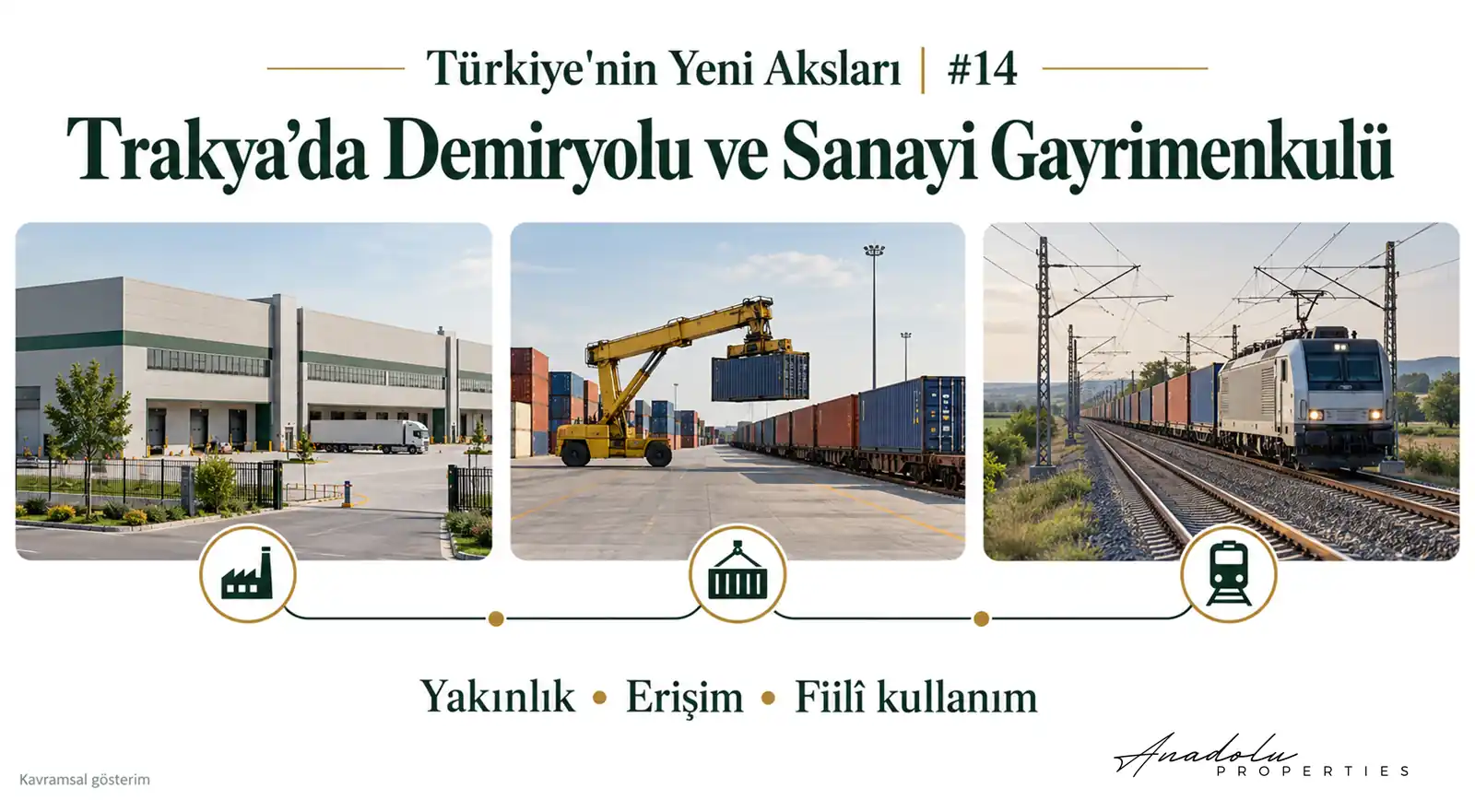
The Impact of Thrace’s Railway on Economic Use
The opening of the Çerkezköy–Kapıkule railway section is a tangible development in Thrace’s transport infrastructure. For industrial property, our main research task is to identify which properties will see changes in their use and logistics conditions as a result of this connection. Proximity to the tracks alone does not mean usable freight access or value appreciation.
In Türkiye’s trade with Europe, production and logistics flows extending westwards from Istanbul reach the border region through Tekirdağ, Kırklareli and Edirne. The Halkalı–Kapıkule Railway Project aims to improve rail connectivity in this area. We should assess the present impact of the opened section separately from the corridor effects that may emerge once all sections are completed.
The Opening of the Çerkezköy Kapıkule Section on 9 October
The Presidency’s Directorate of Communications statement dated 9 October 2026 confirms the opening of the 153-kilometre Çerkezköy–Kapıkule section. A design and operating speed of 200 kilometres per hour is stated for the double-track, electrified and signalled line. This technical specification should not be interpreted as meaning that every train currently operates commercial services at 200 kilometres per hour. Source: Directorate of Communications, 9 October 2026.
The same statement reports 31 bridges, 8 cut-and-cover tunnels, 2 viaducts, 114 underpasses and overpasses, and 175 culverts along the line, as well as new station buildings in Babaeski, Lüleburgaz and Büyükkarıştıran. However, the opening alone does not demonstrate that all passenger and freight services have reached their target capacity. Operating timetables, actual train movements, freight acceptance points and realised transport volumes must be monitored separately.
Opened and Ongoing Sections of the Halkalı Kapıkule Project
The approximately 229-kilometre Halkalı–Kapıkule project comprises three sections. In light of the official statements reviewed as of 18 October 2026, we distinguish the opening of Çerkezköy–Kapıkule from the construction of the connections towards Istanbul.
Çerkezköy Kapıkule
The 153-kilometre section was officially opened on 9 October. Bringing this section into service does not mean that the entire new route from Halkalı to Kapıkule has been completed.
Ispartakule Çerkezköy
The Ministry of Transport and Infrastructure’s statement dated 8 October 2026 describes this section as 69 kilometres long and indicates that work is continuing. When assessing the section’s length, we consider the statement’s date together with the scope of the project.
Halkalı Ispartakule
The same statement reports that construction on this approximately 7-kilometre section is nearing completion and that opening is planned before the end of the year. An announced timetable is not an actual opening. Completion of both connections and their actual operating performance should be tracked separately. Source: Ministry of Transport and Infrastructure, 8 October 2026.
Corridor Targets and Actual Transport Performance
The statement dated 9 October projects a reduction in passenger journey time between Halkalı and Kapıkule from 4 hours to 1 hour and 30 minutes, and in freight transport time from 8 hours and 30 minutes to 3 hours and 30 minutes. Annual passenger capacity is expected to rise from 600,000 to 3 million, and freight capacity from 1.5 million to 9.5 million tonnes.
We interpret these figures as targets for the integrated corridor. Capacity and actual transport volumes are not the same indicator, and target journey times cannot be used as a current service timetable. When researching the new line’s economic contribution, we should examine producers’ actual transport choices and total logistics costs.
Three Stages from Infrastructure to Economic Behaviour
At Anadolu Properties, we consider physical completion, the transition to operations and changes in economic behaviour separately. In the first stage, the line, stations and technical infrastructure are built. In the second, train services and freight operations are actually provided. In the third, industrial and logistics businesses incorporate this infrastructure into their procurement, dispatch and location decisions.
When researching measurable effects on property, we focus particularly on the third stage. The presence of a new station matters; changes in demand for use are understood through transport data, business decisions and completed market transactions.
Rail Access for Industry in Büyükkarıştıran
Büyükkarıştıran is one of the locations where railway investment and existing production activities meet in the same area. The Kırklareli Governorate’s notice dated 15 March 2022 records a positive environmental impact assessment decision for a planned capacity expansion at a flat-glass production facility on specified parcels in the Büyükkarıştıran organised industrial zone. This record provides official context for the industrial investment; it does not prove that the capacity expansion has now been completed or connected to the railway. Source: Kırklareli Governorate, 15 March 2022.
We cannot say that all factories can now transport freight by rail without verifying the new station’s passenger and freight functions, its links to industrial facilities and actual transport options. We are investigating the difference between a factory’s proximity to the line and its ability to use it.
Access from Lüleburgaz Industry to Freight Loading Points
The production base around Lüleburgaz makes the station connection important. The Governorate’s announcement dated 2 May 2025 records a visit to the Lüleburgaz Evrensekiz organised industrial zone on 29 April and a briefing on its activities. This institutional record supports the context of existing industry. Source: Kırklareli Governorate, 2 May 2025.
The following questions are decisive for the assessment: which routes can industrial facilities use to reach loading points? Are loading and unloading services available? Is transferring freight from road to rail economically viable? Are shipment sizes suitable, and do logistics operators provide usable services?
The opening of a nearby station does not mean that every facility’s transport costs will fall. We should assess the advantage through the access producers can actually use and the overall service conditions.
Babaeski Station and Its Relationship with the Local Economy
The construction of a new station building in Babaeski is a development in the district’s transport infrastructure. Its emergence as an economic node depends on transport flows combining with other activities. Daily travel choices, business and service-related mobility, new commercial businesses and regular connections between the station and the town centre should be monitored.
Whether the uses of surrounding properties change is also part of this assessment. We view Babaeski as a centre where the effects of new infrastructure on local use need to be researched, rather than an area where economic impacts are assumed to have already materialised.
Capacity and Operations at the Kapıkule Border Crossing
According to the official statement dated 9 October, the number of tracks in the Kapıkule station yard increased from 23 to 42, while total track length rose from 15,675 metres to 51,000 metres. This demonstrates a tangible change in physical infrastructure capacity; it does not show that cross-border freight has increased by the same proportion.
Customs procedures, train reception capacity, locomotive and wagon organisation, the neighbouring country’s infrastructure, service planning and loading systems must work together. The economic outcome of the Kapıkule expansion needs to be measured through actual freight crossings and processing times.
The Threshold from Rail to Property
In this article, we define the “threshold from rail to property” as the full set of physical, operational and commercial conditions required for nearby railway infrastructure to have a measurable effect on a property’s use, operating costs or economic function. This is the article’s analytical framework, not a calculated score or a coefficient of value appreciation.
Proximity to a railway is a locational characteristic. The ability to benefit from rail is an economic capability that depends on access and service conditions. We examine this distinction through five thresholds.
1 Physical Proximity
Rivers, motorways, land under different ownership and access barriers between a property and the line matter as much as the distance itself. Straight-line distance alone does not explain the route that can actually be used.
2 Functional Connection
Is the nearby station or facility suitable for freight transport, does it accept freight, and does it have transfer infrastructure? Proximity to a station serving only passengers does not provide a factory with direct access to freight transport.
3 Last Mile Access
Reaching the loading point from the factory by truck, a dedicated rail connection or an intermediate storage facility entails different costs. The cost of this final connection may reduce the advantage of rail on the main transport leg.
4 Commercial Usability
Do service frequency, transport prices, delivery time reliability, customs and international connections meet the producer’s needs? Even if the physical infrastructure is suitable, producers may continue to use their existing transport system if the commercial conditions are unsuitable.
5 Realised Economic Impact
Has the producer changed its transport method? Has investment in new warehousing, logistics facilities or industry actually taken place? Has the property’s use changed? We do not infer rail-driven value appreciation without verifying these developments.
Comparing Access for Two Industrial Parcels
Consider two industrial parcels of equal size. Suppose the first is 500 metres from the railway but has no nearby freight acceptance point. Suppose the second is 5 kilometres from the railway and can reach an operating freight terminal through a suitable road connection.
The first parcel appears closer on the map. Nevertheless, when logistics costs, service capacity and usage options are examined, the second parcel may be more functional for a particular producer. This is an illustrative scenario only, not a valuation or price comparison of two actual parcels.
The principle we draw from this is that the nearest property need not be the one that derives the greatest economic benefit. The threshold from rail to property is the framework we use to investigate this difference.
Anadolu Properties Research Agenda
We regard the opening of Çerkezköy–Kapıkule as an important transport development. We do not assume that it automatically justifies value appreciation for all industrial land in Thrace. We first examine the completed sections, then station functions and actual access links with industry, and finally investigate whether producers are using this infrastructure.
The indicators we will monitor include actual passenger and freight services, the operating functions of Büyükkarıştıran, Lüleburgaz and Babaeski stations, access to freight services for organised industrial zones, and crossing volumes and processing times at Kapıkule. Completion of the remaining sections, official records of new warehousing and industrial investments, property use and completed market transactions will complement the assessment.
We do not place industrial land and agricultural land in the same investment category. Proximity to the route does not mean that non-agricultural use or new industrial and commercial zoning will be granted. Each property’s zoning plan, ownership, conservation and agricultural status, expropriation boundaries and relevant authorities’ opinions must be examined separately. Source: Ministry of Agriculture and Forestry, soil protection and land assessment activities.
Measuring Economic Impact through Usable Connections
The opening of the new line marks the start of a period of monitoring its use, rather than the end of the research. Along the same corridor, one facility may benefit from a new freight connection while another producer continues to use its existing transport system. We therefore examine each location through its own economic function.
The question we emphasise in the 14th article of the Türkiye’s New Axes series is this: can this property actually access the economic opportunities provided by rail? Alongside measuring distance, we should seek the answer in freight services, last mile costs and actual demand for use.
This article has been prepared for general information and research purposes. Project targets are not realised operating performance. Proximity to a railway, station or logistics facility does not guarantee property value appreciation or investment returns; each property’s legal, technical and economic conditions must be assessed separately.
Mustafa Yılmaz
CEO – Anadolu Properties
Europe–Türkiye Investment Bridge