The Investment Map of the Future | #04 FROM THE FACTORY GATE TO THE PORT RAIL CONNECTIVITY FOR INDUSTRIAL LAND
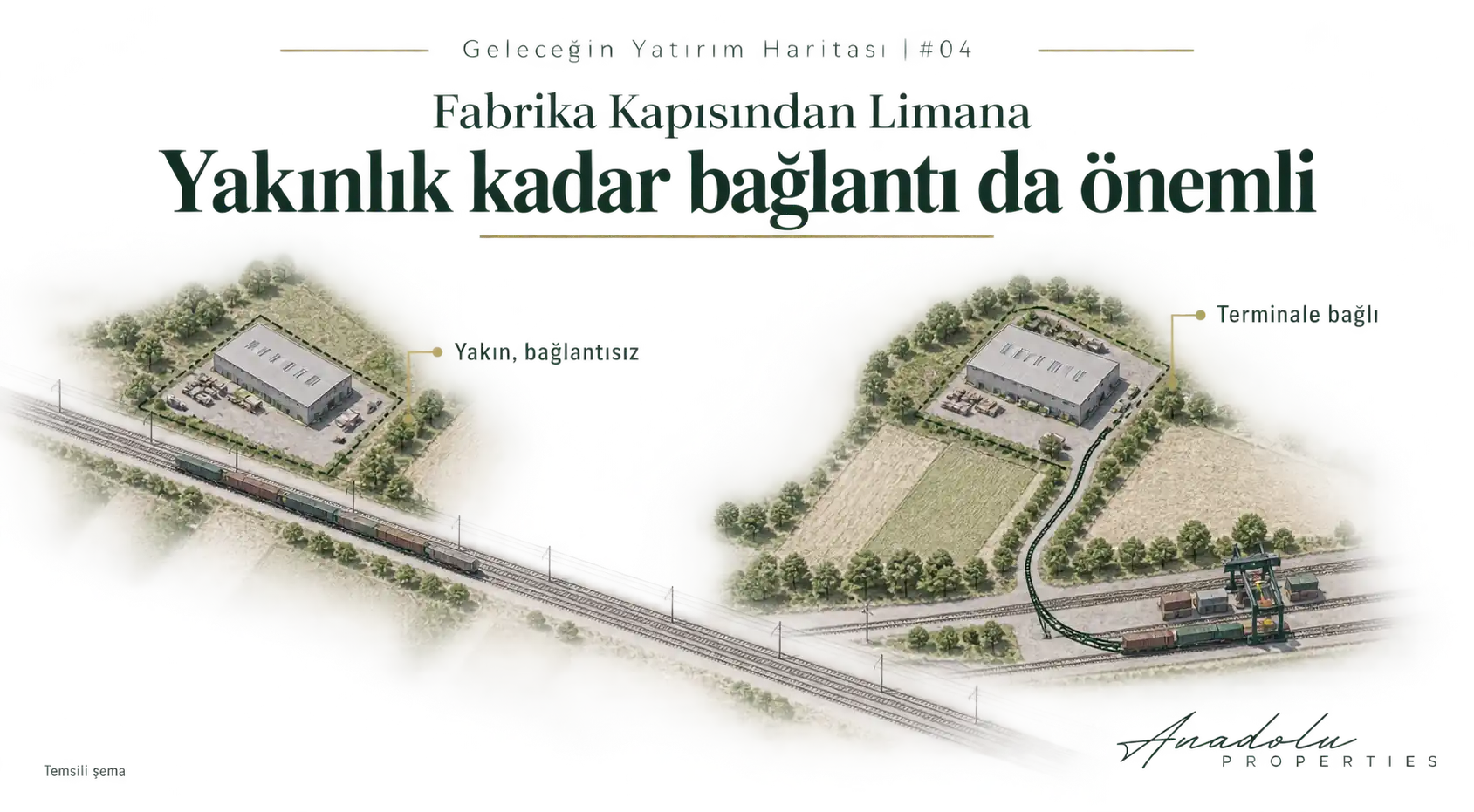
The Difference Between Proximity to a Railway and a Usable Connection
A railway passing close to an industrial plot does not mean that the plot can benefit from rail logistics. Even if the main line is only a few hundred metres away, goods may still have to be taken by truck to another terminal if there is no connection and loading infrastructure to put them onto the railway.
A rail siding is a connection that branches off a main railway line or station tracks to reach facilities such as a factory, organised industrial zone, port, mine or logistics centre. Its economic significance should be assessed not only by its length, but also by how effectively it connects the production site to the transport network.
The more usable the chain linking the factory, railway, logistics centre, port and overseas market becomes, the more meaningful the connection may be for the producer.
In its statement of 23 November 2025, the Ministry of Transport and Infrastructure reported 287 rail sidings with a total length of 445.8 kilometres on the national network. According to the same statement, the 9.8 million tonnes carried via these lines in January–October 2025 represented approximately 46.9% of rail freight. These figures, which relate to that period, demonstrate the importance of the connection between production and the main line.
Source: UAB — 608 km of Rail Siding Support for Industry, 23 November 2025
The Direction Indicated by Railway Investment
While road transport continues to dominate freight transport in Türkiye, public policy aims to increase rail’s share. The long-term framework announced by the Ministry in 2023 envisaged raising rail’s freight share from around 5% to 22% by 2053. These are targets, not achieved outcomes.
Source: UAB — Targeting Zero Emissions in Transport, 5 December 2023
The Ministry’s statement on the 2026 budget, which put rail’s share of investment at 53%, also supports this direction. TCDD Taşımacılık’s 2025 Annual Report gives the company’s total freight volume as 25.261 million tonnes; this operator-specific figure should not be read as the total for all railway operators in Türkiye.
Source: UAB — Statement on the 2026 Investment Budget
Source: TCDD Taşımacılık — 2025 Annual Report
When reading the investment map, we should monitor current freight movements alongside the infrastructure programme for the future. What matters is where industry, railways, ports and logistics centres are actually being integrated.
Assessing Industrial Areas Together with the Logistics Network
The Ministry of Industry and Technology announced a target to expand planned industrial areas from 160,000 hectares to 350,000 hectares under the Industrial Areas Master Plan. Developing the new areas with rail, port and motorway connections is also part of this framework.
Source: Ministry of Industry and Technology — Statement on the Industrial Areas Master Plan
Taken together, the expansion of industrial areas and the development of rail freight call for a broader logistics assessment when choosing a production location. It may no longer be sufficient to regard the industrial site of the future simply as land on which a factory can be built. The cost and connections through which its output can reach the market must also be examined.
From Factory to Logistics Centre in Eskişehir
The siding between Hasanbey Logistics Centre and Eskişehir Organised Industrial Zone (OSB) is one of the connections the Ministry listed as under construction in November 2025. The investment rationale is to bring the production area and the logistics centre into the same transport chain.
Assessing this arrangement requires more than measuring the distance to the OSB. The plot’s access to the freight terminal, the possibility of connecting to the siding, its relationship with the loading area and the target sector’s ability to use rail must all be investigated.
Building the line does not mean that every nearby property will increase in value. A functional advantage may arise for production activities that can use the connection under suitable cost and service conditions.
Connecting the Port and Industry in Filyos
In its statement of 13 July 2025, the Ministry announced the completion of the tender for the siding that would connect Filyos Port and the Filyos Industrial Zone to the national network. The project also includes expanding Gökçeler Station and building a railway bridge over the Filyos River.
Source: UAB — Railway Connection Coming to Filyos Port, 13 July 2025
When industry, rail and the port operate together, moving inland freight to the port and incoming port cargo to the domestic market may become easier. For this reason, when assessing proximity to a port, we examine the actual connection between the land and the port’s logistics system. Distance in kilometres does not explain the entire transport chain.
The Connection Network in Havza and Other Production Areas
The Ministry of Transport and Infrastructure’s statement of 13 September 2026 said that the Havza OSB siding was planned for completion during 2026. The same statement reported the completion of the Gelemen–Tekkeköy siding and Gelemen Logistics Centre, while describing different construction and tender stages for the sections of the Samsun–Amasya–Çorum–Kırıkkale railway project.
Source: UAB — Samsun Statement, 13 September 2026
Havza should therefore be assessed through its place in the regional logistics network, rather than through a single project. In our Investment Map of the Future approach, the way projects connect to one another is as important as the individual projects themselves.
The nine construction projects in the November 2025 statement covered the connections at Filyos, Adapazarı–Karasu, Afyonkarahisar–İscehisar, Polatlı and Chamber of Commerce OSB, Çukurova, the first stage of Dörtyol–Hassa, Hasanbey–Eskişehir OSB, İncesu OSB and Havza OSB. Their total length was 150.5 kilometres. The statement also reported that 10 projects totalling 82.4 kilometres had been completed and that project development work was continuing on 17 lines totalling 189.4 kilometres.
Completion of the same portfolio was expected to bring the total to 331 lines and 885.1 kilometres, while the interim target for 2028 was 608 kilometres. These figures describe different stages and periods; we cannot treat all of them as operational capacity.
Source: UAB — 608 km of Rail Siding Support for Industry, 23 November 2025
Indeed, the Ministry’s 2025 Annual Report records that the Polatlı OSB and Gelemen–Tekkeköy connections had been completed under the relevant target and were planned to open for operation in 2026. Before an investment decision, project lists should be checked again against current operating status and information on the services actually available.
Source: UAB — 2025 Annual Report
A Transport Model in Which Trucks and Trains Work Together
According to the Ministry’s statement of 28 June 2026, prototype production had been completed and testing had begun for TÜRASAŞ’s Semi-Trailer Transport Wagon project. The statement set a production target of 100 wagons for 2026. A prototype and a production target are not the same stage as a fully established commercial service network.
Source: UAB — A New Era in Intermodal Transport, 28 June 2026
This model aims to carry the trailer by rail over long distances while using the flexibility of road transport for the first and last mile. This is also where intermodal transport matters for real estate: production and logistics sites with efficient access to a terminal may offer a functional advantage even if they are not directly beside the tracks.
What the Logistics Connectivity Premium Means
In this article, we use the term “Logistics Connectivity Premium” to describe the potential functional advantage of an industrial or logistics property that can connect its production site to railways, logistics centres, ports and trade corridors seamlessly or with few transfers.
This is not a standardised valuation coefficient or a measured price increase. Whether the advantage is reflected in market value must be examined separately in light of usability, cost, demand and comparable transactions.
Hypothetically, a plot 500 metres from the railway may have no loading facilities. Another plot 5 kilometres from the line may be able to put its freight onto rail through an OSB terminal and siding system. While distance on the map favours the first plot, a usable logistics connection may make the second plot more suitable.
We believe that industrial real estate assessment should consider how the connection works alongside the distance in kilometres.
Examining an Industrial Plot Through Three Maps
At Anadolu Properties, we consider conventional location analysis for industrial and logistics properties alongside three layers:
- Production map: Where are OSBs, factories, mines and agricultural production areas concentrated?
- Transport map: Along which routes are motorways, railways, ports, logistics centres and sidings located?
- Connection map: At which points, and under what conditions of use, can production areas access this infrastructure?
The intersection of these layers may provide a signal worth investigating. However, it must be separately verified whether lines that intersect on a map translate into a connection providing a service on the ground.
Verification Questions from the Anadolu Properties Perspective
The generalisation that “land beside the railway will appreciate” overlooks a property’s actual conditions of use. When researching industrial land investment in Türkiye, the following questions matter, particularly for investors assessing the site remotely:
- Where is the line planned, which OSB does it connect to, and which port or logistics centre does it reach?
- Can the target sector use the line, and are connection rights and loading and unloading infrastructure available?
- In what direction are OSB expansion areas and the industrial uses of new plots developing?
- Is the connection followed by factory investment, warehousing demand and regular commercial freight movements?
Tracing Value Through Actual Freight Movements
In our research, we distinguish between a planned connection, a built connection and a connection in use. Laying tracks alone does not demonstrate economic benefit. Regular freight movements and businesses’ ability to use the connection make the signal in an investment analysis more meaningful.
The expansion of industrial areas, rail siding programmes and the development of intermodal vehicles indicate an intention to change how production output is transported. We cannot infer a direct and certain property price increase from this. We can, however, treat connectivity as a separate assessment criterion when comparing the functional qualities of industrial land.
Two plots close to the same motorway, city or OSB may not have the same logistics conditions. While one may require freight to travel a long distance by road, the other may offer access to rail and the port through a short connection. The economic significance of this difference should be measured using actual service and cost data.
Our central question when examining the industrial real estate of the future is this: How does the freight I produce reach the world from this land?
Each property must be examined individually in terms of zoning, ownership, expropriation, connection rights, infrastructure capacity, industrial use, environmental constraints, logistics costs, demand and liquidity. This article is intended for general information and research; proximity to transport infrastructure does not guarantee an increase in value.
Mustafa Yılmaz
CEO – Anadolu Properties
Europe–Türkiye Investment Bridge