WHAT DOES LAW NO. 7584 INTRODUCE REGARDING FOREST ANNOTATIONS AND THE RETURN OF TITLE DEEDS? HOW COULD THE REAL ESTATE MARKET BE AFFECTED?
A New Era in Property Disputes Arising from Forest Cadastre
Property rights directly affect not only the authority to dispose of a property, but also investment confidence, access to financing, valuation outcomes and the functioning of the real estate market. Long-running disputes between land registry records and forest cadastral surveys may restrict a property’s marketability, collateral value and economic use.
Published in Official Gazette No. 33286 dated 20 June 2026, the Law No. 7584 Amending the Soil Conservation and Land Use Law and Certain Other Laws added Additional Article 22 to Forest Law No. 6831. The amendment establishes a new review mechanism for the land registry records and ownership history of certain properties that had been designated, in whole or in part, as State forest under forest cadastral surveys finalised before the law entered into force.
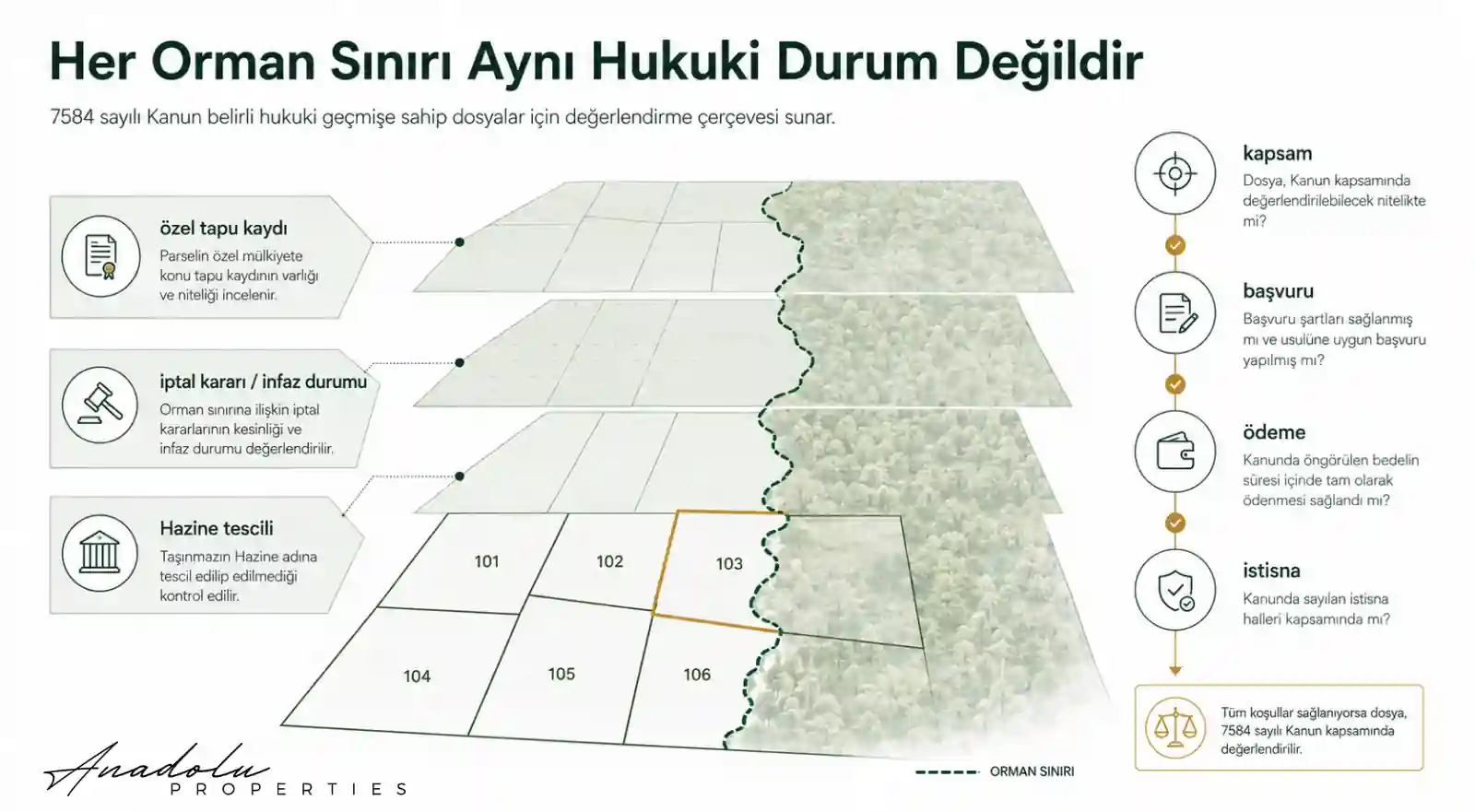
This amendment does not automatically create a right for every property located near a forest boundary. The manner in which the land registry record was created, the date on which the forest cadastre became final, whether a judgment cancelling the title was implemented, whether compensation was previously paid and the statutory exceptions must all be examined together.
What Does Law No. 7584 Introduce?
Additional Article 22 distinguishes between different legal situations under the same heading. This distinction is critical with regard to application periods and financial obligations.
- Title deeds currently registered in the name of natural or legal persons: For records that are not registered in the name of the Treasury and were created in accordance with land registry, cadastral or zoning legislation, the land registry entry may be recognised as valid if the owners or the parties to an ongoing cadastral case apply to the administration and the General Directorate of Forestry approves the application. The General Directorate of Forestry may also establish the accuracy of land registry records through an ex officio review.
- Properties for which a judgment cancelling the title has become final but has not yet been implemented in the land registry: Action may be taken under the article if no payment was made in consideration for the property, or if the total amount previously paid is reimbursed to the Treasury. The amount to be reimbursed may not be lower than the property’s current market value.
- Where the judgment cancelling the title has been implemented and the property has been registered in the name of the Treasury: Former owners or their contractual and legal successors must apply to the administration within two years from the date on which the law entered into force. Restitution requires that no payment was previously made, or that the total amount paid be reimbursed to the Treasury; the reimbursement may not be lower than the current market value.
The two-year application period is specifically prescribed for properties registered in the name of the Treasury following the implementation of a title cancellation judgment or voluntary relinquishment. It should therefore not be assumed that the same period applies in the same manner to every category of property.
What Does It Mean for a Land Registry Entry to Be Recognised as Valid?
Where the statutory conditions are met, the existing land registry entry may be recognised as valid without payment of consideration, and the forest annotation in the land register may be deleted. However, the service expenses arising from the procedures must be paid by the registered owners into the accounts of the General Directorate of Forestry.
The amendment addresses only the property’s status in the land register. Recognition of the title as valid does not automatically make the property suitable for development rights, construction, agricultural use, tourism investment or use as loan collateral. Ownership, zoning, protection status, actual use and access conditions remain separate areas of review.
Which Properties May Fall Outside the Scope?
Additional Article 22 lists the excluded areas in detail. Reviewing only the property’s forest cadastral history is not sufficient; the following exceptions must also be checked.
- Certain properties registered under Olive Cultivation Law No. 3573, the repealed Law on the Distribution of Land to Farmers and related historical legislation, where the transfer conditions were not completed or the relevant procedures were not implemented.
- Pastures, summer grazing grounds, winter grazing grounds and similar properties governed by Pasture Law No. 4342.
- Properties located within culture and tourism protection and development zones, tourism centres, tourism regions and tourism areas.
- Areas governed by the Bosphorus Law and population-exchange agreements.
- Properties located in forests with special status or in areas placed under the forest regime.
- Properties created through subdivision due to permits or easement rights, located in burned forest areas, or whose geometry and physical location cannot be determined.
- Areas containing buildings or facilities connected with the protection, production and development of forests.
Why Is the Amendment Important for the Real Estate Market?
Legal predictability is one of the fundamental components of real estate value. Market participants may apply a higher risk discount to a property affected by title cancellation, a forest annotation or an ongoing ownership dispute; its marketing period may lengthen, bank financing may be restricted and cautious assumptions may be used in the valuation report.
Effective implementation of Additional Article 22 may help reduce this uncertainty for certain properties. The market impact, however, will arise not merely from publication of the law, but from how applications are concluded, the extent to which land registry records are updated and how banks and valuation institutions interpret the new legal status.
Potential Effects on Türkiye’s Real Estate Market
Liquidity in the Rural Land Market
Where the legal status of a property is clarified, the perceived risk between buyers and sellers may decline. This could help bring certain rural building plots and land parcels that have remained unmarketable for extended periods back into market assessment. Nevertheless, transaction volume and price effects will depend on application approval rates and the zoning and use characteristics of the properties.
Valuation and Financing Processes
Removal of the forest annotation or recognition of the land registry entry as valid may change the legal-risk assessment in a valuation report. Banks’ collateral policies, however, depend not only on the land registry entry but also on factors such as zoning status, actual access, building permits, protection status and marketability. Legal clarity may therefore support access to financing, but it does not by itself establish eligibility for credit.
Investor Confidence and Regional Demand
Reduced uncertainty may encourage investors to conduct more detailed reviews in rural areas and locations associated with forest cadastral issues. There is, however, no data supporting an assumption that the amendment will generate broad-based price increases in the short term. Regional price movements must be assessed together with supply, accessibility, infrastructure, development rights, economic activity and actual transaction volumes.
Strategic Assessment by Property Type
Building Plot and Land Investments
For building plot and land investments, the first question is not whether the property is close to a forest, but whether the parcel falls within the scope of Additional Article 22 and whether its legal chain can be verified through documents. The land registry record, cadastral minutes, forest boundary map, court judgments, compensation payments and chain of former owners should be examined together.
Housing and Rural Settlements
The security of ownership for certain dwellings in forest villages or rural settlements may improve. Nevertheless, the building permit, occupancy permit, zoning plan, road access and infrastructure connections must be checked separately. An improvement in the land registry status does not automatically remedy deficiencies under construction and planning legislation.
Commercial Real Estate and Tourism Use
Excluded areas are particularly important for properties intended for rural accommodation, agritourism, nature tourism or commercial use. Since properties located in culture and tourism protection and development zones and tourism centres are expressly excluded by the law, the investment scenario must be assessed together with the relevant planning and protection decisions.
Anadolu Properties Early-Signal Analysis
To measure the amendment’s actual effect on the real estate market, it is necessary to monitor not only the statutory text but also implementation data. The following indicators will be decisive in the coming period:
- The implementation procedures and principles to be determined by the General Directorate of Forestry.
- The number of applications, their geographical distribution and the proportion approved.
- Potential processing volumes at land registry and cadastral offices and average completion times.
- Practices concerning reimbursement of previous compensation payments and calculation of current market value.
- Banks’ collateral and lending policies for properties whose legal status has been updated.
- The new approach to forest cadastre and ownership risk in real estate valuation reports.
- Changes in transaction volume, marketing periods and price differentials in areas where the legal status has been clarified.
Risk and Verification Checklist for Investors
- Scope verification: Determine which legal category under Additional Article 22 applies to the property.
- Time-limit verification: Obtain expert confirmation as to whether the two-year application period applies to the specific case.
- Record chain: Review the land registry entry, cadastral minutes, forest boundaries, court judgments and implementation status together.
- Payment history: If compensation or the property price was paid, assess the reimbursement obligation to the Treasury and the calculation of current market value.
- Exceptions: Check for pasture, tourism, Bosphorus, special-status forest, burned forest area and other excluded circumstances.
- Existing rights: Since the law provides that existing forest permits and leases within the scope of the article are deemed cancelled, the intended use scenario must be reassessed.
- Zoning and use: Verify the land registry status, zoning, permits, protection decisions, actual use and infrastructure suitability separately.
Implementation Is What Converts Security of Ownership into Market Value
Law No. 7584 provides an important legal framework for certain property disputes that arose in the past from forest cadastral surveys. Its effect on the real estate market will not result from every property automatically appreciating in value, but from the legal status being clarified through the correct documentation, the records being updated and the property being reassessed together with its zoning, use and market conditions.
For investors, the essential question is not whether a property is close to a forest boundary, but which record was created, on what date, through which court or cadastral process, and how the new amendment applies to the specific file. A sound decision begins not with the title of the law, but with a combined reading of land registry, cadastral, valuation and field data.
This content is provided for general information and real estate market analysis; it does not constitute legal advice. For specific properties, the land registry, cadastral, court, payment and relevant administrative records should be reviewed by a lawyer and technical specialists.
Mustafa Yılmaz
CEO – Anadolu Properties
Europe–Türkiye Investment Bridge