TÜRKİYE-CHINA MIDDLE CORRIDOR COOPERATION: A NEW INVESTMENT MAP FOR LOGISTICS, INDUSTRY AND REAL ESTATE
Türkiye-China Middle Corridor Cooperation: Could Türkiye’s New Logistics Era Begin?
Diplomatic contacts aimed at re-harmonizing the Middle Corridor with the Belt and Road Initiative stand out as a development that should be read carefully not only in terms of foreign trade, but also in relation to logistics centers, organized industrial zones, commercial real estate and regional development.
In today’s global economy, countries are focusing not only on producing more, but also on transporting faster, more safely and more predictably. Competitive advantage is now measured not only by production costs, but also by supply chain efficiency and corridor diversification.
For this reason, the renewed talks between Türkiye and China on aligning the Middle Corridor and the Belt and Road Initiative should not be viewed as an ordinary diplomatic contact. This process once again brings Türkiye’s potential to convert its strategic position between Europe and Asia into economic value onto the agenda.
The fact that the date of the second meeting is still awaited shows that technical work and diplomatic contacts are continuing. However, from an investor’s perspective, the truly critical question is this: If this process is implemented, how could Türkiye’s investment map change?
What Is the Middle Corridor and Why Is It Important?
The Middle Corridor can be defined as an alternative trade route extending from China through Central Asia, the Caspian Sea, the Caucasus and Türkiye to Europe. The importance of this route comes not only from creating a new route for freight transport, but also from the possibility of repositioning production and distribution networks.
The corridor’s main objectives can be summarized under the following headings:
- Establishing stronger connections between production centers
- Reducing logistics costs
- Shortening delivery times
- Diversifying supply chains
- Increasing regional trade volume
- Making industrial, storage and distribution infrastructure more integrated
In recent years, global geopolitical developments, supply chain disruptions and the search for alternative routes have increased the strategic importance of land- and rail-based trade routes such as the Middle Corridor. For Türkiye, this topic can create a long-term transformation area not only in terms of transit advantage, but also in terms of the value map for production, logistics and real estate.
Will Türkiye Be Only a Transit Country?
The economic value of a corridor does not emerge merely because trains pass through it. Real value emerges through the establishment of logistics centers, the growth of organized industrial zones, the increase of production facilities, the development of storage infrastructure, stronger port and railway integration and faster customs processes.
Therefore, the potential that the Middle Corridor carries for Türkiye is broader than the question of “where does the line pass?” The decisive factor is which economic functions will develop around the route and how these functions will be reflected in the real estate market.
If Türkiye supports this process not only with transit capacity, but also with production, storage, distribution, port connections and industrial integration, the corridor’s impact may be felt more strongly in certain cities. This could create new analysis topics, especially for commercial real estate, industrial land, warehouse areas, logistics facilities and mixed-use zones close to transport axes.
Potential Effects on the Real Estate Market
Large-scale transport corridors can transform not only transportation, but also the economic activities around them. However, the key point to note here is this: Not every region through which a railway line passes automatically turns into an investment opportunity.
Being close to the corridor is not sufficient on its own. What matters is the relevant region’s capacity to integrate with the corridor. This capacity should be assessed together with the presence of organized industrial zones, production volume, port connections, road and rail access, customs infrastructure, qualified labor force, population dynamics and public-private sector investment appetite.
From this perspective, the areas that may stand out in real estate investment could include:
- Commercial real estate close to logistics centers
- Land and industrial parcels around organized industrial zones
- Regions suitable for storage, distribution and bonded warehouse needs
- Development axes with railway, port and road integration
- Areas that can support housing and service demand in cities with rising production capacity
Expectations of value appreciation in these areas become meaningful only when accurate data and regional dynamics are analyzed together. Otherwise, making an investment decision solely by looking at the route on the map may create an incomplete and risky reading.
Which Cities Should Be Monitored More Closely?
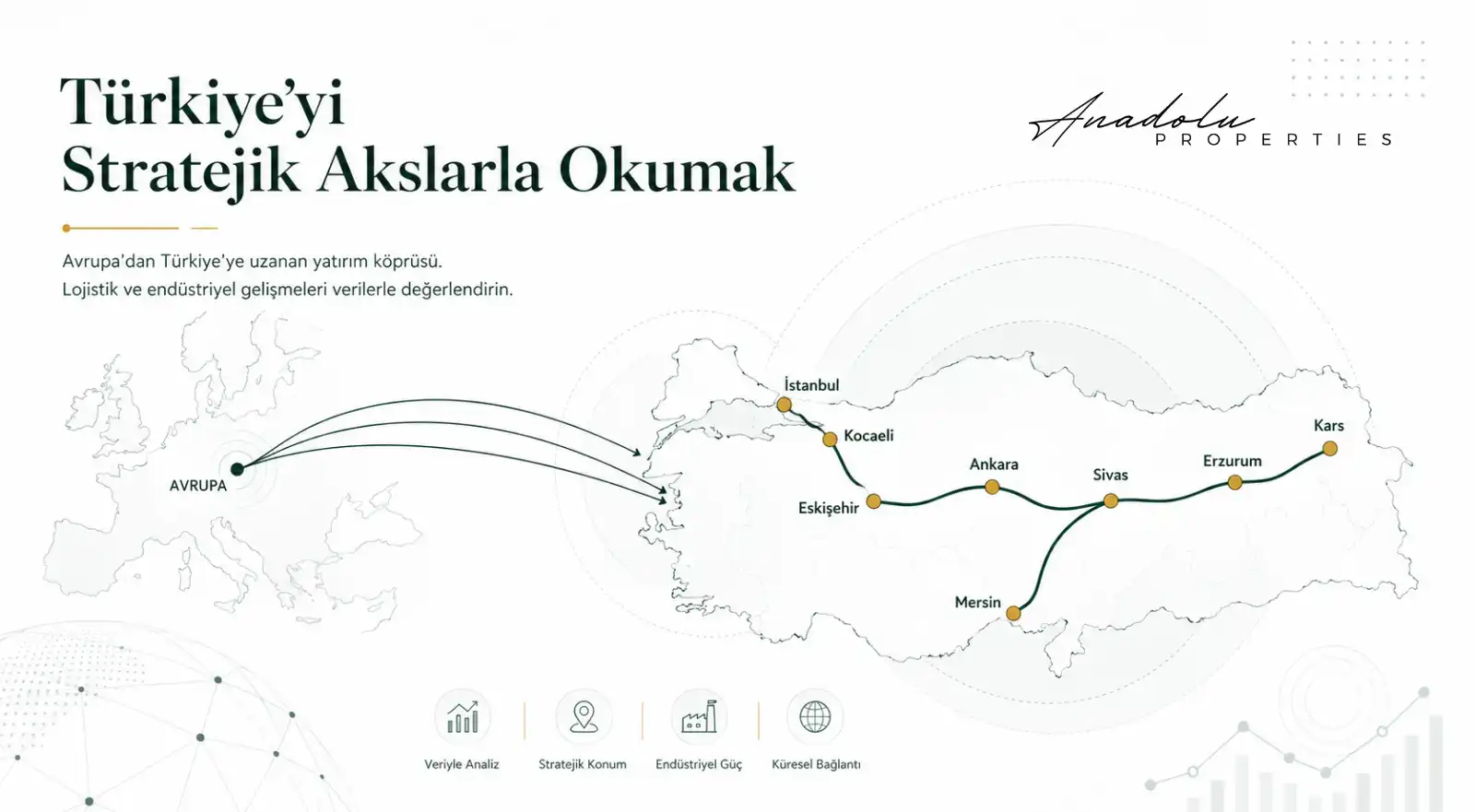
Kars, Erzurum, Sivas, Ankara, Eskişehir, Kocaeli, İstanbul and Mersin can be considered among the cities that should be monitored carefully in the long term due to their railway, industrial and logistics infrastructure.
The common feature of these cities is not merely that they are located on the route. Some stand out with railway connections, some with industrial capacity, some with port and logistics infrastructure, and others with proximity to production and distribution centers.
From an investor’s perspective, the important point is not to read each of these cities individually under the label of “opportunity,” but to analyze which function each one stands out with. For example, one city may be strong in terms of logistics transit, while another may become more strategic through industrial production or port connections.
What Do International Experiences Show?
The examples of Singapore and Dubai show that transportation infrastructure creates real economic value when it is combined with production, trade and investment ecosystems. The strength of these centers lies not only in their locational advantage, but also in their ability to develop port, free zone, logistics, finance, services and investment ecosystems within the same strategic framework.
A similar lesson can be drawn for Türkiye: corridor projects are not sufficient on their own. Permanent value emerges through the economic organization formed around the corridor. Therefore, investment analysis should take into account not only the transport line, but also the production and service ecosystem to which that line is connected.
Possible Scenarios: Basic, Optimistic and Risk-Based Reading
The impact of the Middle Corridor and Belt and Road Initiative alignment process on Türkiye should not be read through a single scenario. From a real estate investment perspective, the healthier approach is to evaluate different possibilities together.
| Scenario | Reading from a Real Estate and Investment Perspective |
| Basic Scenario | Trade volume and infrastructure investments may increase gradually. Logistics centers and areas around organized industrial zones may be monitored more closely. |
| Optimistic Scenario | Türkiye may position itself more strongly as a production and distribution hub between Europe and Asia. Demand for industrial, warehouse and commercial real estate may increase along certain axes. |
| Risk Scenario | Geopolitical tensions, financing conditions, technical delays or international trade balances may slow the process. |
Anadolu Properties Analysis: Value Is Created Not on the Line, but Within the Ecosystem
Large-scale trade projects such as the Middle Corridor can offer investors a strong perspective. However, this perspective should be evaluated through data-driven regional analysis, not through a rushed “route investment” approach.
Real investment opportunities do not emerge at every point through which the line passes; they arise in regions where production, logistics, industry, ports and transport integration develop together. Therefore, valuation reports, location analysis, zoning status, market comparisons and official institutional data should form the main backbone of the investment decision.
Especially for Turks living abroad and foreign investors planning real estate investments in Türkiye, such macro developments should not be seen as a standalone reason for decision-making, but as the starting point of a more detailed analysis process.
Strategic Checklist for Investors
When monitoring this process from an investor’s perspective, looking only at the route alignment is not sufficient. The following topics should be evaluated together:
- The region’s production capacity and industrial infrastructure
- The occupancy, expansion and connectivity status of organized industrial zones
- Port, railway and road integration
- Storage, distribution and logistics facility needs
- The direction of public and private sector investments
- Population, employment and service demand dynamics
- Zoning status, title deed structure and legal usage conditions
- Regional price movements and comparable market analyses
When these headings are examined together, the investment decision is based not merely on expectation, but on measurable data. This enables a more consistent and professional investment reading that reduces risks.
The New Logistics Era Should Be Read Through Data
In real estate, lasting value does not arise solely from a route visible on a map, but from the economic ecosystem formed around that route.
Diplomatic contacts that begin today may shape tomorrow’s logistics centers, industrial axes and investment corridors. However, to draw the right conclusions from this transformation, investors need to read the big picture not only through the news flow, but also together with data, reports, location analysis and risk control.
The real meaning of the Middle Corridor for Türkiye is more than a transport line. When analyzed correctly, this process can open a strong strategic window for reinterpreting Türkiye’s production, logistics and real estate value map.
Mustafa Yılmaz
CEO – Anadolu Properties
Europe–Türkiye Investment Bridge