LAND AND FARMLAND INVESTMENT IN TURKEY: VALUE LOSS OR A TRANSFORMATION IN THE INVESTOR PROFILE?
Is Land and Farmland Investment Really Losing Strength?
Or is what is changing in Turkey not land and farmland investment itself, but the way investors make decisions?
One of the most frequently discussed issues in the real estate sector recently has centered on this question: “Is land and farmland investment losing its former strength?”
Looking at this question only through price movements would be incomplete. The real issue to be read is how the investor profile in Turkey is changing.
For many years, numerous investment decisions were made based on hearsay, informal guidance and the expectation that “it will appreciate anyway.” The rapid price movements experienced especially in the 2020–2023 period strengthened the perception in many regions that “every piece of land will generate returns.”
Today, however, the market is entering a more selective phase. Investors are no longer buying only square meters; they are trying to evaluate risk, liquidity, access, regional development and the relationship with real value together.
This transformation should not be read as a negative signal for the sector on its own. On the contrary, it may indicate that Turkey’s real estate market is beginning to move toward a more professional, more analytical and more sustainable structure.
What Is the New Investor Looking For?
Today’s investor asks more questions than in the past and does not evaluate real estate investment solely through the expectation of price appreciation. Especially in land and farmland investment, the following issues are becoming more critical:
- The region’s development direction and long-term planning potential
- Access to transportation, logistics and main corridors
- The likelihood of industrial, production-related or commercial activity
- The difference between actual transaction prices and listing prices
- The region’s capacity to generate sustainable future demand
- Exit liquidity and resale capability
The increase in these questions does not mean that the market has completely weakened. A more accurate way to put it is that investors are now trying to read the right location, the right timing and the right value instead of merely “taking a position.”
For this reason, location analysis, zoning review, valuation reports and regional investment analysis are becoming more firmly established at the center of investment decisions.
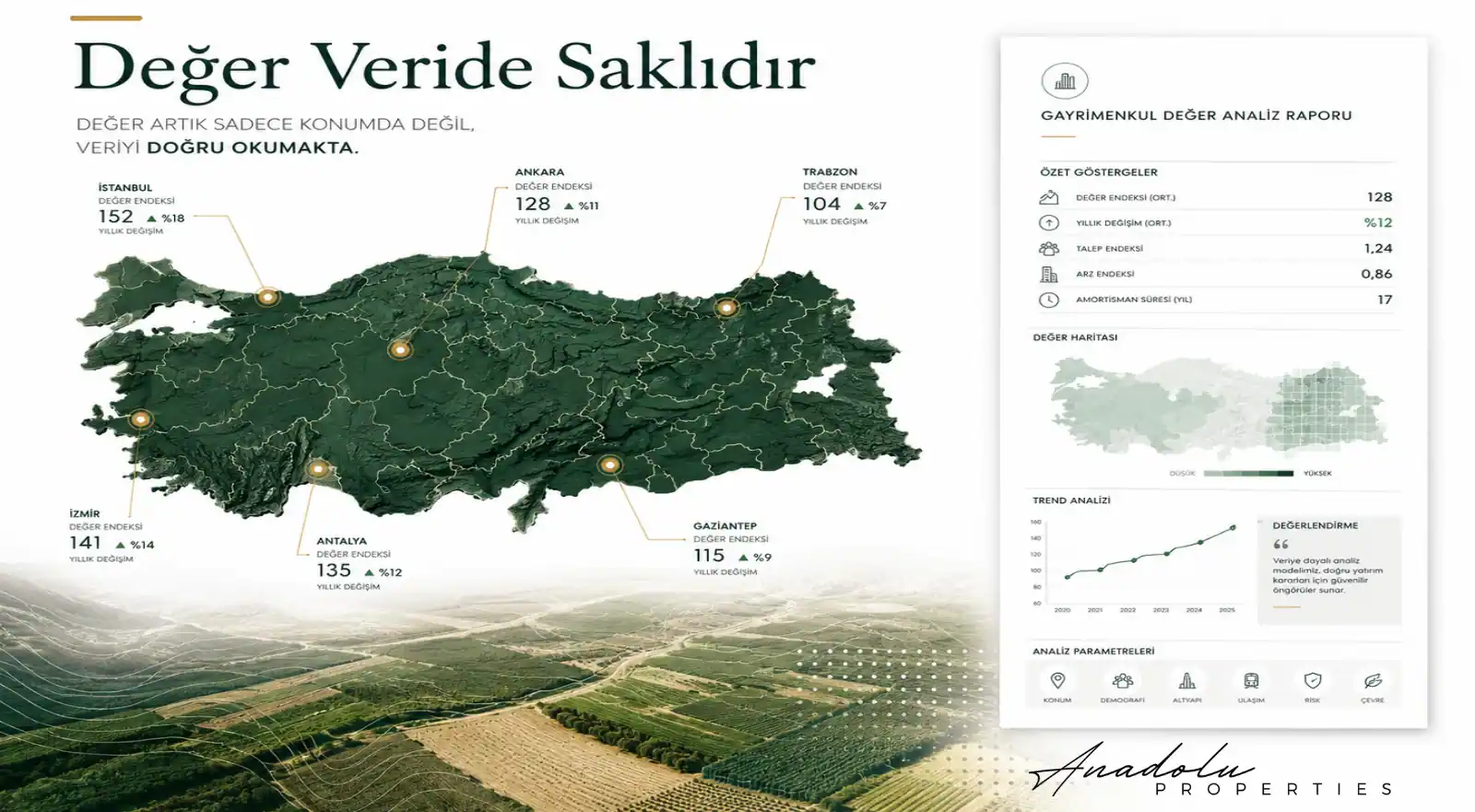
The Market Is Moving from the “Story” Era to the “Data” Era
In the period ahead, merely owning land may no longer be sufficient for investors on its own. Investors who can read data, understand regional transformation, interpret investment psychology and manage risk may move into a more advantageous position.
Because the market is beginning to move not with rumors but with data; not with expectations but with analysis; not with short-term excitement but with a strategic perspective.
This shift naturally helps the real estate sector evolve toward a more institutional structure. For investors, the important question is no longer only “where should land be purchased?” but “which data supports the value of this region?”
At this point, official data, field intelligence, zoning status, regional development corridors and comparative market analyses are becoming fundamental elements that place investment decisions on a healthier foundation.
Real Estate in Turkey Still Carries Strong Potential
New industrial corridors, logistics investments, transportation projects, production centers, energy investments and metropolitan expansion zones continue to emerge in many regions of Turkey.
For this reason, the issue should not be reduced to the question “is land investment over?” The more accurate question is: Which region carries development potential, for what reason, within which timing and based on which data?
The investor of the future is not only buying price. They are also buying data, accessibility, sustainability, regional vision and real potential.
This approach becomes even more critical for Turks living abroad and foreign investors considering investment in Turkey. In investment decisions made from a distance, access to accurate information, local market reading and a professional valuation process are among the key factors that reduce risk.
The Real Transformation: A More Conscious Investment Decision
Perhaps the period ahead will not be one in which land and farmland investment weakens, but one in which it becomes more professional.
The difference between regions losing value and regions being quietly accumulated will not be determined only by today’s price level. The region’s development direction, capacity to generate demand, zoning reality, transportation connections and liquidity strength will become more decisive.
Therefore, the real advantage in real estate investment no longer lies only in acting early, but in being able to read the right data at the right time.
Land and farmland investment continues. However, what will make this investment type meaningful will no longer be only expectation, as in the past, but a culture of analysis, reporting and strategic assessment.
Mustafa Yılmaz
CEO – Anadolu Properties
Europe – Turkey Investment Bridge