RETHINKING THE 2B SYSTEM: LAND, URBANIZATION, AND INVESTMENT DYNAMICS IN TÜRKİYE
Why Are 2B Lands Misunderstood?
One of the most misunderstood topics in Türkiye’s real estate market is 2B land.
Some people perceive 2B lands as “forest land sales.” Others see them simply as “cheap land opportunities.” Some avoid the entire field altogether because they consider the process too risky.
In reality, the 2B system is a unique structure where the state, land users, urbanization, and investment dynamics converge at the same point.
At the core of the quietly growing movement in the field today lies a fundamental question:
Who will control large-scale land areas along the future growth corridors?
This question demonstrates that 2B lands should be evaluated not only based on their current prices, but also in terms of their future urbanization potential.
What Is 2B Land?
2B lands are areas that once had forest status but later lost this qualification and were removed from forest boundaries over time.
The term “2B” originates from Article 2/B of the Turkish Forest Law No. 6831.
A significant portion of these lands has been under the de facto use of occupants for many years. Over time, the state established sale, payment, and title transfer processes for some of these lands.
Within this framework, some 2B lands have:
- Been opened for sale to rightful users
- Been subject to specific payment models
- Been transferred into private ownership through title deed processes
However, public discourse has mostly focused only on the “cheap land” aspect. The truly important question is this:
Which 2B lands genuinely possess value-generation potential?
Because this is precisely where the key distinction in 2B investment decisions emerges.
Why Does Large Capital Seek Control Over Large Land Areas?
Throughout real estate history, large-scale capital has often focused on much more than small independent units.
Its focus has generally centered around:
- Large-scale land areas
- Development corridors
- Urban growth directions
- Transportation connections
- Industrial and logistics axes
- Tourism development zones
A similar process is unfolding today.
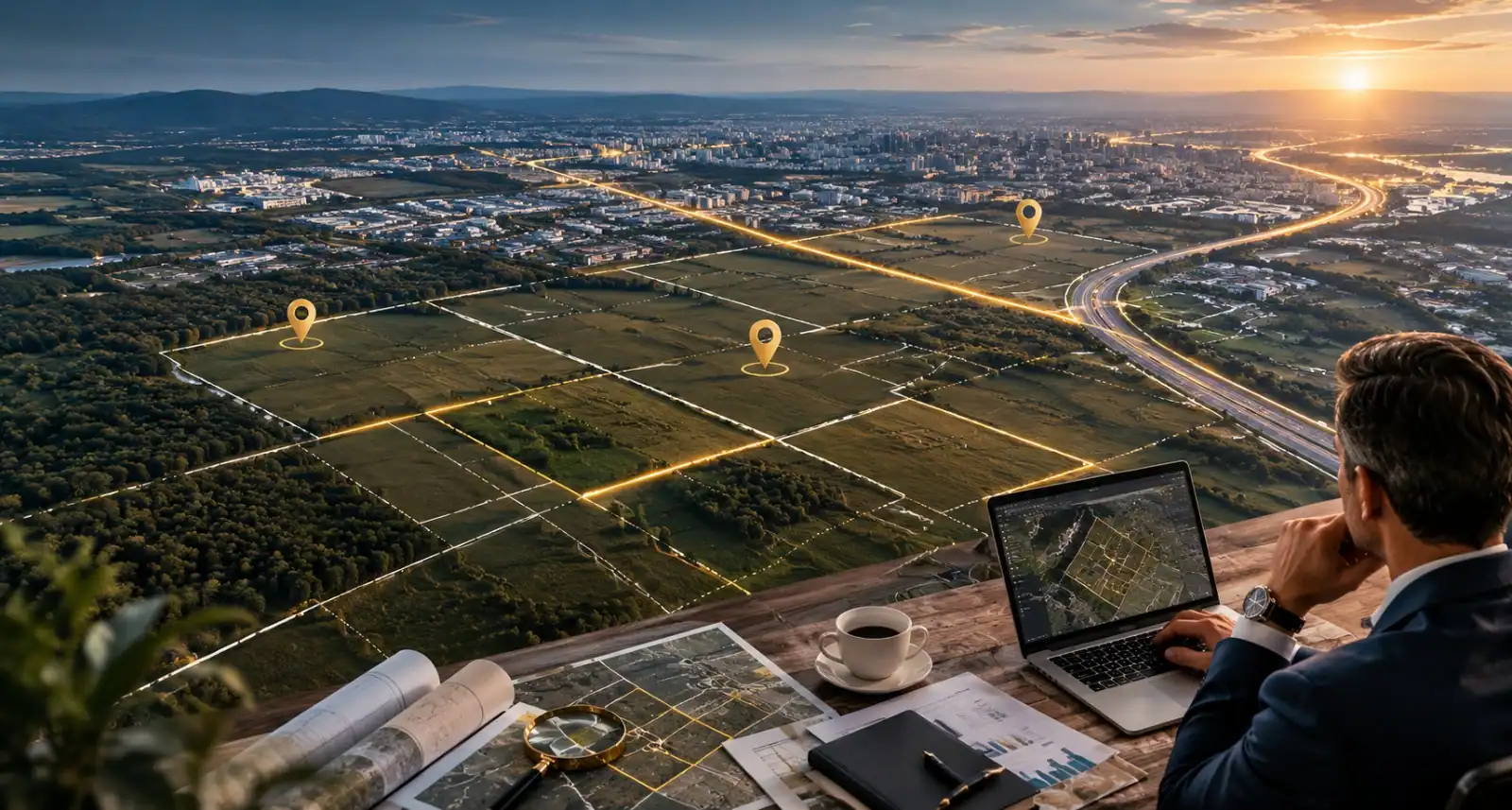
Interest in 2B lands is increasing particularly in urban outskirts, areas close to new transportation projects, industrial and logistics corridors, tourism development regions, and expanding population corridors.
This is because some investors are no longer thinking solely about today’s prices, but rather about the future map of cities.
The fundamental question behind this approach is:
How could a land area that appears low-value today position itself within tomorrow’s urbanization system?
Not Every 2B Land Is an Opportunity
One of the biggest misconceptions about 2B lands is evaluating all such lands within the same investment category.
Some 2B lands merely appear inexpensive, while others may truly hold strategic value.
The main factors that determine this distinction include:
1. Proximity to Urban Settlement
The value of land is related not only to its current location, but also to the direction in which urban growth is progressing.
Before making an investment decision, the following questions should be asked:
- In which direction is the city expanding?
- Toward which axis is the population shifting?
- In which regions are municipal investments intensifying?
- Are there nearby housing, industrial, tourism, or transportation projects?
Purchasing land solely because it has a large square meter size—without answering these questions—may fail to generate the expected value for many years.
2. Cadastral Road Access and Accessibility
In Türkiye, many investors focus only on location when purchasing land. However, accessibility is at least as important as location itself.
Areas lacking cadastral road access, suffering from transportation issues, or having limited infrastructure access may appear large on paper, yet create serious problems in terms of practical use and long-term appreciation.
For this reason, professional investors first ask one critical question:
Is this land genuinely accessible?
A 2B land parcel with accessibility problems may become disadvantaged both in terms of usability and future liquidity.
3. Regional Development Dynamics
The value of land is not always created within its own boundaries. More often, value begins with surrounding developments.
For example:
- New industrial investments
- Organized industrial zones
- Logistics centers
- Port connections
- High-speed rail projects
- Highway connections
- Tourism investments
- University and campus expansions
can directly influence a region’s future value.
The land activity currently observed in certain regions of Türkiye is also largely driven by these types of development dynamics.
The Real Value in 2B Lands: Process Management
Many investors purchase land but fail to manage the process correctly. In 2B investments, however, true value often emerges not only from the acquisition price, but from how the process itself is managed.
The main factors that require attention in 2B investments include:
- Legal status analysis
- Cadastral and road access verification
- Actual usage assessment
- Title deed and rights-holder processes
- Regional development analysis
- Payment models and cost calculations
- Correct positioning strategy
- Long-term exit strategy
Some investors simply buy land. Others attempt to interpret future urbanization, population movements, investment corridors, and state planning together.
This is generally where the major difference emerges.
Türkiye’s New Real Estate Perspective: From Small Parcels to Area Control
In the coming years, Türkiye’s real estate investment mentality is likely to evolve.
While many investors in the past focused primarily on single apartments, small parcels, or short-term price movements, some investors today are increasingly concentrating on controlling larger-scale land areas.
The areas where this transformation is becoming most visible include:
- Development corridors
- Urban growth axes
- Logistics connection zones
- Industrial transformation areas
- Tourism development regions
- Areas surrounding new transportation projects
For this reason, the 2B system may become one of the more widely discussed subjects in Türkiye’s real estate market in the coming years.
However, the key point to remember is this:
2B lands generate value not simply because they offer large square-meter areas, but only when they are positioned within the right region, under the right legal status, and within the right development scenario.
What Are the Risks of Investing in 2B Lands?
2B lands may offer potential, but as with any investment, there are significant risks that must be considered.
The primary risks include:
- Unclear legal status
- Incomplete title deed processes
- Lack of cadastral road access
- Unrealistic zoning expectations
- Slower-than-expected regional development
- Delays in infrastructure investments
- Incorrect pricing
- Absence of an exit strategy
For this reason, making investment decisions based solely on “cheapness” can be a serious mistake.
A professional approach requires analyzing not the land’s current price, but the future planning and development system it may become part of.
Conclusion: 2B Is Not Simply a Cheap Land Story
Viewing 2B lands merely as “cheap square meters” is both incomplete and risky.
Because in real estate, true value is often created not by the land’s current condition, but by the future system to which it will become connected.
For this reason, a professional evaluation of 2B lands should include:
- Regional analysis
- Cadastral and accessibility control
- Legal process review
- Urban growth direction analysis
- Infrastructure projects
- Population and investment movements
- Risk analysis
- Long-term scenario assessment
In real estate, the biggest difference sometimes lies not only in “what” you buy, but in which transformation you position yourself within.
And that is precisely why 2B lands represent an investment field that must be interpreted carefully. When analyzed correctly, they may present strategic opportunities; when evaluated incorrectly, they can immobilize capital for long periods of time.