TÜRKİYE’S NEW AXES | #10 THE ANTALYA ALANYA MOTORWAY AND THE TRAVEL TIME PREMIUM IN REAL ESTATE
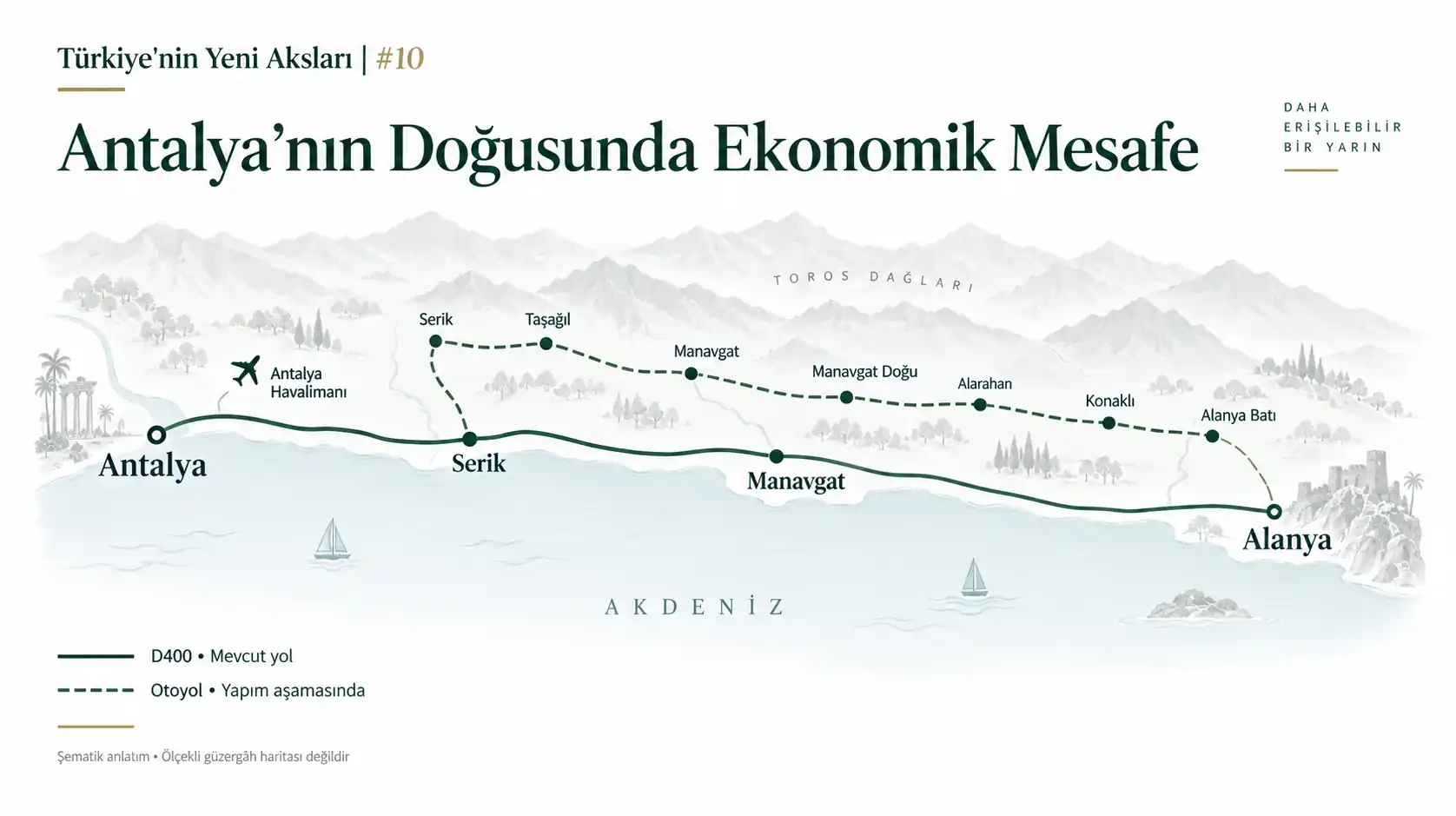
A New Travel Time Map East of Antalya
By changing travel times along the Serik–Manavgat–Alanya corridor, the Antalya–Alanya Motorway could reshape the relationships between tourism, agriculture, commerce and real estate. Where and to what extent this effect emerges will depend as much on how economic activities connect to the road as on where the road runs.
In real estate, we often describe distance in kilometres. For investors and businesses, however, the key measure is how long it takes to reach the centre they need. Access to an airport, customers, employees or production areas can change without a place’s geographical location changing.
This is the perspective through which the area east of Antalya should be assessed. Alongside their tourism facilities, Serik, Manavgat and Alanya are connected through agricultural production, hotel supply chains, services and the daily movements of their resident populations. The new motorway’s economic significance will emerge from the time advantage it can bring to these relationships.
Current Status and Route of the Antalya Alanya Motorway
The project, whose groundbreaking took place on 25 July 2025, was planned with a total length of 122 kilometres: 84 kilometres of main carriageway and 38 kilometres of connecting roads. Starting in Serik and continuing towards Taşağıl, Manavgat, Alarahan and Konaklı, the route extends to the west of Alanya.
According to the Ministry of Transport and Infrastructure’s statement of 25 August 2026, physical progress stands at 30%. Work is continuing on all five tunnels and 15 of the 16 viaducts. These are indicators of the construction phase; they do not mean that the motorway has opened to traffic. Source: UAB project statement, 25 August 2026.
The financing agreement signing ceremony took place on 6 October 2025. The Ministry announced an investment cost of €2.429 billion, with a financing structure of 30% equity and 70% bank loans. Approximately €1.7 billion in lending was secured through a structure involving 14 financial institutions, eight international and six domestic. Sources: UAB financing statement. Limak, date of the signing ceremony.
The Ministry aims to reduce the journey, which takes approximately 2.5 hours under normal conditions on the existing road and up to 4 hours during busy periods, to 36 minutes once the project is completed. The stated duration is a project forecast. Reaching the interchange, leaving the motorway and completing the final stretch on local roads will also affect the total duration of each journey.
Serik’s Role from Entry Point to Distribution
As the route’s western entry point, Serik could gain importance in distributing economic activity from central Antalya and the airport area towards the east. The first thing to monitor here is the activity that will use the new access, before focusing on land around the motorway.
Hotel supply chains, storage, agricultural freight transport and vehicle services can be considered in this context. Field research should examine whether businesses are changing their location choices, whether delivery times are falling and where traffic leaving the D400 creates demand for services.
Not every property in Serik will enjoy the same transport advantage. Considering usable interchange access together with the property’s conditions of use makes the actual economic significance of proximity on a map easier to understand.
The Connection between Tourism and the Everyday Economy in Manavgat
The project includes two interchanges, Manavgat and Manavgat Doğu. These connections call for Manavgat to be examined not only as a place traffic passes through, but also in terms of tourism around Side, employee transport, everyday commerce and supply relationships.
Access to a tourism facility is not limited to visitor transfers. Employee transport, food and equipment deliveries, maintenance services and daily connections with surrounding settlements also affect a business’s time and cost structure.
Real estate research in Manavgat should therefore not be limited to asking, “How close is it to the motorway?” A more useful question is: how many minutes does it take to reach the nearest usable interchange from the property, and which economic activity does that connection serve?
Distinguishing Proximity from Access in Alarahan and Konaklı
A motorway passing alongside a property does not mean that the property has a direct connection to it. Around Alarahan and Konaklı, too, the quality of the local road leading to the interchange and the total access time are decisive considerations in valuation.
Consider a purely hypothetical example: a plot 500 metres from the motorway might require a 15-kilometre journey to reach a usable interchange. Another plot farther from the motorway might reach the interchange in 5 minutes. This example does not represent an actual plot or a measured route; it illustrates why straight-line distance alone is insufficient.
The local road network, topography, continuity of the connection and intended use can widen this difference. For land investment, an access advantage cannot be assessed independently of the property’s zoning and ownership conditions.
Travel Time and Capacity in Alanya’s Airport Connection
For Alanya, the issue goes beyond reaching Antalya more quickly; it concerns how the connection with international tourism flows operates. This relationship becomes clearer when the capacity expansion at Antalya Airport is considered together with road access towards the east.
The new terminal buildings, which entered service on 12 April 2025, increased the airport’s annual passenger capacity from 35 million to 82 million. According to the Ministry’s statement, the number of passengers served in the first quarter of 2026 rose by 5% compared with the same period a year earlier, reaching 3,138,499. Capacity and actual passenger traffic are different indicators; 82 million is not an actual annual passenger count. Source: UAB, Antalya Airport terminal and passenger data.
The 36-minute target announced for the motorway should not be read as the total transfer time from the airport to any hotel or home in Alanya. Leaving the airport, connecting towards Serik, using the chosen interchange and reaching the final destination will all form part of the total journey time.
What matters for tourism and housing demand is how this total time changes in practice and how that affects users’ preferences. An increase in airport capacity alone cannot be expected to generate the same demand in every area.
What the Travel Time Premium Means in Real Estate
In this article, I use the term “travel time premium” to describe the functional advantage that may arise when a property can reach economic centres more quickly without its location changing. This is not a measured rate of price growth or a rule of automatic appreciation.
For the advantage to translate into real estate demand, it must be reflected in users’ behaviour. Businesses opening new warehouses or distribution points, changes in hotel supply arrangements, employees’ residential choices and new commercial uses may demonstrate this response.
A longer tourism season, employment growth or changes in housing demand can also be monitored; however, it would be wrong to attribute all such developments to the motorway. Understanding transport’s contribution requires comparisons across periods and similar regions, alongside consideration of other economic conditions.
An increase in asking prices alone does not prove that a travel time premium has emerged. A more robust investment analysis is possible when completed transactions, rental demand, intensity of use and businesses’ location choices are assessed together.
How Commercial Activity along the D400 Could Change
To understand the new motorway’s impact, we must also examine the existing D400 corridor. Hotels, restaurants, filling stations, retail businesses and roadside services along the coast are connected to today’s traffic patterns.
The diversion of some long-distance traffic onto the motorway could reduce congestion in certain settlements and improve living conditions and local transport. Conversely, businesses whose income depends on passing traffic could be adversely affected by changing customer flows. The scale of these effects will become clear through the actual distribution of traffic.
Research should therefore ask two questions together: where is new access generating activity, and where is existing activity receding? Expecting a business on the D400 and a logistics site connected to a new interchange to be affected in the same way overlooks differences in their local economies.
The Mediterranean’s Connection to the Wider Motorway Network
The Antalya–Alanya route is also being considered within the wider transport network. The entire 163-kilometre Aydın–Denizli Motorway opened to traffic on 17 October 2024. The Ministry states that this road reduced the journey between Aydın and Denizli to 55 minutes. Source: UAB, opening of the Aydın–Denizli Motorway.
The Ministry’s statement of 27 May 2026 sets out the aim of integrating the Antalya–Alanya Motorway into the network extending to İzmir, İstanbul and the European border, through the Denizli–Burdur and Burdur–Antalya motorways planned for implementation in future years. Source: UAB, the motorway network extending from the Mediterranean to Europe.
The operational Aydın–Denizli Motorway, the Antalya–Alanya Motorway under construction and the other planned connections are at different stages. Presenting future network integration as a transport option already fully available today can distort the time dimension of an investment assessment.
Indicators to Monitor from Anadolu Properties’ Perspective
At Anadolu Properties, we begin by examining this corridor through a map of travel times. While a property’s location remains fixed, the economic area it can access may change. Understanding that change requires monitoring land use and investment decisions around the road as closely as its construction.
The project includes seven interchanges: Serik, Taşağıl, Manavgat, Manavgat Doğu, Alarahan, Konaklı and Alanya Batı. Each connects to a different local economy; this does not automatically turn every interchange’s surroundings into an investment location.
Planning decisions around the interchanges, permitted uses, warehouse and logistics investments, agricultural supply facilities, tourism businesses’ choices and new residential areas should be examined together. Business openings, employment, rental activity and completed sales help show whether expectations are translating into economic activity.
At property level, zoning status, title and ownership structure, agricultural and conservation status, the effects of expropriation, interchange access, topography, infrastructure, market demand and liquidity must also be assessed. Particularly for investors monitoring the region from a distance, it is important to consider official project information, site inspections and valuation data together.
Early signals are not limited to construction progress or changes in asking prices. Changes in economic actors’ behaviour should also be monitored. Tracking the new access map together with the redistribution of existing commercial activity along the D400 therefore provides a more comprehensive approach.
Economic Distance Can Change While Kilometres Remain the Same
Along the Antalya–Serik–Manavgat–Alanya corridor, the new motorway has the potential to change the time relationships underpinning tourism, production and everyday life. How this potential is reflected in the real estate market will depend on actual access, conditions of use and the demand that emerges.
In the period ahead, the key is to monitor which activities actually use the new connection, as well as which places are close to the road. If a producer can deliver more quickly, a business can change its supply arrangements or a settlement can participate more easily in everyday economic relationships, the economic meaning of distance also begins to change.
The geography may remain the same. Yet when access times change, the economic map can be reshaped. Interpreting this transformation correctly requires testing infrastructure expectations against actual activity and property-specific data.
This article is intended for general information and research. Project targets do not represent realised outcomes; proximity to transport investments does not guarantee appreciation or investment returns for any property.
Mustafa Yılmaz
CEO – Anadolu Properties
Europe–Türkiye Investment Bridge