TÜRKİYE–POLAND TRADE TARGET OF USD 15 BILLION: POTENTIAL EFFECTS OF THE DEEPENING TURKISH BUSINESS NETWORK IN EUROPE ON REAL ESTATE AND THE INVESTMENT ECONOMY
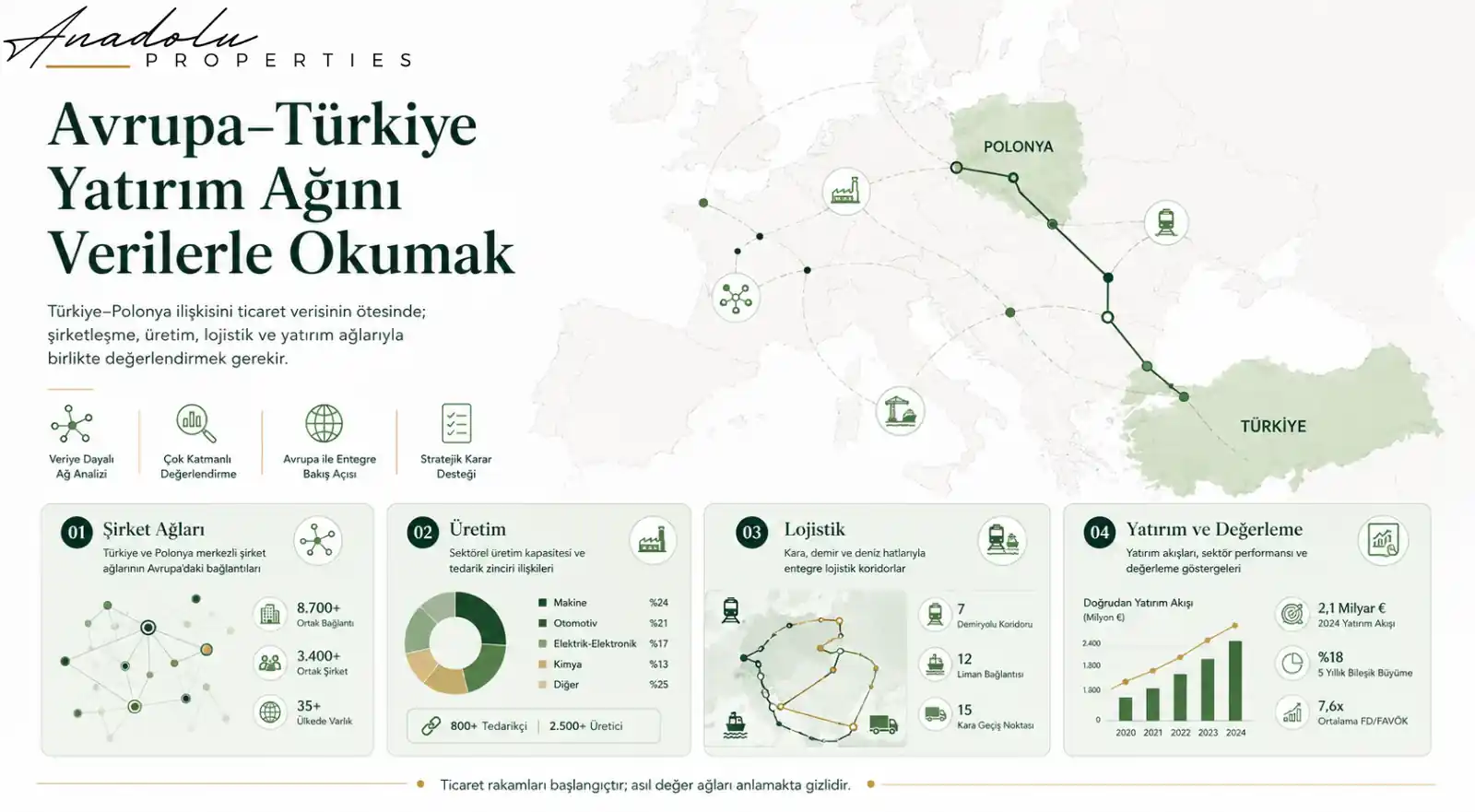
Why Is the Türkiye–Poland Economic Corridor Becoming More Strategic?
As production centers and supply chains are being reshaped across the global economy, companies are not only seeking new markets; they are also building partnerships that can make production, logistics and supply more secure, closer and more resilient. As Central and Eastern Europe gains greater visibility in this transformation in terms of industrial, logistics and infrastructure investment, Türkiye continues to be one of the important actors in this network thanks to its strong production capacity and proximity to the European market.
According to the statement issued by the Republic of Türkiye Ministry of Trade on 6 August 2026, bilateral trade volume between Türkiye and Poland reached USD 12.5 billion in 2025, exceeding the previous joint target of USD 10 billion. The new short-term target is stated as USD 15 billion. The same statement notes that Türkiye’s overseas contracting sector has completed 72 projects in Poland to date, with a total value of approximately USD 10.1 billion.
Reading this picture simply as “trade is increasing” would be incomplete. The more relevant question is: In which sectors is trade growing, which transport and production networks does it rely on, and in which cities can this economic activity translate into a lasting increase in capacity? For real estate and the investment economy, the determining factor is not trade volume alone, but the connection that trade establishes with production, logistics, employment and capital investment.
What Lies Beyond the USD 12.5 Billion Trade Volume?
The growth of the economic relationship between Türkiye and Poland does not simply mean an increase in the flow of goods. As the relationship deepens, inter-company cooperation, engineering services, logistics operations, supplier networks, technology transfer and investment decisions also gain greater importance.
For this reason, it is more appropriate to view the USD 15 billion target not as an “automatic forecast of achievement,” but as an indicator of direction and scale for the economic integration of the two countries. Which sectors will contribute to the target, how balanced the growth in trade will be, and in which geographies new investments will concentrate are issues that should be monitored separately.
At the Poland–Türkiye Economic Forum held in May 2025, energy, renewable energy, chemicals, contracting, automotive and the supplier industry, agriculture, infrastructure, environment and waste management, and logistics were identified among the main areas of cooperation between the two countries. This diversity indicates that the economic relationship is not dependent on a single sector and can extend across different investment channels.
Why Do Poland’s Growth Model and EU-Funded Investments Matter?
Poland’s economic outlook is one of the factors explaining why this relationship is attracting greater attention. According to preliminary data from Poland’s statistical office, the country’s economy grew by 3.6% in real terms in 2025. In the same year, real growth across the European Union was 1.5%. The European Commission forecasts 3.5% growth for Poland in 2026 and states that high levels of EU-funded investment are supporting growth.
The concentration of EU-funded investments in areas such as transport, sustainable mobility, energy and digital infrastructure provides a basis that could strengthen Poland’s production and logistics capacity over the long term. The project track record of Turkish contracting and engineering companies in Poland also shows that the economic link between Türkiye and this infrastructure transformation is not based solely on exports.
At the same time, strong macroeconomic growth does not mean that every sector or every region will appreciate at the same rate. From an investment perspective, the key analysis should focus on the sectors in which growth turns into lasting capacity and the locations where new investment demand becomes tangible.
How Could the Turkish Business and Contracting Network Affect the Investment Economy?
The experience Turkish companies have gained in infrastructure and contracting projects in Poland is an important indicator strengthening the service and investment dimension of the economic relationship between the two countries. Large-scale projects can affect not only the main contractor, but also the ecosystem of construction materials, engineering, machinery, logistics, technical services and subcontractors.
Over time, such business networks can provide a basis for new joint ventures, supply agreements or cross-border corporate structures. However, it would not be accurate to draw a direct conclusion that “trade has increased, therefore Turkish capital is expanding rapidly in Europe.” To assess capital movements, separate indicators such as foreign direct investment stock, new company formations, acquisitions, joint ventures and permanent operating investments need to be monitored.
A similar distinction is important from a real estate perspective. Contracting project volume alone does not prove demand for residential or commercial real estate. For the impact to become lasting, project activity needs to translate into tangible occupancy and use demand, such as employment, company establishment, warehouse and logistics needs, office demand or new production capacity.
Which Production and Logistics Centers in Türkiye Should Be Monitored?
For Türkiye, production centers integrated with the European market are among the areas that should be monitored most closely. In the Marmara Region, Istanbul, Kocaeli, Bursa, Sakarya and Tekirdağ are among the important production clusters through which changes in European trade can be assessed, due to their automotive, machinery, chemicals, supplier-industry and logistics connections. In Central Anatolia, industrial centers such as Ankara, Eskişehir and Kayseri can also be considered as different links in this integration on a sector-by-sector basis.
However, it would not be appropriate to declare these cities “winning locations” simply because they have strong industrial infrastructure. To assess the impact of growth in Türkiye–Poland trade on a specific city, product-group export data, company locations, Organized Industrial Zone capacity, new investment incentives, logistics routes and employment data need to be examined together.
For investors, the correct approach is not to translate country-level trade data directly into an expectation of value appreciation at city or parcel level, but to investigate the intermediate mechanisms through which the economic signal could turn into local demand.
Does Growth in Trade Translate Directly into Real Estate Value?
An increase in trade volume does not mean that real estate values in a particular region will automatically rise. Foreign trade data may be an early macro signal in investment analysis, but its effect on a local real estate market can emerge only through a series of intermediate channels.
For example, mechanisms such as new export orders turning into production-capacity investment, new production creating demand for warehouse and logistics space, improvements in transport infrastructure, employment growth and the formation of supplier clusters can support real estate demand. Without these links, drawing conclusions about value appreciation for land, industrial real estate, residential property or commercial property solely from trade figures remains analytically weak.
Real estate investment analysis should therefore be conducted by considering trade volume together with location, zoning status, existing and planned infrastructure, market comparables, actual use demand and valuation data. Particularly in regions affected by major infrastructure announcements, investment decisions should not be made before official route, planning and expropriation data have been verified.
What Does This Mean for Turkish Investors and the Diaspora in Europe?
The deepening of Türkiye–Poland economic relations can also create a basis for new business connections for Turkish entrepreneurs and investors living in Europe. However, measuring the diaspora effect solely through trade volume is not sufficient.
More meaningful indicators include the company-formation trends of Turkish entrepreneurs in Poland, joint ventures between the two countries, chamber of commerce and business council networks, professional labor mobility, direct investments and the development of cross-border investment models. As these indicators strengthen, it becomes easier to assess whether the economic relationship is evolving from a purely commercial relationship into a more institutional and lasting investment network.
The same principle applies to investors living in Europe who are researching real estate or commercial investments in Türkiye: international trade news may be an initial signal, but investment decisions should be validated with local data such as location, ownership, zoning, valuation, demand and exit scenarios.
Anadolu Properties Analysis: Which Indicators Should Investors Monitor?
The most notable aspect of this development is not only the size of the trade volume, but also the channels through which the economic relationship is deepening. The key question for investors is: In which sectors is this trade growing, and in which production, logistics and investment centers in Türkiye and Poland are these sectors concentrated?
- The distribution and growth rate of Türkiye–Poland trade by product and sector
- Capacity, occupancy and expansion data for Organized Industrial Zones that export to Europe
- New infrastructure, transport and engineering projects undertaken by Turkish contractors in Poland
- The timetable for EU-funded rail, port, road, energy and logistics infrastructure investments in Poland
- Capacity increases in port, customs, rail and transport infrastructure in Türkiye
- New industrial and logistics area planning in cities with intensive trade links to Europe
- Employment, investment incentives and capacity growth in high-value-added manufacturing sectors
- Changes in direct investment, joint ventures and permanent corporate structures between the two countries
- Actual use demand and market comparables for industrial, warehouse, logistics and commercial space in the real estate market
When these indicators are monitored together, it becomes easier to distinguish where trade data reflect genuine economic capacity and where they reflect expectations alone.
From Trade Figures to an Investment Map: The Connection That Really Needs to Be Monitored
The USD 12.5 billion trade volume between Türkiye and Poland and the new USD 15 billion target are important indicators pointing to the expansion of economic networks between Europe and Türkiye. For investors, however, the essential value lies less in the figure itself than in understanding how trade translates into production, logistics, infrastructure, employment and lasting investment decisions.
Today’s trade data do not determine tomorrow’s investment map on their own. Investors who monitor sector, location and infrastructure data together and question the mechanisms through which economic activity could translate into real estate demand can analyze the transformation earlier and within a more realistic framework.
Mustafa Yılmaz
CEO – Anadolu Properties
Europe – Türkiye Investment Bridge