HOW COULD THE BAŞAKŞEHİR–NAKKAŞ MOTORWAY AFFECT ISTANBUL’S WEST–NORTH DEVELOPMENT AXIS?
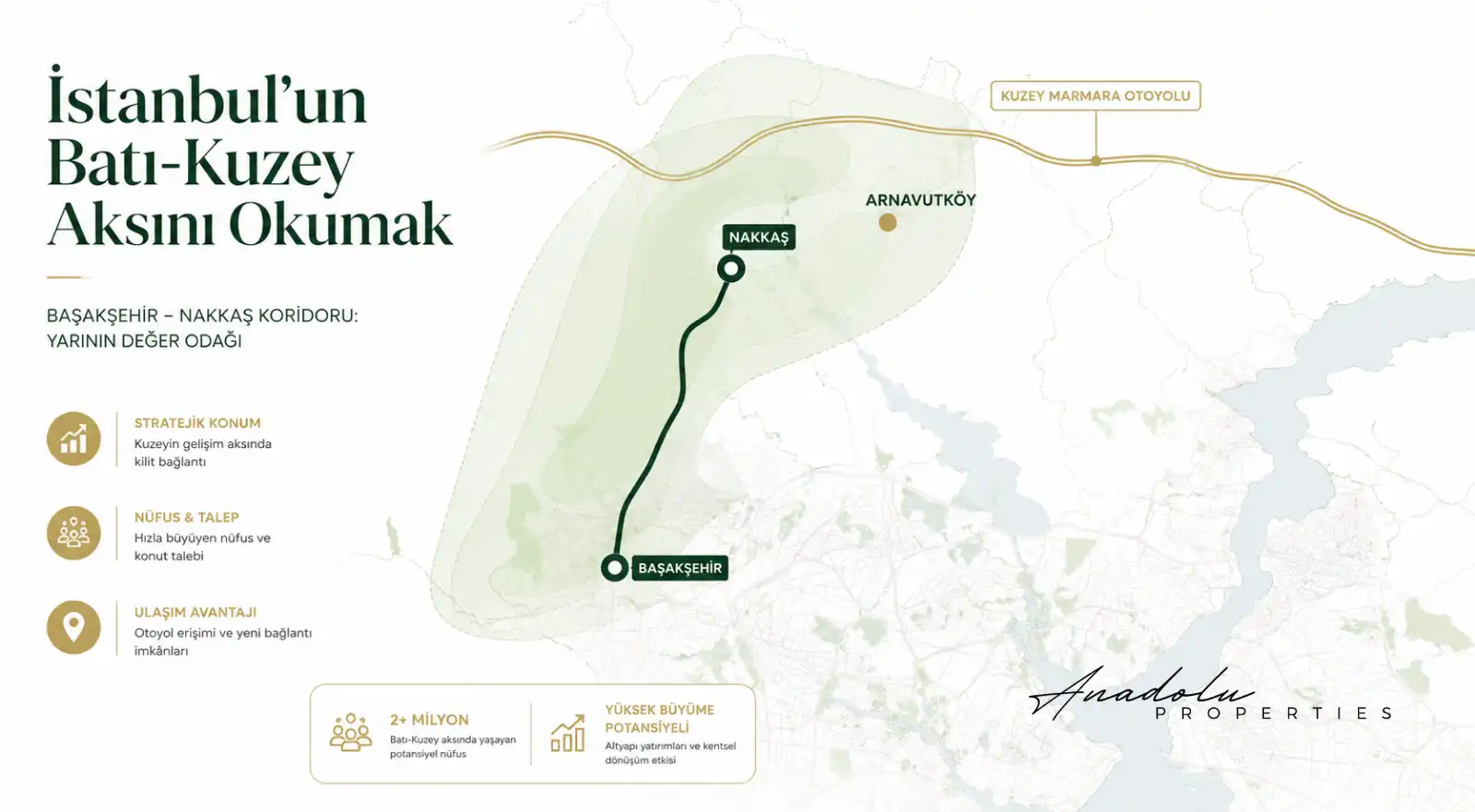
Is the Başakşehir–Nakkaş Motorway Shaping Istanbul’s New Development Corridor?
Having reached more than 80 percent physical progress, the Başakşehir–Nakkaş Motorway should be monitored not only as a new transport route, but also as a strategic infrastructure investment that could influence logistics, industrial, residential and commercial real estate dynamics along Istanbul’s west–north axis.
When a city grows, transport axes change first; then the location decisions of production, trade, warehousing, housing and service areas may be reshaped. For this reason, major motorway projects are multi-layered developments that affect not only vehicle traffic, but also the regional investment map.
Within the scope of the project, a new 45-kilometre transport network is being developed, consisting of a 24.2-kilometre main section and 20.8 kilometres of connection roads. This structure has the potential to integrate Istanbul’s western side more strongly with the Northern Marmara Motorway.
Does a Transport Investment Create Value, or Direct Value?
One of the common mistakes in real estate investment is reading new road projects as a direct and automatic signal of value appreciation. However, transport investments do not create value on their own; they can change the direction of economic activity by increasing accessibility.
For this reason, when projects such as the Başakşehir–Nakkaş Motorway are evaluated, proximity to the route alone should not be the only criterion. Zoning plans, land-use functions, population movements, public investments, private sector interest and the existing economic character of the region should be analysed together.
The Balance Between Logistics and Settlement on Istanbul’s West–North Axis
In recent years, Istanbul’s western and northern axis has stood out with logistics, industry, warehousing, planned settlement areas and the need for commercial use. Developments in Başakşehir, Bahçeşehir, Arnavutköy and the surrounding connections show that this line should be read not only through housing, but also through production and distribution functions.
The Başakşehir–Nakkaş Motorway may be considered one of the projects capable of supporting this transformation. However, the decisive question here is which economic functions the areas through which the road passes will integrate with. Without examining logistics centres, industrial connections, commercial areas and planned residential development within the same data set, it is not possible to make a healthy investment reading.
Road Proximity Alone Is Not an Investment Criterion
A property’s proximity to a motorway may be noteworthy from an investment perspective; however, this is not a sufficient indicator on its own. The real investment value depends on which land-use decisions and which level of economic density support the transport advantage.
In this context, investors should evaluate the following headings together:
- The region’s current zoning function and planning decisions
- The direction of industrial, logistics and warehousing investments
- The characteristics of new housing projects and the demand profile
- The balance between commercial density and accessibility
- The completion schedule of infrastructure investments and their regional impact
- The land’s usability, legal status and valuation data
Without this analysis, decisions based solely on the statement “close to the road” may create an incomplete or misleading framework for investors.
What Do International Examples Show?
International examples such as Seoul and Singapore show that transport infrastructure creates value not on its own, but when combined with an ecosystem of technology, logistics, trade, finance and planned urban development.
In these examples, the factor that enables lasting economic centres to emerge is not merely new roads. The real value is created through production capacity, commercial activity, qualified labour, institutional planning and investment confidence around transport networks.
Anadolu Properties Analysis
The Başakşehir–Nakkaş Motorway is an important infrastructure topic for Istanbul’s west–north development axis. However, a real estate investment decision should not be made solely according to the road route.
Such projects can be read more accurately when examined together with zoning plans, logistics investments, commercial developments, population movements, regional supply-demand balance and valuation reports. This is exactly where the Anadolu Properties approach comes into play: placing the investment decision not on a single news headline, but on an analytical process based on multiple data layers.
Strategic Reading for Investors
When evaluating the real estate potential around the Başakşehir–Nakkaş Motorway, investors need to develop a data-driven perspective rather than a rushed price expectation.
The region’s zoning function, logistics investments, industrial development, new housing projects and whether the transport advantage is supported by economic activity should be analysed together. Especially for Turkish investors living abroad, such infrastructure developments should be read not only through location information, but also through current data, official records, valuation reports and field information.
The Core Dynamic That Determines Lasting Value
In real estate, lasting value is built not only with asphalt, but with the economic life that forms around that road. For this reason, the Başakşehir–Nakkaş Motorway should be evaluated not merely as a transport project, but as a strategic data point through which the new functions, risks and opportunities that may develop on Istanbul’s west–north axis should be read together.
Mustafa Yılmaz
CEO – Anadolu Properties
Europe–Türkiye Investment Bridge