THE DEVELOPMENT ROAD PROJECT AND REAL ESTATE: HOW COULD TURKEY’S NEW TRADE CORRIDOR CHANGE THE VALUE MAP?
Development Road Project: From Trade Corridor to Real Estate Value Map
The statement by Minister of Transport and Infrastructure Abdulkadir Uraloğlu that geopolitical developments in the Middle East are reshaping transport corridors and that, for this reason, the first objective under the Development Road Project is to complete the railway line is not a development that concerns only the transport sector. This statement is part of a strategic transformation that could affect Turkey’s economic direction in the coming years in terms of logistics, foreign trade, industrial investments and the real estate market.
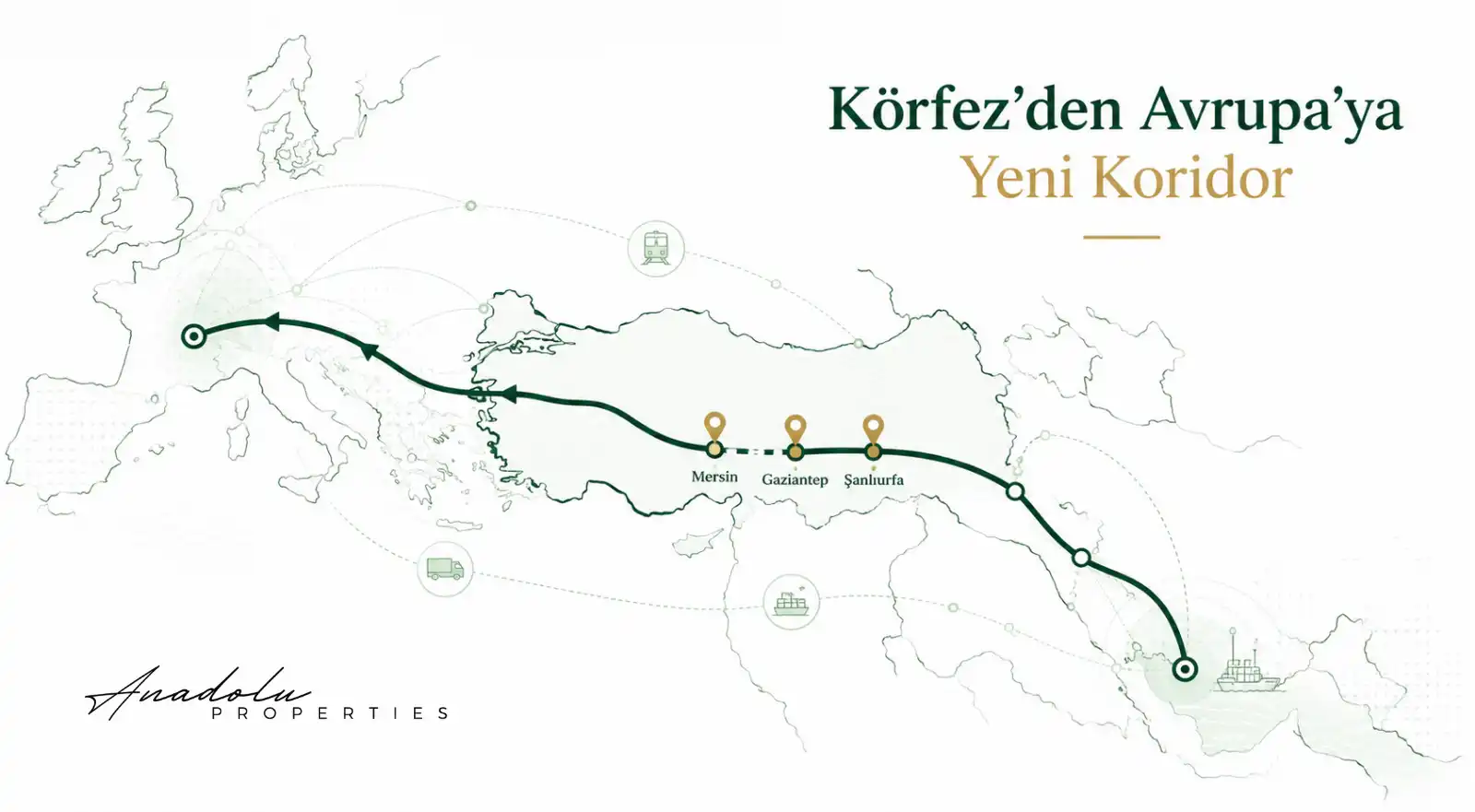
The foundation of this process is not new. The Development Road Project, developed by Turkey, Iraq, Qatar and the United Arab Emirates, covers an approximately 1,200-kilometre railway and highway corridor that will connect the Grand Faw Port in the Persian Gulf to Europe through Turkey. Recent security risks in the Middle East, attacks along the Red Sea route and disruptions around the Suez Canal have made alternative trade corridors more visible on a global scale.
Why Is Global Trade Looking for Alternative Corridors?
Analyses by the World Bank, the OECD and international logistics organisations show that global trade is now being evaluated not only by cost, but also by supply-chain security, route diversification and transport continuity. For this reason, the Development Road is being monitored as a logistics alternative that could become part not only of Turkey’s, but also Europe’s supply-chain strategy.
A significant share of world trade currently moves through the Suez Canal. However, geopolitical crises in recent years, delays in vessel traffic and rising insurance costs have increased the economic and strategic value of alternative routes. At this point, the Development Road aims to create a new logistics backbone connecting the Persian Gulf to Europe through Turkey.
How Do Transport Corridors Affect the Real Estate Market?
Major transport corridors do not merely carry freight. They also reshape production decisions, industrial investments, warehouse demand, logistics centres, port investments and, consequently, the value of commercial real estate. Throughout history, major trade routes have been one of the main carriers of economic growth in the regions they crossed. What has changed today is that caravan routes have been replaced by railways, highways, port connections and logistics centres.
Global examples clearly demonstrate this transformation. Along the logistics corridors created under China’s Belt and Road Initiative, organised industrial zones, free trade areas and logistics parks have developed. In Europe, the railway networks connecting the Port of Rotterdam to Germany and Central Europe have affected not only transportation, but also the value of the surrounding industrial real estate. Similar transport and warehousing investments have also been behind Poland’s emergence over the last decade as one of Europe’s important logistics centres.
For Turkey, the Impact Area Is Not Limited to Southeastern Anatolia
From Turkey’s perspective, the impact of the Development Road may not remain limited to Southeastern Anatolia. Freight movement starting from the Persian Gulf could connect to Turkey’s existing railway and highway network through Şanlıurfa, Gaziantep, Mardin, Adana, Mersin and Osmaniye. It could then become part of a broader trade flow extending toward Central Anatolia, Marmara and European markets.
This potential may create new investment themes for production and logistics centres along the corridor. However, a critical distinction must be made here: a corridor being planned on the map and that corridor beginning to generate economic value are not the same thing. Infrastructure must be completed, railway connections must be established, port integration must be secured, customs procedures must be accelerated and international freight volume must shift toward this corridor.
In Real Estate, the First Impact May Be Seen in Industry and Logistics, Not Housing
From a real estate market perspective, the first impact is more likely to be seen not in housing, but in industrial and logistics real estate. Railway-connected organised industrial zones, logistics warehouses, distribution centres, bonded warehouses and port-back commercial areas may be directly affected by this process. This is because production and logistics investments come before housing demand.
In the housing market, a more indirect effect should be expected. As industrial investments increase, employment grows, the service sector develops and, over time, qualified housing demand may emerge. A similar development sequence is observed in logistics centres around the world: first infrastructure and production functions, then commercial activity, and later permanent housing and service demand.
A Strategic Reading for Mersin, Gaziantep and Şanlıurfa
Cities such as Mersin, Gaziantep and Şanlıurfa should be monitored more closely in this process. The role of Mersin Port in international freight movement, Gaziantep’s strong industrial infrastructure and Şanlıurfa’s developing production capacity could make these cities part of a stronger logistics network together with the Development Road.
However, the realisation of this potential depends on the project progressing as planned and on private-sector investments accompanying the process. Therefore, investment decisions should not be evaluated only through news flow, but through project phases, the public investment timetable, port connections, railway integration, occupancy rates in organised industrial zones and commercial-use functions.
Which Data Should Investors Track?
At Anadolu Properties, we do not evaluate the Development Road Project merely as a new transport investment. This project is a strategic economic transformation theme that could strengthen Turkey’s role in the global trade network, improve its logistics infrastructure and change the direction of industrial investments. For this reason, it should be followed through data, especially in terms of industrial land, logistics warehousing areas, organised industrial zones and commercial real estate.
- In cities along the Development Road route, monitor not only the housing market, but also industrial and logistics investments.
- Regularly track public investment timetables for organised industrial zones, logistics warehousing areas and port-connected commercial real estate.
- In land investments, evaluate not only proximity to the corridor, but also zoning status, transport connections and use function.
- Analyse separately industrial and warehouse investments with high rental potential in production regions connected to railways.
- Base decisions not on short-term news flow, but on the project’s phased progress and changes in international freight volume.
- Build a long-term investment strategy by evaluating Turkey’s Development Road, Middle Corridor and Europe-connected logistics projects together.
The Main Dynamic That Determines Value: Not Proximity to the Corridor, but Economic Function
Not every corridor-related news item makes every land parcel or every city valuable to the same extent. Real value is formed together with transport connection, zoning status, production capacity, logistics access, port integration and the completion level of public investments. Therefore, investment decisions should analyse not only proximity to the corridor, but also economic function.
Global trade now competes not only on where production is carried out, but also on how quickly, at what cost and with what level of security a product reaches the market. For this reason, railway corridors, ports and logistics centres will be among the important value generators of the real estate market as much as of industry in the coming period.
From this perspective, the Development Road Project is not merely a new railway line. It is a strategic infrastructure move that redefines the role Turkey could assume in the trade network between Europe, the Middle East and the Gulf countries. For investors who want to read this transformation correctly, the key issue is not the line on the map, but the production, logistics, zoning and commercial-use relationship that will form around that line.
Mustafa Yılmaz
CEO – Anadolu Properties
Europe – Turkey Investment Bridge