TURKEY-ARMENIA TRANSPORT CONNECTIVITY PROCESS: A NEW TRADE CORRIDOR FOR EASTERN ANATOLIA?
How Should a New Trade Corridor for Eastern Anatolia Be Interpreted?
The renewed progress in the process aimed at developing transport links between Turkey and Armenia may at first appear to be a development that can be assessed within the framework of diplomatic relations. From an economic perspective, however, the issue covers a much broader field. Transport corridors, border trade, logistics centers and regional development are among the strategic factors that could affect Eastern Anatolia’s investment dynamics over the long term.
This process is not new. The land border between Turkey and Armenia has been closed since 1993. Nevertheless, the normalization talks conducted in recent years at the level of special representatives have brought issues such as border crossings, the Kars-Gyumri railway, technical infrastructure and transport connections back onto the agenda.
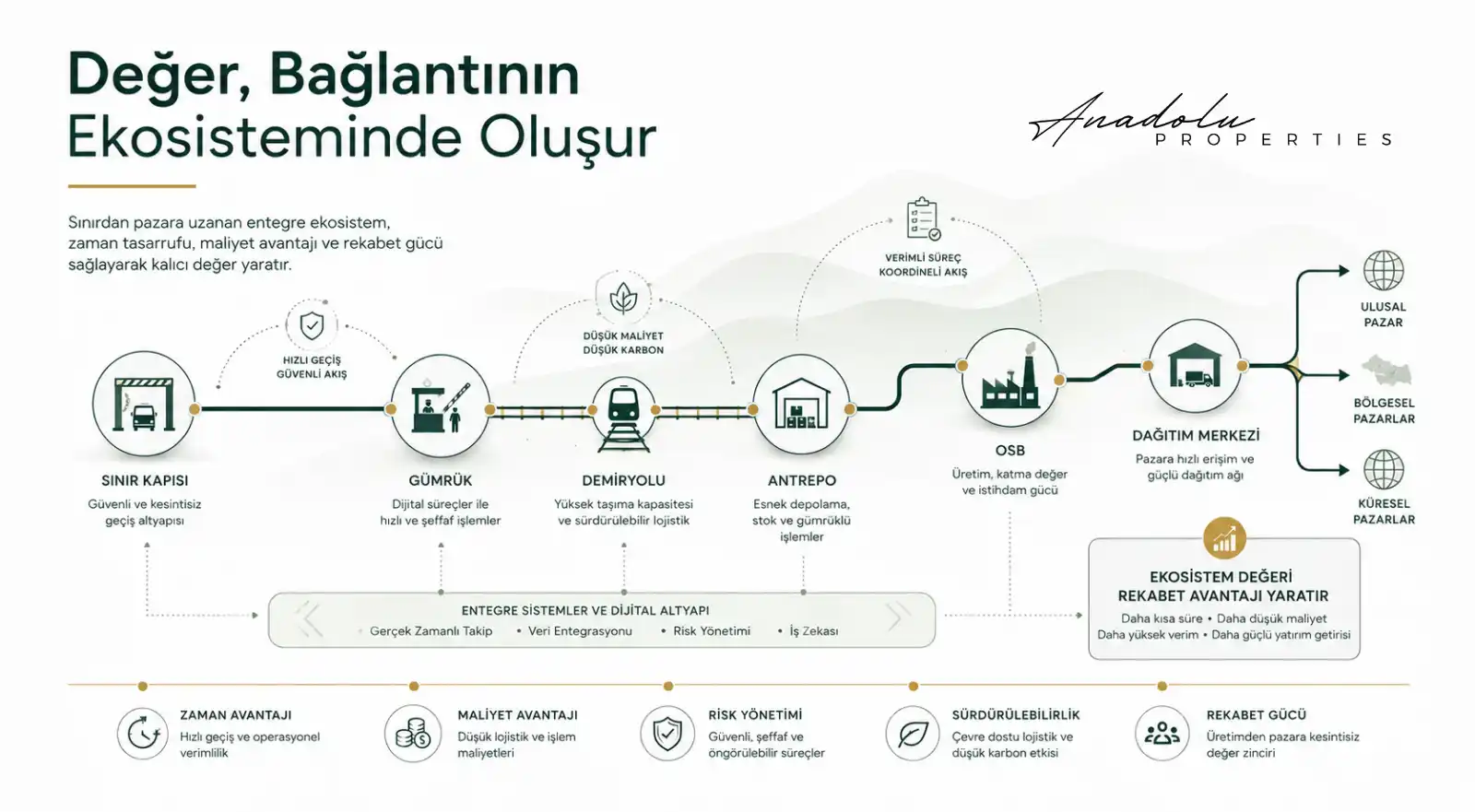
Reading this development only as a step that could increase trade between Turkey and Armenia would be incomplete. The issue is also directly related to the future trade networks of the South Caucasus, Middle Corridor connections and Eastern Anatolia’s production-logistics axis.
Transport Connectivity Does Not Create Value on Its Own
One of the most common mistakes in real estate investment is interpreting every new connection visible on a map as an automatic increase in value. In reality, true value does not arise from the political statement itself, but from the economic function that this statement generates on the ground.
Route information alone is not sufficient for a border line or railway connection to affect the regional real estate market. Political consensus, legal regulations, border infrastructure, customs systems, railway modernization, trade volume and private-sector investment must emerge together. For this reason, the Turkey-Armenia transport process should be evaluated from the perspective of long-term regional transformation rather than short-term price movements.
The Strategic Meaning for the Middle Corridor and Caucasus Connections
Turkey is one of the critical countries of the Middle Corridor between Europe and Asia through its links with Azerbaijan, Georgia, Caspian crossings and Central Asia. The development of transport connections with Armenia may contribute to strengthening alternative crossing points and regional trade relations within this network.
When global examples are examined, the reopening of border gates or the activation of transport corridors does not only increase foreign trade volume. Logistics investments, industrial zones, storage facilities, bonded areas and commercial real estate demand also become part of this process. Border logistics clusters in Europe, Central European railway corridors and new trade routes in Central Asia clearly demonstrate this relationship.
Which Cities May Fall Within the Direct and Indirect Area of Impact?
From Turkey’s perspective, Kars, Igdir, Ardahan and the surrounding provinces can be considered within the natural impact area of this process. In these cities, border crossings, railway links, logistics areas and trade infrastructure should be monitored more closely.
In addition, cities such as Erzurum, Erzincan and Sivas, which have production, connectivity and distribution capacity, may also fall within the indirect area of impact. Transport corridors affect not only the cities located on the border line, but also the inland production centers and main distribution axes to which these lines are connected.
At this point, the key question for the investor is this: In which city will the new connection create economic activity, which industrial zone will it support, and in which type of real estate will it generate measurable demand?
Where Could the First Impact Be Seen in the Real Estate Market?
In such regional transport processes, the first strong impact in the real estate market is expected to appear in industrial and logistics areas before housing. The development of border trade may increase interest in warehouses, logistics depots, bonded areas, distribution centers, industrial parcels and organized industrial zones.
For this reason, not every plot close to transport connections has the same potential. Planned industrial areas, commercial parcels with clear zoning status, storage zones with strong access to main transport axes and locations supported by public investment plans should be examined more carefully.
Why Should the Housing Effect Be Read With a Delay?
The effect on the housing market should be expected to emerge in a more limited and gradual process. It is not healthy to speak of a permanent value change in the housing market before production, trade and employment growth materialize.
International examples show that economic activity increases first in transport corridors, followed by labor mobility and only then housing demand. Therefore, instead of expecting housing prices to rise based solely on news flow, employment, industrial investment, rental-market and population-movement data in the region should be monitored together.
Which Data Should Investors Track?
When evaluating the Turkey-Armenia transport process from a real estate investment perspective, it is not sufficient to focus on a single news headline or route expectation. An investment decision should be made by reading official statements, the infrastructure timetable, trade volume, regional plans and field data together.
- The usage model and scope of crossings at border gates
- Progress on the Kars-Gyumri railway and related transport projects
- Customs infrastructure, logistics-center and storage capacity
- Occupancy, expansion and investment appetite in organized industrial zones
- Zoning status, transport access and public investment plans in land investments
- Regional employment, trade volume and population movements
- Level of integration with the Middle Corridor, Caucasus connections and other transport projects
Practical Checklist for Investors
- Do not evaluate transport connections as a standalone investment criterion; analyze logistics infrastructure, industrial investments and trade volume together.
- Regularly monitor planned transport and logistics investments in cities such as Kars, Igdir, Ardahan and Erzurum.
- Assess the impact of developments in border trade on organized industrial zones and logistics storage areas separately.
- In land investments, examine zoning status, transport connection, ownership structure and public investment plans together.
- Act with a 5- to 10-year regional development perspective, not according to short-term news flow.
- Analyze in a data-based way how Turkey’s Middle Corridor, Caucasus and Eastern Anatolia transport projects complement one another.
Reading Corridors Through Implementation, Not News
The process aimed at developing transport links between Turkey and Armenia is a strategic development that should be closely monitored not only in terms of relations between the two countries, but also in terms of Turkey’s logistics strength, foreign trade capacity and Eastern Anatolia’s economic future.
However, in the real estate market, lasting value emerges not from diplomatic statements, but when implementation begins, trade volume is formed and the logistics-economic ecosystem strengthens on the ground. For investors, the key issue is therefore not hearing about the process early, but reading it through the right data, in the right locations and with the right timing perspective.
Mustafa Yılmaz
CEO – Anadolu Properties
Europe – Turkey Investment Bridge