IS TURKEY’S FUTURE NOT IN CONCRETE, BUT IN PRODUCTIVE LAND?
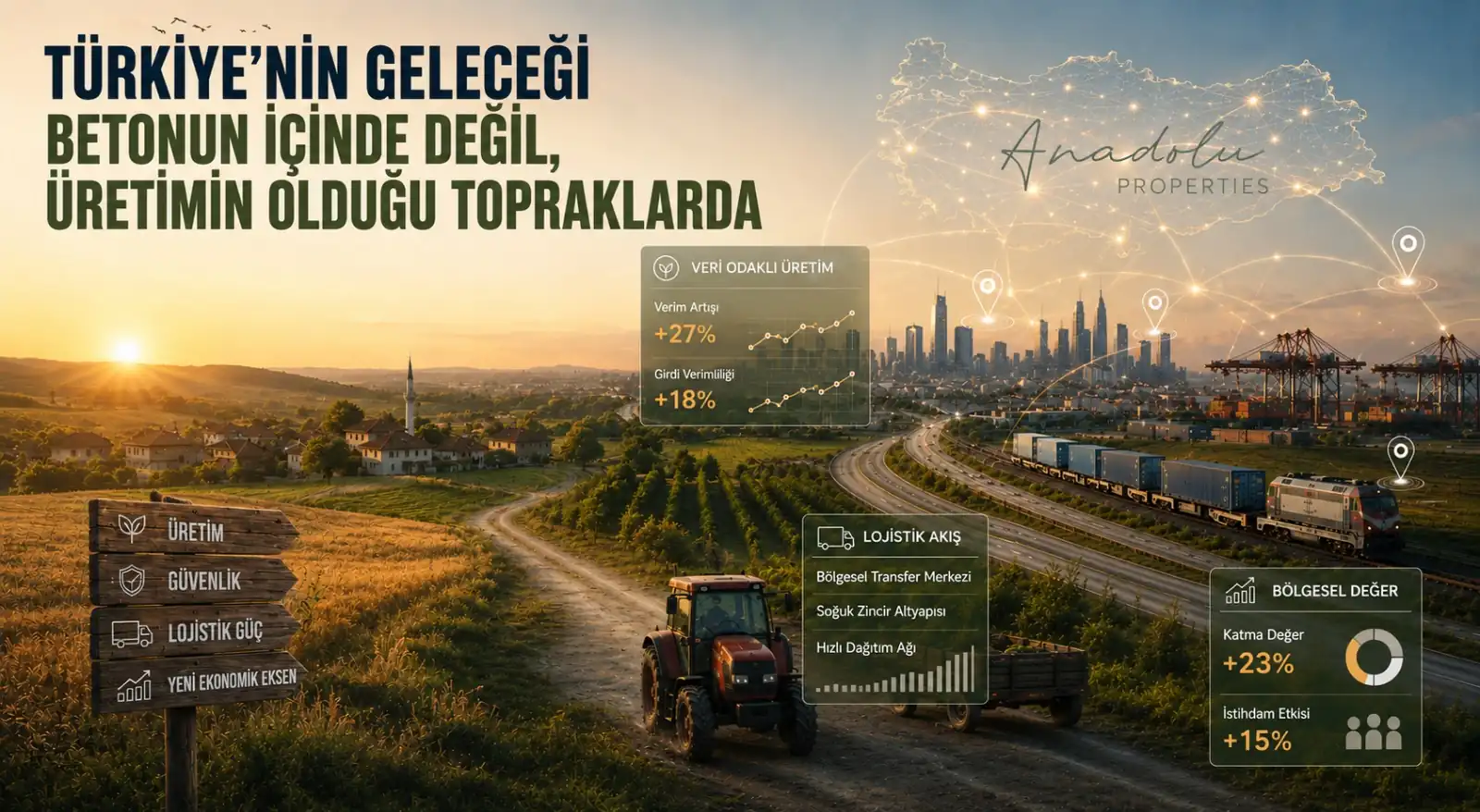
Return-to-Village Policies Are Back on the Agenda: Is Turkey on the Verge of a New Wave of Rural Development?
One of the most notable transformations observed around the world in recent years has been the shift of people away from major cities toward more sustainable, production-oriented regions with a higher quality of life.
This trend, which gained momentum after the pandemic, has begun to influence not only individual lifestyle preferences but also government policies across many countries, from Europe and America to Asia and Turkey.
In Turkey, rural development is no longer viewed solely as an agricultural policy. It is also being assessed in terms of the economy, demography, food security, energy, production capacity and strategic population management.
The new circular and rural development support mechanisms published in the Official Gazette with the signature of President Recep Tayyip Erdoğan are also being interpreted as important signs of this transformation.
Why Has Rural Development Become Strategic Again?
For many years, Turkey’s population has been concentrated in major cities. While centers such as Istanbul, Ankara and Izmir became the main engines of economic growth, many villages aged, production declined and the economic strength of rural areas weakened.
However, the picture is changing today.
Modern states are no longer focusing only on urban growth, but also on much broader strategic priorities:
- Food security
- Production sustainability
- Energy costs
- Strategic agricultural areas
- Population balance
- Local production capacity
- Supply chain security
Global crises have shown that urban economies based solely on consumption can become fragile in the long term.
For this reason, the “productive rural model” is once again gaining importance worldwide.
What Is Turkey Aiming For?
The main objective of the new support packages is not merely to encourage people to move back to villages.
The real objective is to create economically viable rural regions.
This is a critical distinction.
Because while many rural support models in the past remained at the level of social assistance, the new approach points to a more comprehensive understanding of development.
The key areas highlighted in this approach are:
- Increasing production capacity
- Supporting rural investments
- Strengthening cooperatives
- Bringing young people back into rural areas
- Expanding technological agricultural practices
- Encouraging rural entrepreneurship
This transformation is also directly linked to Turkey’s new economic architecture.
The Key Concept of the New Era: Smart Rural Development
Today’s rural model is no longer limited to traditional agricultural activities.
The new-generation rural economy is evolving into a more integrated structure that brings together production, technology, energy, logistics, tourism and digital marketing.
The core components of this model are:
- Smart agricultural technologies
- Data-driven production
- Solar energy investments
- Hybrid models combining agriculture and tourism
- Natural living concepts
- Rural logistics centers
- Organic production chains
- Direct sales channels through digital marketing
For this reason, the concept of the village is also changing.
The rural areas of the future may be positioned as new economic centers that offer lower costs, a higher quality of life and value creation through production capacity.
How Should the Real Estate Sector Interpret This Process?
This is precisely where the critical issue begins.
Rural development support mechanisms do not only create social transformation. They may also create new areas of activity in the real estate market.
This process may generate economic activity particularly in the following asset groups:
- Land plots
- Agricultural land
- Village houses
- Rural tourism areas
- Agro-investment regions
- Rural areas connected to production and logistics
However, there is an important point that must be considered here:
Not every rural region is an investment opportunity.
On the contrary, rural areas may carry serious risks for investors who act without proper planning.
Therefore, in rural real estate investments, it is not sufficient to focus only on price. The following factors must be analyzed together:
- Zoning status
- Transport connections
- Agricultural production potential
- Access to water resources
- Demographic transformation
- Government incentives
- Regional development plans
- Integration of tourism and production
- Logistics and energy infrastructure
In particular, rural areas surrounding major cities, villages close to transport axes, regions with access to water resources, rural locations with tourism potential and organized agricultural corridors may be monitored more closely in the coming period.
The Most Valuable Element of the New Era: Data
In the past, rural investment decisions were often made based on hearsay.
Today, however, the investment mindset is changing.
Investors are no longer asking only, “Is the land cheap?” They are raising much more strategic questions:
Is a government investment planned for this region?
Is the young population staying in the area, or is there a trend of return migration?
Is production capacity increasing?
Is agricultural technology integration possible?
Will road, energy or logistics investments come to the region?
What kind of economic value could this area turn into 10 years from now?
For this reason, rural investment no longer means simply buying land.
The real issue is the ability to read the economic corridors of the future.
Its Strategic Importance for Turkey
When rural development policies are managed correctly, they may produce significant results for Turkey.
1. Food Security May Be Strengthened
Rural development plays a critical role in increasing production capacity, reducing external dependence and supporting local production.
2. Pressure on Major Cities May Decrease
The pressure on housing, traffic, infrastructure and living costs may become more balanced through a production-oriented regional development model.
3. New Economic Regions May Emerge
Different regions of Anatolia may be repositioned not only as living areas, but also as centers of production and investment.
4. New Opportunities May Arise for the Young Population
The integration of agriculture with technology may create new business models and rural entrepreneurship opportunities for young entrepreneurs.
5. A New Data-Driven Era May Begin in Real Estate
Value appreciation in rural regions should be analyzed not only through expectations, but also through data on production, infrastructure, incentives, demographics and regional planning.
Conclusion: Turkey May Be at the Beginning of a New Transformation
If today’s rural development support mechanisms are interpreted only under the heading of “returning to the village,” the issue will be assessed incompletely.
There is a much broader possibility of transformation here.
Turkey may be signaling a transition from an urban-centered growth model to a production-oriented regional development model.
In this process, the winners will not only be those who buy land.
The real advantage will belong to those who:
- read data correctly,
- analyze regional transformation,
- understand production potential,
and think with a long-term perspective.
Because one of the most valuable investments of the future may not be the land itself alone, but regions that are correctly positioned, supported by production and carry strategic development potential.