BURSA DEFENSE INDUSTRY AND REAL ESTATE ANALYSIS: HOW COULD PRODUCTION STRENGTH AFFECT THE INVESTMENT MAP?
Is Bursa Approaching a New Threshold in the Defense Industry?
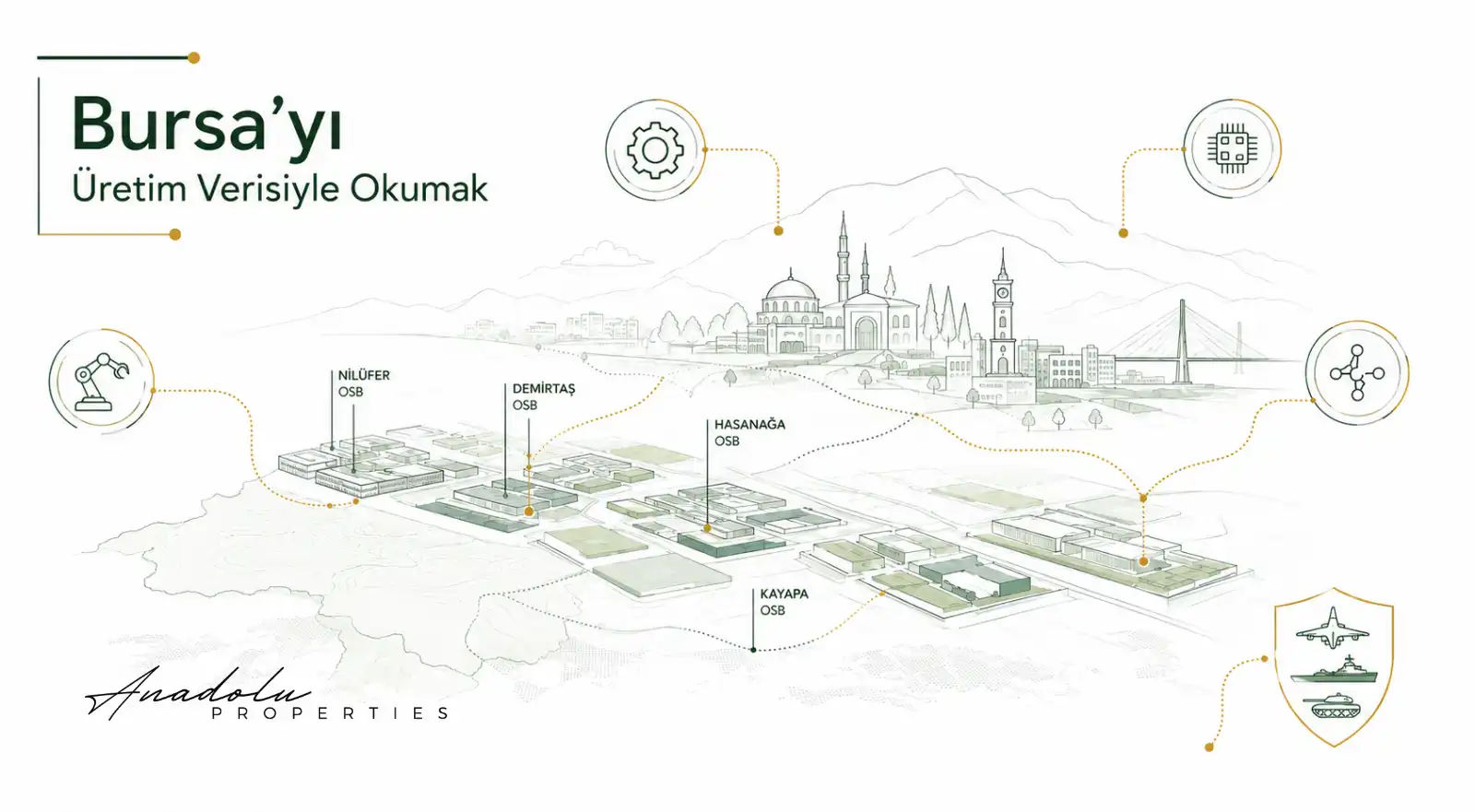
Recent assessments regarding Bursa’s production capacity in the defense industry should not be viewed merely as a sectoral issue. This topic concerns a broader economic ecosystem extending from organized industrial zones to logistics infrastructure, from demand for commercial real estate to the mobility of qualified labor.
A city’s economic future can sometimes change through a new highway project, sometimes through a port investment, and sometimes through becoming the focus of a strategic sector. For Bursa, one of Türkiye’s strong centers in terms of automotive, machinery and advanced manufacturing capability, the defense industry is therefore of particular importance.
The emphasis by Defense Industry President Prof. Dr. Haluk Görgün on Bursa’s production infrastructure, engineering know-how and entrepreneurial culture indicates that the city’s existing industrial capacity may be utilized in higher value-added fields.
Why Does the Defense Industry Affect the Regional Economy?
The defense industry is not a closed production field made up only of prime contractors. Main industrial companies, subcontractor manufacturers, engineering firms, software developers, logistics companies, testing centers, universities and research institutions work together within the same economic network.
For this reason, growth that may occur in the defense industry can simultaneously affect production volume, employment structure, technology investments and regional economic activity. The key point for the real estate market begins precisely here: expectations of value appreciation should be read not only from statements, but from how this ecosystem expands on the ground.
Why Does Bursa’s Production Infrastructure Stand Out?
Bursa is one of Türkiye’s strong industrial cities with its automotive, machinery manufacturing, metal processing, textile technologies, mold industry and export-oriented production culture. Sustainable success in the defense industry is also often built on this type of production discipline, engineering capability and supply-chain depth.
From this perspective, Bursa’s advantage is not limited to its existing factory capacity. The city offers a strong foundation for the development of strategic sectors through its production culture, qualified human capital, supplier network and logistics position within the Marmara Region.
Potential Reflections on the Real Estate Market
Developments related to the defense industry do not, on their own, mean that land, housing or commercial real estate prices will increase permanently. The real impact can be read more accurately when new investment decisions, capacity increases, occupancy rates in organized industrial zones, logistics infrastructure, subcontractor growth and qualified employment mobility occur together.
Therefore, the key indicators to monitor for Bursa’s real estate market are as follows:
- Capacity increases or new expansion decisions in organized industrial zones and industrial areas
- Location choices of defense industry supplier companies in and around Bursa
- Changes in demand for storage, production areas, offices and commercial real estate
- Possible effects of qualified labor mobility on the housing and rental market
- Strengthening of logistics connections, port access and main transportation axes
The effect on the housing market, however, may be more indirect and spread over time. Production, employment and commercial use areas move first; housing demand is then shaped depending on the continuity of this economic activity.
Bursa’s Role Within the Marmara Production Network
The defense industry potential in Bursa should not be assessed only within the city’s borders. The Marmara production network, which includes Kocaeli, Sakarya, Yalova, Balıkesir and Istanbul, forms a regional structure that must be read together in terms of supply-chain relationships and logistics connections.
Bursa’s strengthening in higher value-added production areas within this network may create new room for movement on a regional scale in subcontracting, technical services, logistics operations and demand for commercial real estate. However, whether this potential turns into lasting value should be tracked through realized investments and measurable economic data rather than statements.
What Do International Examples Show?
International examples such as Huntsville and Toulouse show that the real value in defense- and aerospace-focused cities arises not only from the number of factories, but from knowledge production, innovation, R&D capacity, university-industry cooperation and strong supply chains.
These examples do not imply a direct one-to-one comparison for Bursa. However, they show that real estate value in cities developing around a defense industry focus can be understood most accurately when production functions, qualified employment, commercial-use intensity and infrastructure investments are analyzed together.
Possible Scenarios for Investors
Developments regarding Bursa’s role in the defense industry can be read through three main scenarios:
- Base scenario: Existing production infrastructure may be used in more defense industry projects; this could create limited but monitorable movement, particularly in industrial areas and technical service needs.
- Optimistic scenario: If new investment decisions, capacity increases and supplier clustering strengthen, demand around organized industrial zones, logistics axes and commercial real estate may be supported more visibly.
- Risk scenario: Global economic conditions, financing costs, investment delays or uncertainties in project timelines may limit the effects that will be reflected in the real estate market.
Reading Value from Data, Not Headlines
From Anadolu Properties’ perspective, such developments are not a sufficient reason for an investment decision on their own; they are an initial signal that requires asking the right questions. When evaluating real estate investment in Bursa, occupancy rates in organized industrial zones, zoning status, transportation infrastructure, company clusters, capacity increases, and rental and sales data should be examined together.
Especially for Turkish investors living abroad, industrial cities such as Bursa should be read not only through housing prices or location perception, but together with production data, location analysis, valuation reports and long-term regional development axes.
Bursa’s development in the defense industry does not by itself offer an investment guarantee. However, for investors who want to understand Türkiye’s future production map, it creates an important data field. Lasting value is born not from expectations, but from measurable production capacity, economic activity and accurate analysis.
Mustafa Yılmaz
CEO – Anadolu Properties
Europe–Türkiye Investment Bridge