WHY IS TURKEY TURNING BACK TO RURAL AREAS? RETURN-TO-VILLAGE SUPPORTS AND THE NEW ECONOMIC BALANCE
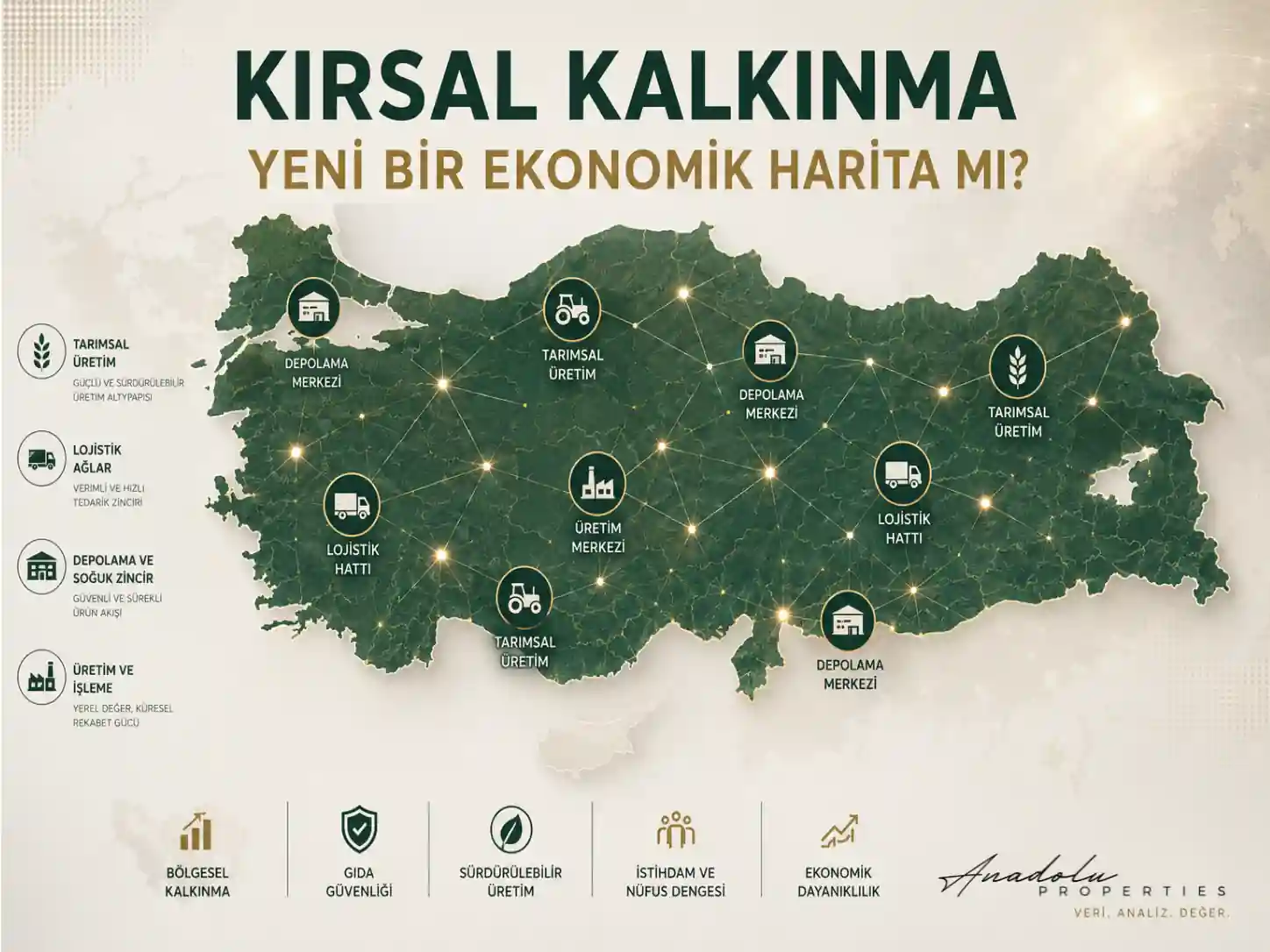
RETURN-TO-VILLAGE SUPPORTS: IS TURKEY BUILDING A NEW ECONOMIC BALANCE?
A country’s future is sometimes hidden not only in major industrial investments, but also in seemingly small shifts in direction.
Today, if return-to-village policies, agricultural incentives, interest-free loan supports and rural development are read merely as social assistance policies, the larger picture remains incomplete.
Because the issue is no longer limited to a few citizens returning to their villages. The issue is how Turkey will produce over the next 10 to 20 years, how it will feed itself, how the population will be distributed, how sustainable cities will remain, and on what foundation economic security will be built.
Many countries in the world have faced a reality they recognized late: food is no longer only an agricultural issue. It is as strategic as energy, as critical as logistics and as much a matter of national security as defense.
The pandemic, the Russia-Ukraine war, energy crises, disrupted supply chains and global inflation waves forced states to ask the same question: “Is your production capacity truly under your control?”
The recent series of rural support announcements in Turkey should be read within this framework. These steps may signal a transformation larger than a conventional “policy to support villagers.”
WHY IS TURKEY PUTTING RURAL AREAS BACK ON ITS AGENDA?
Over the past 30 years, much of the world followed a similar economic model: migration from rural areas to cities, the growth of the service sector, the decline of the agricultural population and the rise of megacities as economic centers.
Turkey experienced this transformation as well. However, the hidden costs of this model became more visible over time.
- A population disconnected from production
- Rising food prices
- Emptying villages
- An aging agricultural population
- Increasing living costs in cities
- Fragile supply chains
- Uncontrolled urban density
The housing crisis, traffic congestion, cost-of-living pressure and social stress seen today in major cities such as Istanbul, Ankara and Izmir are not merely urban planning problems. This picture is also the economic result of an imbalanced population distribution.
One of the most critical reflexes of states throughout history has been the capacity to distribute population strategically. From Rome to China, from the Soviet Union to the United States, great powers grew not only through economics, but also through demographic management.
From this perspective, Turkey’s renewed focus on rural areas can be read not only as an agricultural move, but also as a geoeconomic one.
AGRICULTURE IS NO LONGER THE “OLD ECONOMY”
For a long time, agriculture was seen as a low-prestige sector lagging behind industrialization. Yet the global system is changing.
Today, major investors and strategic institutions around the world evaluate water resources, agricultural land, logistics corridors, food supply chains, vertical farming technologies and energy-efficient production systems as strategic assets.
Because future competition may be shaped not only by energy or technology, but also by access to food.
Especially after climate change, the decline of fertile agricultural land, water crises, migration waves and rising production costs have made agriculture a strategic sector once again.
For this reason, Turkey’s intention to revive rural production should be evaluated not only as an economic policy, but also as a policy of national resilience.
THE CORE ISSUE: A RETURN TO THE PRODUCTION ECONOMY
Turkey has long advanced with a consumption-weighted growth model. Construction, the service sector and domestic consumption have been among the key drivers of growth.
However, sustainable economic power is built not only through consumption, but through production capacity. At this point, the critical question is this: what kind of economy does Turkey want to build in the new period?
Return-to-village incentives become important precisely here. These policies may be targeting not only individual returns, but also a broader production ecosystem.
- Reintegrating the idle rural population into production
- Increasing agricultural productivity
- Protecting domestic food supply security
- Spreading regional development
- Reducing pressure on major cities
- Reconnecting the young population to the production chain
This picture should not be read merely as social policy. It should also be considered as an attempt at economic rebalancing.
HAS THE WORLD EXPERIENCED SIMILAR PROCESSES?
Yes. Especially after the pandemic, many countries began to reassess rural production as a strategic field.
In the United States, local supply chains and production resilience were discussed more intensely during the pandemic. China has long sought to reposition rural areas not only as agricultural zones, but also as centers of technology, production and logistics through its “rural revitalization” approach. In the European Union, agricultural supports are now placed within a broader framework that includes not only production, but also carbon management, energy security and strategic autonomy.
These examples point to a shared conclusion: countries that lose their rural base may also weaken their long-term strategic resilience.
THE MOST CRITICAL ISSUE FOR TURKEY: DEMOGRAPHIC BALANCE
One of the most important risks facing Turkey is not only the economy, but also its population structure.
While the young population is squeezed under high living costs in major cities, production capacity in rural areas is aging. This structure is not sustainable in the long term.
If rural transformation is carried out together with digital infrastructure, education, healthcare investments, logistics networks, data-based agriculture and technology-supported production models, Turkey can strengthen not only agriculture, but also a new-generation regional development model.
The real issue is not people returning to villages out of nostalgia. The real issue is rural areas becoming capable of generating economic value again.
Because people do not go only where they long for the past; they go where they see a future.
WHAT SHOULD BE SEEN FROM AN INVESTOR PERSPECTIVE?
Markets often underestimate major transformations at their earliest stage. Strategic investors, however, pay close attention to the areas where states direct long-term capital, incentives and infrastructure.
The areas to monitor today may include the following:
- Agricultural technologies
- Cold chain logistics
- Water management
- Energy-efficient production
- Agricultural land
- Rural data infrastructures
- Regional storage systems
- Food processing facilities
- Rural housing transformation
- Micro-production centers
In the future, value may be created not only in metropolitan areas, but also in regions with production capability. However, there is a critical risk at this point.
If the process remains limited to short-term incentives and the infrastructure and production model do not transform, policies may create only a temporary effect. In other words, the issue is not merely distributing credit, but building a sustainable ecosystem.
The same reality applies to real estate and land investment. The future value of a region should be evaluated not only by its current price, but also together with its production capacity, transportation links, zoning structure, water resources, logistics access and official planning decisions.
Therefore, not every plot of land or field in rural areas is automatically an opportunity. Investments made without the right location, proper zoning checks, official record review and a data-driven valuation approach may carry serious risks.
IS TURKEY CREATING A NEW ECONOMIC MAP?
Perhaps this is the central question.
In the coming period, countries will be assessed not only by the size of their economies, but also by their production resilience, food security, energy access, population balances, logistics capabilities and continuity of domestic production.
Turkey’s geographical advantage becomes critical here. Located between Europe, the Middle East, the Caucasus and Asia, Turkey has the potential to be not only a consumer market, but also a regional production center.
If rural development policies are read correctly, this process can be evaluated not merely as a “return to the village,” but as an attempt to strengthen Turkey’s economic backbone.
CONCLUSION: WHERE WILL THE VALUE OF THE FUTURE BE CREATED?
Sometimes the most important steps taken by states appear ordinary at first glance. Yet history shows that real transformations often begin with population movements.
Are the agricultural incentives and rural supports discussed in Turkey today merely economic aid policies, or is Turkey already preparing for the production, food, energy and demographic security order of the next 20 years?
Perhaps this is the most important question.
Because the countries that will be strong in the future will not only be those that can consume, but those that can continue producing in times of crisis.
Mustafa Yılmaz
CEO – Anadolu Properties
Europe – Turkey Investment Bridge